Wolverine Protocol
What is The WOLVERINE Protocol™?
The WOLVERINE Protocol™ is a 60-day, research-informed durability and performance resilience framework designed to examine connective tissue signaling, mitochondrial communication, structural remodeling pathways, and metabolic adaptation during sustained high-output training phases.
Rather than focusing on isolated repair mechanisms, The WOLVERINE Protocol™ integrates complementary research peptides studied across structural and cellular domains. This systems-based approach reflects emerging research suggesting that durability and resilience develop through coordinated multi-week biological adaptation rather than short-term intervention.
Protocol Overview
The WOLVERINE Protocol™ was designed as a coordinated 60-day performance cycle examining how connective tissue communication, cellular remodeling, and mitochondrial energy adaptation interact under repeated mechanical and metabolic stress exposure.
- Connective tissue signaling and structural communication
- Cellular remodeling and migration pathways
- Mitochondrial-derived signaling and energy sensing
- Metabolic adaptation during sustained training stress
The WOLVERINE Protocol™ is intended for research and educational use only and is not designed to diagnose, treat, cure, or prevent any disease.
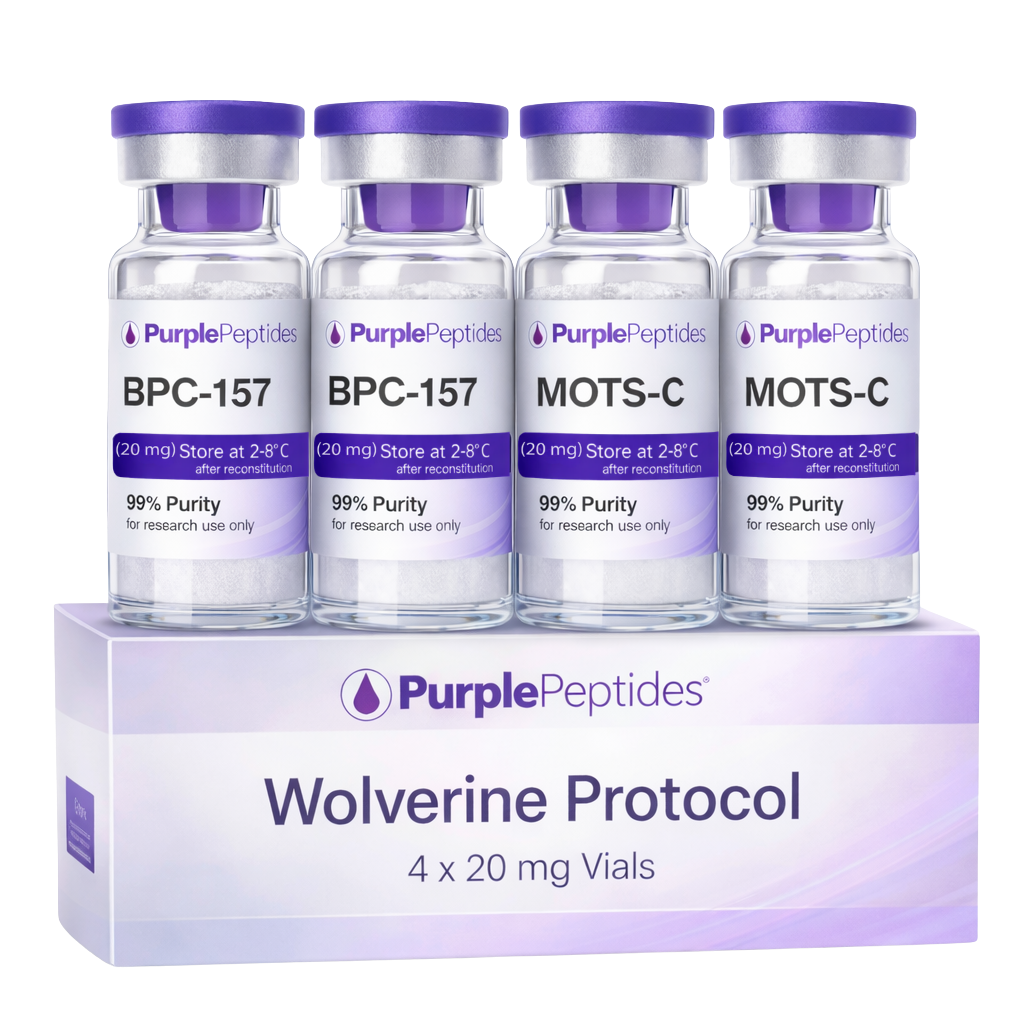
What You Receive in The WOLVERINE Protocol™ 60-Day Kit
Kit Contents (Per 60-Day Protocol)
- BPC-157 + TB-500
Total Provided: 40 mg
Configuration: 2 × 20 mg vials - MOTS-c
Total Provided: 20 mg
Configuration: 2 × 10 mg vials
Each kit is assembled to align with a complete 60-day coordinated performance research cycle.
Pricing
Retail Value: $456
Protocol Price: $347
The WOLVERINE Protocol™ offers a structured durability-focused research framework at a bundled price compared to purchasing components separately.
Protocol Components (Research Context)
BPC-157
BPC-157 is a synthetic peptide derived from a naturally occurring gastric protein fragment, widely studied in preclinical models for its involvement in connective tissue signaling, cytoprotective pathways, and structural communication processes.
TB-500
TB-500 is a synthetic fragment analog of thymosin beta-4, researched for its role in cellular migration, actin regulation, and tissue remodeling pathways in laboratory models.
MOTS-c
MOTS-c is a mitochondrial-derived peptide encoded by mitochondrial DNA. Research has examined its influence on cellular energy metabolism, metabolic flexibility, and mitochondrial signaling adaptation during physiological stress.
Why These Peptides Are Studied Together
- BPC-157: Connective tissue signaling & structural communication
- TB-500: Cellular remodeling & migration pathways
- MOTS-c: Mitochondrial energy sensing & metabolic adaptation
Together, these peptides form a coordinated durability-focused research framework aligned with systems biology models examining resilience across structural and metabolic domains.
Frequently Asked Questions
Is The WOLVERINE Protocol™ approved for human use?
No. The WOLVERINE Protocol™ peptides are provided strictly for research and educational purposes only and are not approved for human consumption.
Is this an injury treatment protocol?
No. The WOLVERINE Protocol™ is a research framework designed to examine structural and metabolic signaling pathways during active training phases. It is not a medical therapy.
Why is this structured as a 60-day protocol?
Training adaptation typically occurs over multi-week cycles. The WOLVERINE Protocol™ aligns with a structured 60-day performance block to examine coordinated signaling support during sustained high-output periods.
Need Help?
If you have questions regarding certificates of analysis, product documentation, or general research inquiries, our support team is here to assist.
Contact SupportImportant Notice
The WOLVERINE Protocol™ is intended for research and educational use only. These products are not approved for human consumption and are not intended to diagnose, treat, cure, or prevent any disease.