Klow
What is KLOW?
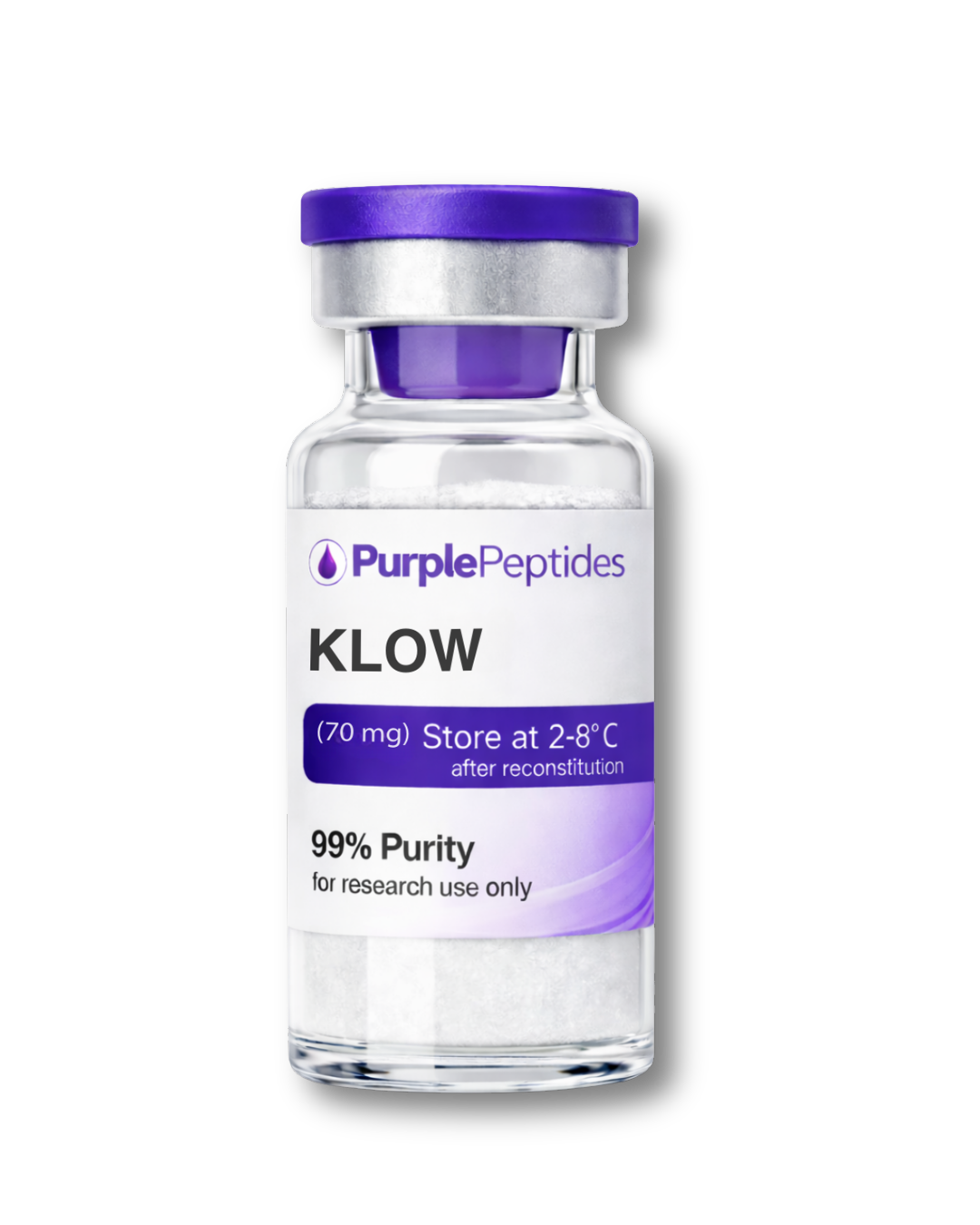
KLOW is a multi-peptide research formulation composed of TB-500, BPC-157, GHK-Cu, and KPV. In controlled laboratory settings, it is studied for its role in cellular recovery pathways, inflammatory signaling, tissue-level support, and peptide-driven repair mechanisms.
Research applications commonly focus on post-injury models, extracellular matrix dynamics, angiogenic signaling, immune modulation, and epithelial integrity, making KLOW a compound of interest in experimental systems investigating regenerative and recovery-oriented biological processes.
Certificate of Analysis
Third-party tested for purity and analytical verification
KLOW Blend Overview
The KLOW Blend combines GHK-Cu, BPC-157, TB-500, and KPV into a single formulation designed for research into cellular repair, immune signaling, and systemic regulation. Across laboratory and preclinical models, these peptides have been investigated for their involvement in tissue remodeling, angiogenesis, inflammatory modulation, and extracellular matrix activity.
- Peptide-driven cellular recovery pathways
- Inflammatory and immune signaling modulation
- Angiogenic and connective tissue research models
Together, this blend enables exploration of synergistic peptide pathways related to regeneration, vascular biology, immune balance, and connective tissue dynamics.
Pickart L. & Margolina A., 2018History and Development
The KLOW Blend is derived from decades of peptide research spanning multiple biological systems and research disciplines.
GHK-Cu was first identified in human plasma in the 1970s and has been studied for its influence on gene expression, collagen synthesis, and wound-repair models.
BPC-157, synthesized in the 1990s as a gastric protein fragment analog, has been explored for angiogenic signaling, tissue protection, and reparative pathways.
TB-500, a synthetic fragment derived from thymosin beta-4 research dating back to the 1960s, has been examined in studies involving cellular migration, angiogenesis, and tissue remodeling.
KPV, a C-terminal fragment of α-MSH, has been investigated for its immunomodulatory and anti-inflammatory activity in epithelial and systemic research models.
Collectively, these peptides represent key areas of investigation in regenerative biology, vascular signaling, and immune regulation. The KLOW Blend is supplied for research use only and is not intended for human or animal therapeutic applications.
Maquart F.X. et al., 1988Molecular Information
- GHK-Cu CAS #: 49557-75-7
- GHK-Cu Molecular Formula: C₁₄H₂₄CuN₆O₄
- GHK-Cu Molecular Weight: 340.9 g/mol
- GHK-Cu PubChem ID: 5311476
- BPC-157 CAS #: 137525-51-0
- BPC-157 Molecular Weight: 1,419.5 g/mol
- BPC-157 PubChem ID: 16132235
- TB-500 CAS #: 77591-33-4
- TB-500 Molecular Formula: C₂₁₂H₃₅₀N₅₆O₇₈S
- TB-500 Molecular Weight: 4,963.5 g/mol
- TB-500 PubChem ID: 16132321
- KPV CAS #: 3061-91-6
- KPV Molecular Formula: C₁₆H₂₈N₆O₅
- KPV Molecular Weight: 388.4 g/mol
- KPV PubChem ID: 16129619
Research Findings
The KLOW Blend has been examined across structural, vascular, dermatological, and systemic research models. Published findings highlight peptide activity related to collagen formation, extracellular matrix remodeling, angiogenesis, wound closure, and inflammatory signaling.
Key Areas of Investigation
- Structural: Collagen synthesis, matrix remodeling, connective tissue dynamics
- Vascular: Angiogenesis, nitric oxide signaling, tissue remodeling
- Dermatological: Wound closure, skin biology, hair follicle research models
- Systemic: Immune signaling, inflammation modulation, recovery pathways
Taken together, these findings support the KLOW Blend as a versatile research platform for studying regenerative processes, tissue repair mechanisms, and systemic resilience in laboratory settings.
Sikiric P. et al., 2020References
- Pickart L. et al. (2015). GHK-Cu and regulation of biological processes in aging and repair.
- Sikiric P. et al. (1993). Characterization of BPC-157. Peptides.
- Goldstein A.L. et al. (2005). Thymosin beta-4 and tissue regeneration.
- Maquart F.X. et al. (1988). Stimulation of collagen synthesis by GHK.
- Moss J. et al. (2020). Anti-inflammatory activity of KPV.