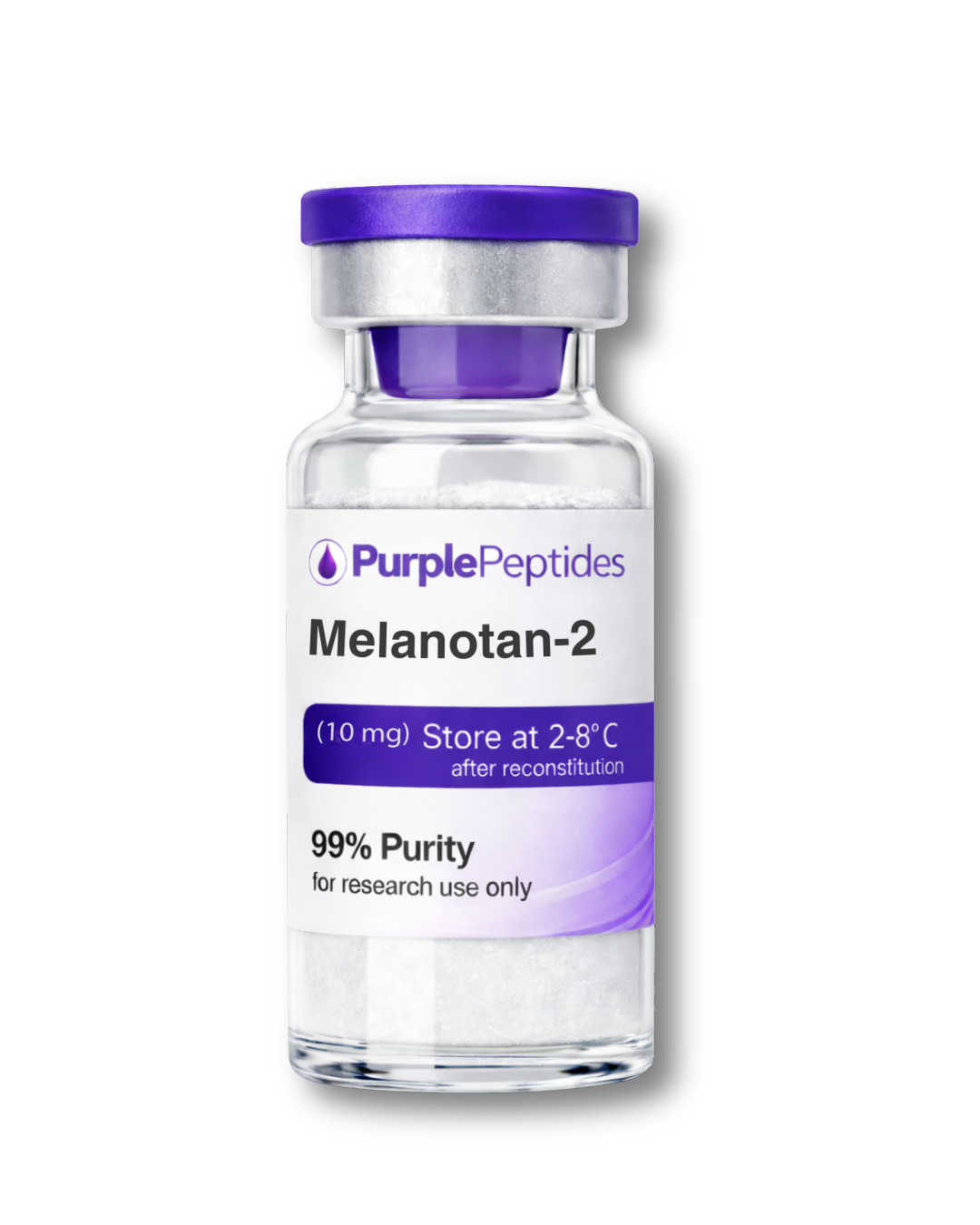
Melanotan-2
What is Melanotan-II?
Melanotan-II (MT-II) is a synthetic peptide analog of α-melanocyte-stimulating hormone (α-MSH) studied for its interaction with melanocortin receptors. In laboratory and preclinical research settings, MT-II has been examined for its role in melanin production, pigmentation signaling, appetite regulation, and central nervous system pathways.
Due to its receptor-mediated activity across melanocortin pathways, Melanotan-II is a compound of interest in pigmentation and neuroendocrine research models.
Certificate of Analysis
Third-party tested for purity and analytical verification
Melanotan-II Overview
Melanotan-II is a cyclic peptide derived from α-MSH, designed to study melanocortin receptor activation, particularly MC1R, MC3R, MC4R, and MC5R. In research models, MT-II has been investigated for its influence on melanogenesis, pigmentation pathways, appetite signaling, and neurobehavioral responses.
- Melanocortin receptor activation (MC1R, MC3R, MC4R, MC5R)
- Melanogenesis and pigmentation pathway signaling
- Appetite, energy-balance, and neuroendocrine research models
Ongoing research explores its role in hormone-mediated signaling and receptor-specific activity across dermatological and central pathways.
Hadley M.E. & Haskell-Luevano C., 1999History and Development
Melanotan-II emerged from early research into melanocortin biology and the physiological roles of α-MSH. Initial studies focused on pigmentation signaling and UV-induced melanogenesis.
Subsequent research expanded into central melanocortin pathways, examining MT-II’s interactions with receptors involved in energy balance, neuroendocrine regulation, and behavior. Its defined cyclic structure has made it a recurring compound in experimental models of receptor signaling.
Hruby V.J. et al., 1995Melanotan-II Structure

Research Findings
Melanotan-II has been studied across dermatological, neurological, and systemic research models, with findings highlighting its effects on melanin synthesis, melanocortin receptor signaling, and central nervous system pathways.
Key Areas of Investigation
- Dermatological: Melanogenesis, pigmentation pathways, UV response models
- Neurological: Melanocortin signaling, CNS receptor activity
- Systemic: Appetite regulation, energy balance, hormone signaling
Together, these findings position Melanotan-II as a useful research compound for investigating melanocortin receptor biology, pigmentation signaling, and integrated neuroendocrine pathways in laboratory models.
Hadley M.E. & Haskell-Luevano C., 1999References
- Hruby V.J. et al. (1995). Design and biological activity of melanocortin agonists and antagonists. Journal of Medicinal Chemistry.
- Hadley M.E. & Haskell-Luevano C. (1999). The proopiomelanocortin system. Annals of the New York Academy of Sciences.
- Cone R.D. (2006). Studies on the melanocortin system. Nature Reviews Neuroscience.