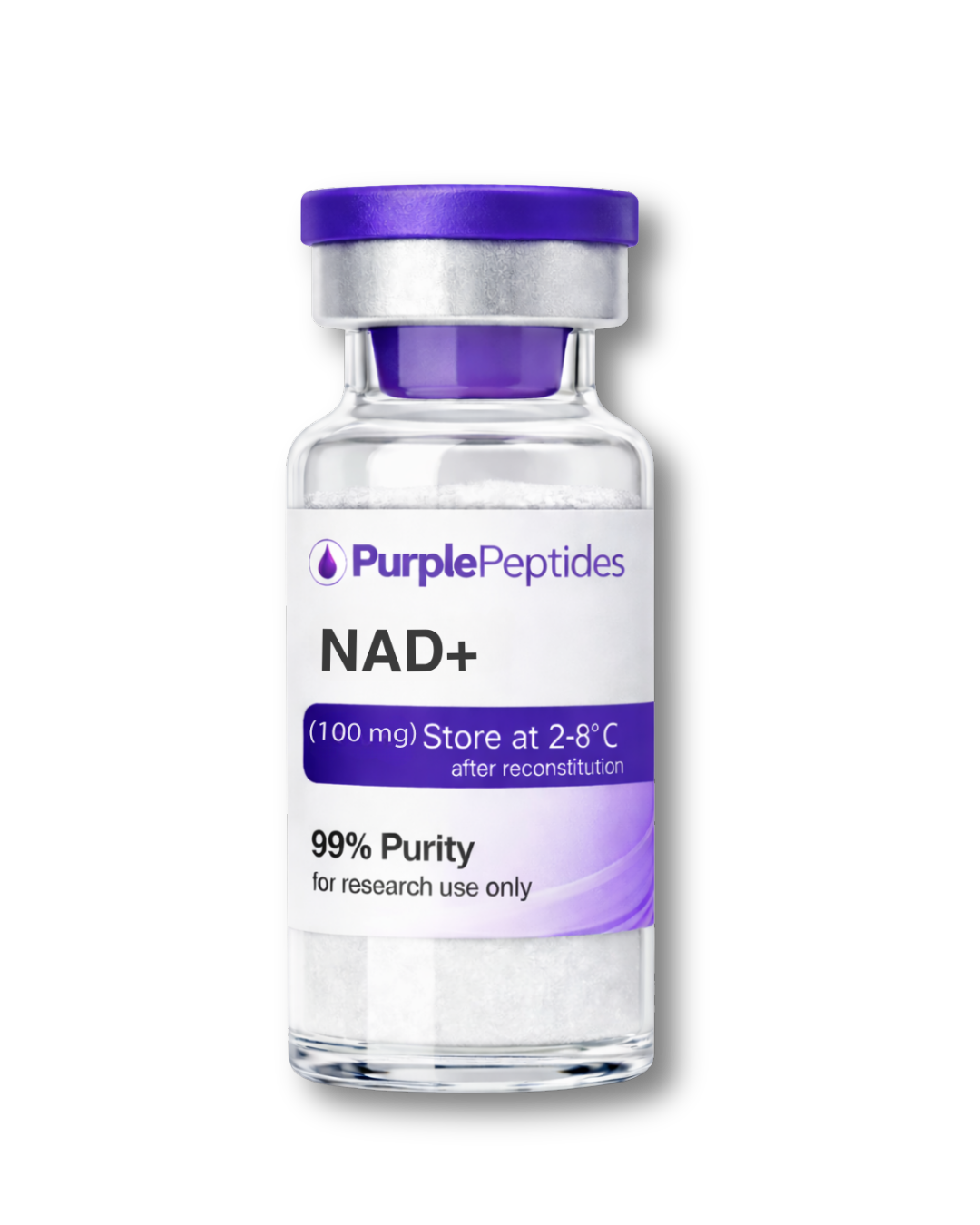
NAD+
What is NAD⁺?
NAD⁺ (Nicotinamide Adenine Dinucleotide) is a naturally occurring coenzyme present in all living cells and fundamental to cellular energy metabolism and redox reactions. In research settings, NAD⁺ is studied for its role in mitochondrial function, DNA repair processes, and cellular stress responses.
Because of its central involvement in metabolic and signaling pathways, NAD⁺ is widely explored in models of cellular resilience and longevity biology.
Certificate of Analysis
Third-party tested for purity and analytical verification
NAD⁺ Overview
Nicotinamide adenine dinucleotide (NAD⁺) is a central coenzyme involved in electron transfer, energy production, and cellular signaling. In laboratory and preclinical models, NAD⁺ has been studied for its influence on mitochondrial efficiency, DNA repair mechanisms, and cellular adaptability.
- Electron transfer and redox-related cellular activity
- Mitochondrial function and metabolic coordination
- Cellular repair processes and stress-response pathways
Ongoing research examines NAD⁺ in relation to sirtuin activity, oxidative stress regulation, and broader signaling dynamics involved in cellular maintenance.
Verdin E., 2015History and Development
NAD⁺ was first identified in the early 1900s during foundational research on fermentation and cellular respiration. Subsequent biochemical studies established its role as a critical coenzyme in enzymatic redox reactions.
Over time, research expanded to include NAD⁺’s involvement in DNA repair systems, aging-related pathways, and cellular survival mechanisms, leading to its widespread use as a research tool in metabolic and stress-response models.
Elhassan Y.S. et al., 2017NAD⁺ Structure

Research Findings
NAD⁺ has been extensively investigated across metabolic, cellular, and systemic research models. Studies highlight its role in energy metabolism, mitochondrial maintenance, and cellular repair pathways. Additional research explores its influence on oxidative stress responses, genomic stability, and overall cellular resilience in preclinical environments.
Key Areas of Investigation
- Metabolic: Energy production, mitochondrial function
- Cellular: DNA repair, oxidative stress regulation, cell viability
- Systemic: Recovery mechanisms, stress resilience, metabolic balance
Collectively, these findings underscore NAD⁺ as a versatile research compound for investigating fundamental processes related to energy regulation, cellular maintenance, and systemic adaptability in laboratory models.
Rajman L. et al., 2018References
- Verdin E. (2015). NAD⁺ in aging, metabolism, and neurodegeneration. Cell Metabolism.
- Cantó C. et al. (2015). NAD⁺ metabolism and the control of energy homeostasis. Cell Metabolism.
- Elhassan Y.S. et al. (2017). NAD⁺ and the regulation of metabolic health and disease. Cell Metabolism.
- Rajman L. et al. (2018). Therapeutic potential of NAD⁺ modulation in aging and disease. Cell Metabolism.