−30%
Compound · Tissue Repair
Research compound · Research Use Only
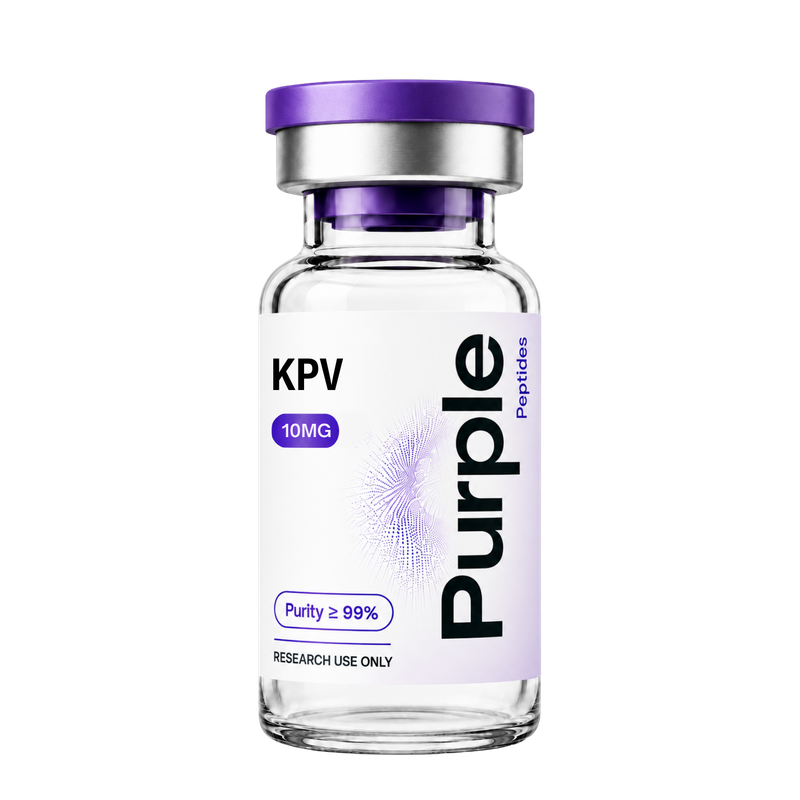
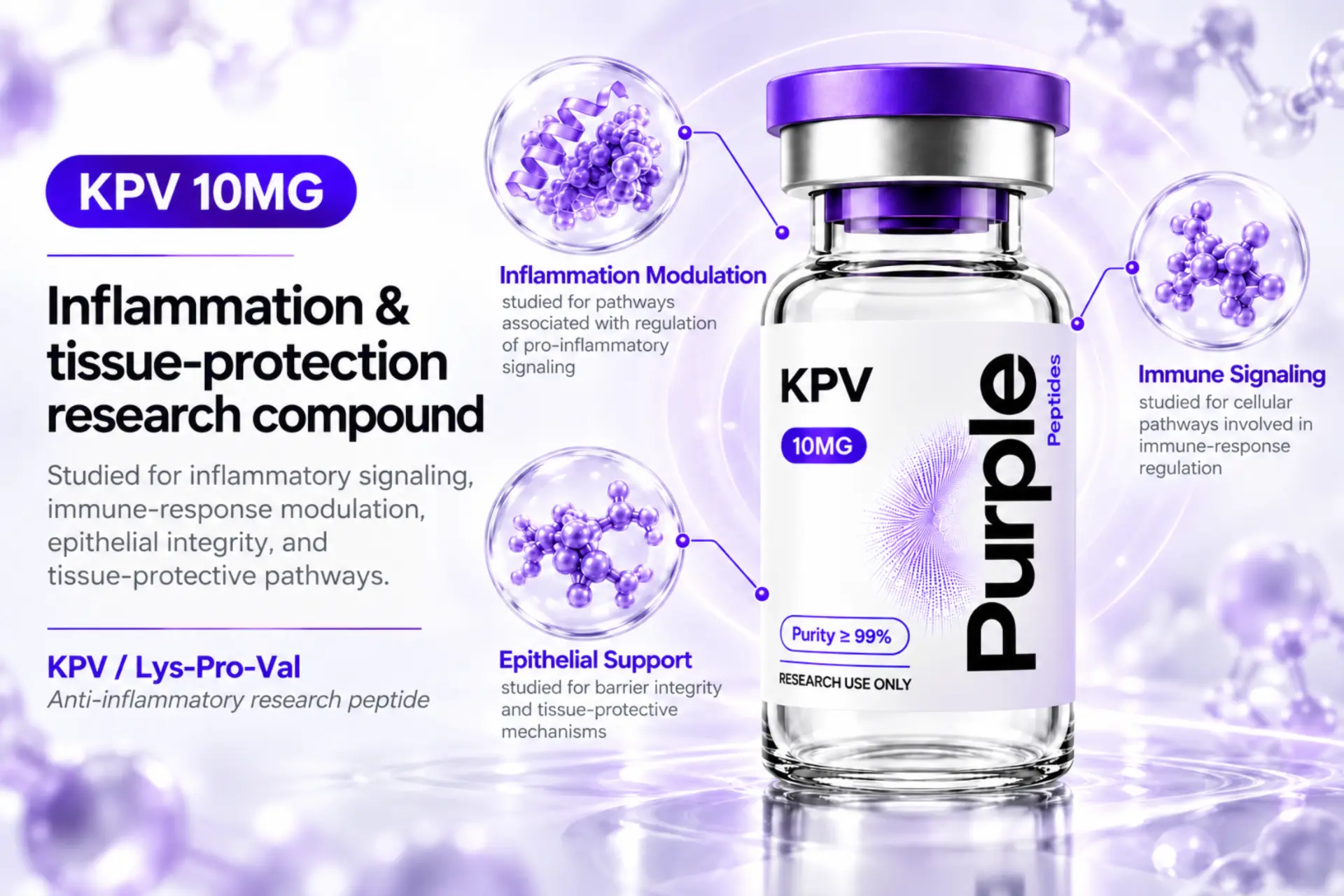
KPV — research compound supplied by Purple Peptides with batch-level documentation. For laboratory research use only.
$43.99$30.79
FIRST30 applied automatically · 30% off during launch
Bundle & Save
Order by 12:00 PM PT
Orders placed before the cutoff enter same-day processing
Estimated delivery
Free standard shipping on qualifying orders
Shipment protection available
Add coverage for lost, stolen, or damaged orders at checkout.
2-3 day priority & overnight
Pick your speed at checkout






Tissue Repair research compounds
The Purple Standard™
Available original certificates give you a clear record you can open before you order. Research transparency is the standard — not an add-on.
More ways to save
Purple BoxNew
Choose 4 compounds to save 35%, or 6 to save 40%, on your monthly research order.
Bulk OrdersNew
Save 50% on qualifying volume orders with dedicated Purple Direct support.
Purple Verified™
The Purple Standard™
Every vial earns its release through documented proof, not marketing language. Review the supplied certificate for the selected strength. Results apply only to its tested samples; unavailable documentation is marked pending.
Freedom Diagnostics
Reported October 3, 2026 · 10mg
Certificate of Analysis
99.52%
Purity by HPLC
Batch testing
Purity
HPLC-UV · analytical result
Sample 1 purity
HPLC-UV · sample summary
Sample 2 purity
HPLC-UV · sample summary
Identity
LC-MS
Net content
Reported analytical result
Appearance
Sample summary
Elemental impurities
ICP-MS · As / Cd / Pb / Hg
Microbial analysis
PCR
Endotoxin
USP <85> · LAL
Fentanyl screen
Sample summary
Results are transcribed from the supplied original. A reported purity value is not a pass/fail claim. Missing tests are not inferred.
Certificates of Analysis · latest batches
KPV 10mg
99.52% purity (HPLC)
What the standard requires
Reported Purity
Exact HPLC-UV results from supplied samples.
Double Tested
Manufacturer + independent third-party.
Batch Traceable
Chain-of-custody documented end to end.
Purple Verified™
Released only after alignment.
Technical specifications
Molecular profile
Storage requirements
Lyophilized (sealed vial)
Storage information pending final content approval.
Reconstituted
Keep refrigerated at 2–8°C after reconstitution.
Reconstituted vials are stored refrigerated at 2–8°C. Remaining Purple-approved storage guidance will appear here once confirmed.
Research overview · preclinical evidence
KPV is a tripeptide (lysine–proline–valine) that corresponds to the C-terminal amino acids 11–13 of alpha-melanocyte-stimulating hormone (α-MSH). The literature studies it as a small fragment that may retain some of α-MSH's anti-inflammatory activity observed in experimental models (Brzoska et al., 2008). Published work on KPV is in vitro and preclinical.
Intestinal inflammation models: cell and mouse studies examined KPV uptake through the PepT1 peptide transporter and reduced inflammatory signaling (Dalmasso et al., 2008), and its effects in murine colitis models (Kannengiesser et al., 2008). Delivery research: oral nanoparticle formulations were tested in mouse colitis models (Xiao et al., 2017). Researchers in tissue biology also study BPC-157 and TB-500.
Proposed mechanisms in these models include transport into intestinal epithelial cells via PepT1 and reduced NF-κB and MAP-kinase inflammatory signaling. These observations come from specific experimental systems and are not established in humans.
No controlled human clinical trials of KPV are reported in the references below. Findings come from cell culture and rodent models and do not establish effects, safety or efficacy in humans. Explore more at the Research Institute.
Peer-reviewed literature
Research context on this page traces back to the 4 publications below.
Research FAQs
KPV is a synthetic tripeptide (lysine–proline–valine) matching the C-terminal residues 11–13 of α-MSH. Purple Peptides supplies it for laboratory research use only.
Published studies examine KPV in cell and mouse models of intestinal inflammation, its uptake through the PepT1 transporter, and oral delivery formulations. See the references on this page.
The references on this page are cell and animal studies. No controlled human clinical trials are cited, so findings should not be read as evidence of effects in humans.
α-MSH is a 13-amino-acid peptide. KPV corresponds to its last three amino acids and is studied as a small fragment of the parent hormone (Brzoska et al., 2008).
Identity confirms the material is the intended molecule, typically by mass spectrometry. Purity measures how much of the sample is that molecule relative to other detected components, typically by HPLC.
The product is sold exclusively for laboratory research. It is not for human or veterinary use and is not intended to diagnose, treat, cure or prevent any disease. Learn about our testing approach on The Purple Standard™ or browse All Products.
Important research notice
Not for human, veterinary, or food use. This product is sold exclusively for laboratory research and educational purposes. It is not intended to diagnose, treat, cure, or prevent any disease.
Published research referenced on this page is provided for educational reference only and should not be interpreted as medical advice or product claims.
By purchasing this product, you confirm that you are a qualified researcher and will use it in accordance with all applicable laws and regulations.
Subscribe for catalog updates, new research compounds, and quality documentation news.
For researchers and labs. No spam, unsubscribe anytime.