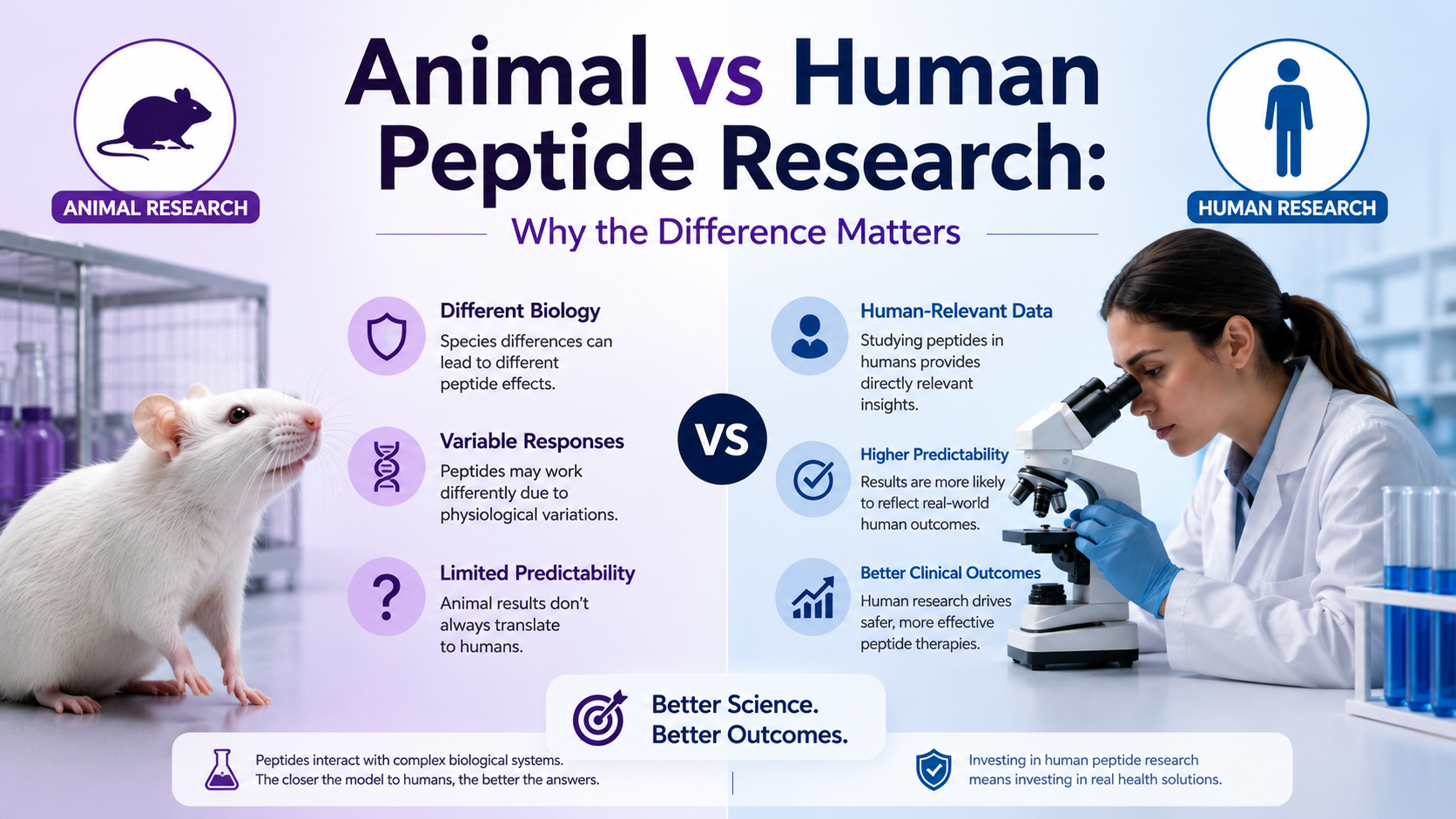
Animal vs Human Peptide Research: Why the Difference Matters
Animal peptide research and human peptide research are both important, but they do not answer the same questions. Animal studies can reveal mechanisms, safety signals, biological patterns, and pathway activity. Human studies help determine whether those findings translate into real-world human relevance. Understanding this difference is one of the most important skills for anyone reading peptide research, wellness claims, or biohacking content online.
This Is Where Most Peptide Research Confusion Starts
If you have ever heard someone say, “This peptide worked in mice, so it must work in humans,” this article is for you. That kind of statement sounds confident, but it skips the most important part of science: translation.
Animal research is not fake science. It is also not final proof. It is a foundational step that helps researchers understand whether a peptide interacts with a pathway, produces a measurable biological response, and shows any obvious safety concerns before moving toward human research.
Animal research helps scientists ask better questions. Human research helps answer whether those questions matter clinically.
The key is not to dismiss animal studies or overhype them. The responsible approach is to understand what each type of research can and cannot prove.
Why Peptide Research Often Starts in Animals
Before a peptide can be studied meaningfully in humans, researchers need to understand how it behaves in a living biological system. Cell studies can show receptor activity or pathway interaction, but they cannot fully show how the compound behaves across organs, metabolism, immune activity, circulation, clearance, and whole-body feedback loops.
Animal models help bridge that gap. They allow controlled experiments in living systems where researchers can observe biological activity, toxicity signals, dose-response patterns, and mechanism-of-action clues.
Animal peptide studies often help researchers ask:
- Does the peptide survive long enough in a living organism to have an effect?
- Does it activate the intended receptor, pathway, or tissue response?
- Does it create measurable changes in biomarkers or behavior?
- Does it cause obvious toxicity or unwanted biological effects?
- Which dose ranges appear biologically active in the model?
Reference: NIH overview on animal research
Why So Many Peptide Studies Use Mice
Mice are commonly used in biomedical research because their biology is well studied, their genomes are well mapped, and many signaling pathways are conserved across mammals. They also have short lifespans, which allows researchers to observe biological changes more quickly than they could in long-term human studies.
However, conserved pathways do not mean identical outcomes. A peptide may activate a similar pathway in mice and humans, but the size of the effect, the duration of the effect, the side-effect profile, and the clinical relevance can be very different.
Mice are useful models. They are not miniature humans.
- Mice have faster metabolic rates than humans.
- Their immune systems differ in important ways.
- Receptor density and sensitivity may not match human tissues.
- Hormonal feedback loops can behave differently.
- Short-term animal responses may not predict long-term human outcomes.
Where Animal Peptide Data Is Strongest
Animal studies are especially valuable when researchers are trying to understand mechanism. Mechanism means how something works. For example, if a peptide appears to activate AMPK, influence inflammation markers, affect collagen signaling, improve glucose handling, or change tissue repair pathways, animal models can help show whether that signal happens inside a living system.
Animal research is often strongest for:
- Mechanism of action: identifying which biological pathways may be involved.
- Receptor mapping: understanding where and how a peptide binds or signals.
- Whole-system response: observing effects across multiple tissues and organs.
- Toxicity screening: identifying obvious harm before moving into human exposure.
- Biomarker patterns: measuring changes in enzymes, hormones, inflammatory markers, or tissue markers.
Reference: Animal models in translational medicine
Where Animal Data Breaks Down
The biggest mistake is treating animal results as if they automatically predict human results. Many compounds that look promising in animals do not produce the same results in humans. Sometimes the effect is weaker. Sometimes the dose does not translate. Sometimes the pathway matters in animals but is less important clinically in people.
This does not mean the animal study was useless. It means biology is layered. Translation from animal to human requires pharmacology, safety testing, clinical design, dose translation, and careful interpretation.
Animal-to-human differences may include:
- Metabolic rate: animals may clear compounds faster or slower than humans.
- Immune response: inflammatory and immune signaling may differ between species.
- Receptor expression: receptor density, tissue distribution, and sensitivity may vary.
- Hormonal feedback: endocrine systems may respond differently across species.
- Lifespan and timing: short-term effects in animals may not predict long-term human outcomes.
Why Animal Doses Cannot Be Copied Into Humans
One of the most dangerous mistakes in peptide discussions is casual dose extrapolation. People sometimes see an animal study dose and assume it can be linearly converted into a human amount. That is not how pharmacology works.
Dose translation must consider body surface area, metabolism, clearance, route of administration, exposure time, species differences, and safety margins. A dose that produces a measurable response in mice may not be appropriate, safe, or relevant in humans.
When people casually copy animal doses, they skip an entire discipline of pharmacology.
Reference: FDA guidance on dose translation
Responsible peptide education should never present animal-study doses as direct human-use instructions.
What Human Peptide Research Actually Answers
Human research answers a different set of questions. It helps determine whether the mechanism observed in cells or animals translates into human biology. It also evaluates safety, tolerability, pharmacokinetics, biomarkers, individual variability, and eventually clinical outcomes.
Early human studies may focus on safety and tolerability. Later studies may examine whether a peptide produces measurable changes in a specific population. Larger trials may compare outcomes across groups, durations, doses, and endpoints.
Human studies are used to evaluate:
- Safety and tolerability: whether the compound is reasonably tolerated in humans.
- Pharmacokinetics: how the body absorbs, distributes, metabolizes, and clears the compound.
- Pharmacodynamics: what the compound does to biological markers or pathways.
- Clinical relevance: whether the effect matters in real-world human outcomes.
- Individual variability: how age, sex, genetics, health status, and lifestyle may influence response.
Reference: Overview of clinical research phases
Animal Study, Human Trial, or Marketing Claim?
A smart reader should always ask where a claim sits in the research pipeline. Is the claim based on a cell study, an animal study, a small human pilot study, a randomized controlled trial, or only anecdotal reports? Each level of evidence carries different weight.
| Research Type | What It Can Tell You | What It Cannot Prove Alone |
|---|---|---|
| In Vitro / Cell Study | Pathway activity, receptor interaction, cellular mechanism | Whole-body safety or real human outcomes |
| Animal Study | Living-system response, mechanism, toxicity signals, biological patterns | Guaranteed human effectiveness or proper human dose |
| Small Human Study | Early safety, tolerability, pharmacokinetics, biomarker response | Broad effectiveness across populations or long-term safety |
| Large Human Trial | More reliable evidence for safety, efficacy, and clinical relevance | Perfect certainty for every individual response |
| Anecdotal Claim | Real-world interest or personal experience | Scientific proof, mechanism, safety, or population-level effect |
Animal and Human Research Work Together
Good science does not dismiss animal studies, and it does not exaggerate them either. Animal research helps identify promising pathways and risk signals. Human research tests whether those findings are meaningful in people. Both stages matter because each one answers a different question.
- Animal research helps scientists ask better questions.
- Human research helps refine answers and test relevance.
- Skipping animal studies may increase risk before human exposure.
- Ignoring the limits of animal studies creates false confidence.
- Responsible interpretation respects the full research pipeline.
Real science is not one study. It is a chain of evidence.
How to Read Peptide Studies More Intelligently
When you read peptide research online, pause before accepting the headline. A claim may sound impressive, but the quality of the evidence depends on study design, research model, endpoints, sample size, duration, and whether the outcome is mechanistic or clinically meaningful.
Ask these questions before trusting a claim:
- Was the study done in cells, animals, or humans?
- Was the result mechanistic, biomarker-based, or clinical?
- Was the outcome measured directly or inferred from a pathway?
- Was the study short-term or long-term?
- Was the peptide tested alone or as part of a combination?
- Was the population healthy, diseased, young, older, male, female, or mixed?
- Does the claim match the evidence, or does it exaggerate the findings?
If those answers are not clear, you may be reading marketing content rather than education.
What to Remember About Animal vs Human Peptide Research
- Animal peptide research is foundational, but it is not definitive human proof.
- Mice and other animals are useful models, not miniature humans.
- Animal data is strongest for mechanisms, patterns, pathway activity, and toxicity screening.
- Human research is needed to evaluate safety, tolerability, pharmacokinetics, variability, and clinical relevance.
- Animal doses cannot be directly copied into human use.
- Responsible peptide education should clearly separate animal evidence, human evidence, and marketing claims.
Animal Research Is a Step, Not the Finish Line
Animal peptide research is not hype, and it is not proof. It is a step in the scientific process. Understanding which step you are looking at protects you from exaggerated claims, unrealistic expectations, and false certainty.
Science moves forward one layer at a time. Cell studies reveal mechanisms. Animal studies test living-system patterns. Human studies evaluate relevance. Anyone promising certainty from one layer is skipping the rest of the story.
Educational content only. This article is not medical advice, diagnosis, treatment guidance, or a usage protocol. Any discussion of peptide research, animal studies, human trials, or biological pathways is for general research education only.