ARA 290
What Is ARA-290?
ARA-290 is a synthetic peptide modeled from the three-dimensional structure of erythropoietin, or EPO. It was specifically engineered to interact with the innate repair receptor, a receptor complex studied for its role in tissue protection, cellular recovery, and regulation of inflammatory communication.
Unlike full-length erythropoietin, ARA-290 was designed to preserve repair-focused signaling without activating the classical erythropoietic pathway associated with red blood cell production. This selectivity gives researchers a way to investigate protective signaling separately from hematopoietic activity.
ARA-290 is studied in laboratory and investigational settings involving neurobiology, inflammatory signaling, microvascular communication, tissue stress responses, and mechanisms associated with cellular resilience.
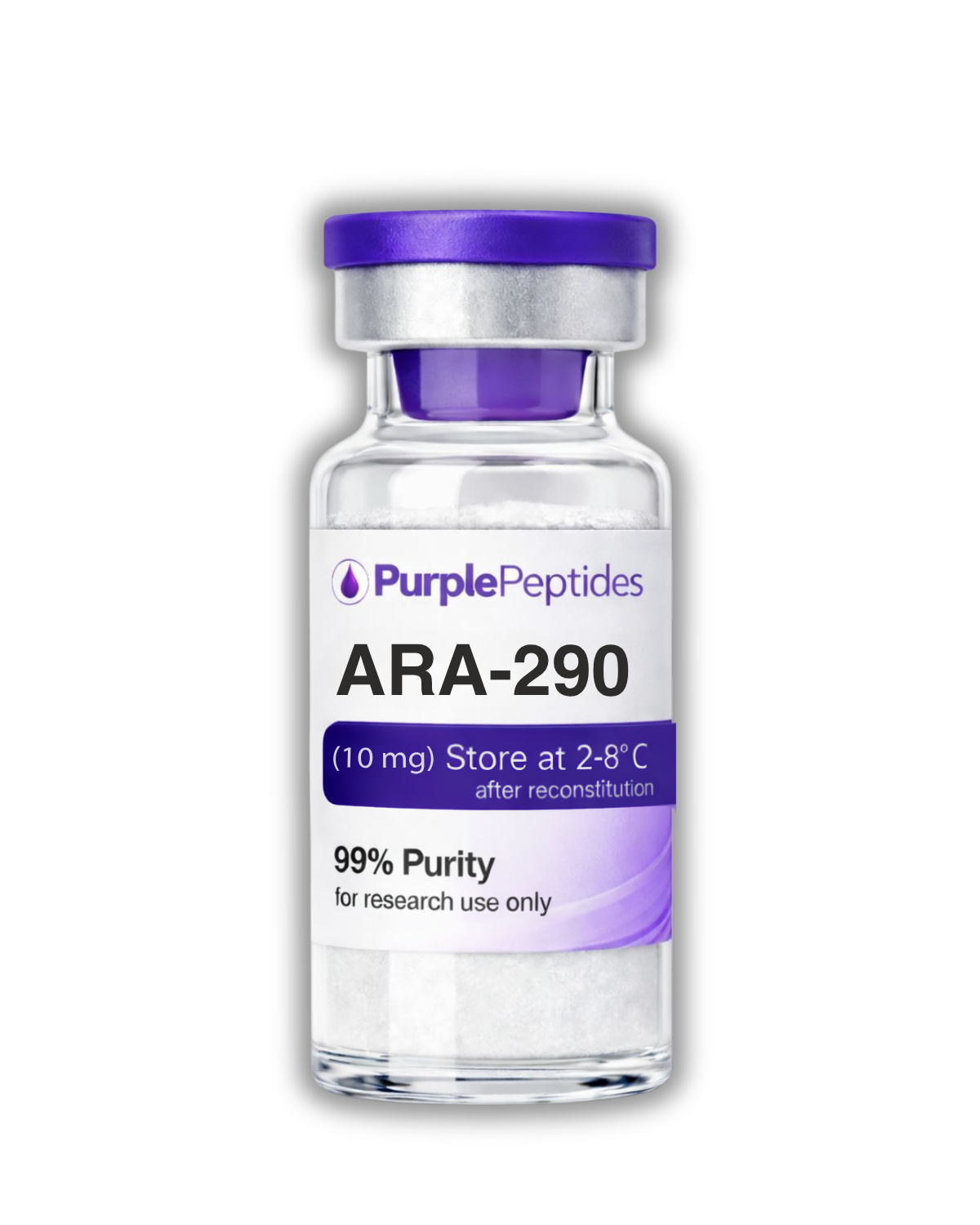
Purple Peptides supplies ARA-290 in a 10 mg research vial for controlled laboratory and analytical applications only.
ARA-290 Profile
Primary Research Focus: Innate repair receptor signaling, tissue-protective communication, neuroimmune biology, inflammatory regulation, microvascular physiology, and cellular recovery pathways.
ARA-290 Research Overview
ARA-290 is an 11-amino acid peptide based on the helix B region of erythropoietin. This region has been investigated for its relationship with tissue-protective signaling rather than the red blood cell-forming activity normally associated with EPO.
Laboratory and investigational research involving ARA-290 has examined:
- Innate repair receptor activation
- Tissue-protective signaling pathways
- Neuroimmune communication
- Peripheral nerve biology
- Inflammatory signaling regulation
- Endothelial cell communication
- Microvascular physiology
- Cellular stress and recovery responses
- Tissue remodeling mechanisms
Its targeted design makes ARA-290 a distinctive research tool for studying how damaged or stressed tissues communicate with immune, vascular, and neural systems during repair-related responses.
The Science Behind ARA-290
When biological tissue is exposed to injury, reduced oxygen availability, inflammation, or other forms of stress, multiple signaling systems determine whether cells recover, adapt, or move toward progressive dysfunction.
One pathway studied by researchers involves the innate repair receptor, a receptor complex that is functionally separate from the classical erythropoietin receptor. ARA-290 was developed to activate repair-associated signaling through this receptor while avoiding stimulation of erythropoiesis.
Experimental work has examined whether this signaling may influence communication among immune cells, endothelial cells, neurons, and stressed tissues. Areas of interest include inflammatory modulation, preservation of cellular integrity, microvascular signaling, and support of repair-related biological pathways.
These mechanisms remain investigational and should be interpreted as research findings rather than approved medical or therapeutic outcomes.
History and Development
ARA-290 originated from research investigating the non-hematopoietic functions of erythropoietin. Scientists found that certain structural regions of EPO appeared to participate in tissue-protective signaling independently of red blood cell production.
Researchers used this insight to create a smaller peptide intended to selectively reproduce repair-focused signaling while reducing interaction with the receptor responsible for erythropoietic activity.
Since its development, ARA-290 has been evaluated in laboratory, preclinical, and human research contexts involving peripheral nerve biology, inflammatory conditions, ischemic stress, wound-related models, microvascular function, and broader tissue recovery mechanisms.
ARA-290 Structure
ARA-290 is an 11-amino acid synthetic peptide modeled from the helix B surface region of erythropoietin. Its compact structure was designed to retain receptor-selective tissue-protective signaling while avoiding classical erythropoietic receptor activation.
Primary Research Focus: Receptor-selective tissue protection, neuroimmune communication, inflammatory regulation, cellular resilience, and repair-associated biological signaling.
Current Areas of Research
Regenerative Biology Research
- Innate repair receptor activation
- Tissue-protective signaling
- Cellular recovery mechanisms
- Tissue remodeling biology
Neuroscience Research
- Peripheral nerve physiology
- Neuroimmune communication
- Nerve repair-associated pathways
- Neuroinflammatory signaling
Inflammation Research
- Cytokine communication
- Immune-cell signaling
- Resolution-phase inflammatory biology
- Cellular stress adaptation
Vascular Research
- Endothelial cell biology
- Microvascular communication
- Ischemia-associated signaling
- Vascular repair mechanisms
Mechanism-Based Research Interest
ARA-290 is studied because its receptor selectivity connects several important fields of tissue-protection research:
- Innate repair receptor signaling
- Cytokine and inflammatory communication
- Neuroimmune interaction
- Endothelial cell function
- Peripheral nerve signaling
- Microvascular physiology
- Cellular stress responses
- Tissue remodeling pathways
- Repair-associated cellular communication
This profile makes ARA-290 a useful investigational peptide for studying how receptor-specific signaling may coordinate protective responses across neural, vascular, immune, and damaged-tissue systems.
Research Applications
ARA-290 may be useful in controlled laboratory models focused on:
- Innate repair receptor research
- Tissue-protection pathway studies
- Neuroinflammatory signaling models
- Peripheral nerve biology
- Endothelial and microvascular research
- Cellular resilience investigations
- Cytokine communication studies
- Ischemic stress response models
- Tissue remodeling research
- Repair-related cellular signaling
What Researchers May Document
In controlled research environments, investigators may document broad patterns related to:
- Innate repair receptor pathway activity
- Inflammatory signaling markers
- Neuroimmune communication patterns
- Peripheral nerve response models
- Endothelial cell observations
- Microvascular communication
- Cellular stress-response activity
- Tissue remodeling indicators
- Protocol consistency and analytical handling
ARA-290 research is intended to investigate biological signaling and laboratory observations. It is not intended to promise or imply a clinical outcome.
Why Researchers Continue Studying ARA-290
ARA-290 represents a distinctive development in peptide science because it was intentionally designed to separate tissue-protective signaling from erythropoietic activity.
This selective approach allows investigators to study a naturally occurring repair-communication system without directly stimulating red blood cell production. That distinction has created research interest across regenerative biology, neurobiology, vascular physiology, and inflammatory signaling.
As scientific understanding of the innate repair receptor continues to develop, ARA-290 remains a valuable investigational compound for examining how cells respond to stress, coordinate protective communication, and participate in tissue-recovery pathways.
Purple Peptides Research Snapshot
Key Biological Pathways
- Innate repair receptor signaling
- Tissue-protection communication
- Neuroimmune interaction
- Cellular recovery pathways
- Inflammatory regulation
- Microvascular physiology
The Purple Standard™
Every vial supplied by Purple Peptides is handled according to the Purple Standard™. This includes third-party testing, purity verification, controlled storage practices, batch tracking, and internal rejection of any lot that does not meet required quality thresholds.
The Purple Standard™ exists to support consistency, documentation, and research confidence across every Purple Peptides product.
Investigational Research Context
ARA-290 should be treated as an investigational research compound. Available literature includes cellular, animal, laboratory, and human research. Findings must not be interpreted as approved medical, therapeutic, diagnostic, veterinary, or human-use outcomes.
This 10 mg product is supplied exclusively for laboratory research and analytical applications. It is not intended for human consumption, self-experimentation, supplementation, diagnostic use, disease treatment, or disease prevention.
Scientific References
View References
- Brines M, et al. Proceedings of the National Academy of Sciences. 2008;105(31):10925–10930.
- Brines M, et al. Molecular Medicine. 2014;20(Suppl 1):S23–S30.
- Heij L, et al. Journal of Translational Medicine. 2019.
- Leist M, et al. Science. 2004;305(5681):239–242.
- Brines ML, Cerami A. Nature Reviews Drug Discovery. 2008;7(6):484–494.
- PubChem — ARA-290 compound profile and chemical identifier.
Research Use Only
For Laboratory Research Purposes Only
- Not for human consumption
- Not for animal consumption
- Not intended for diagnostic or therapeutic use
- Not intended to prevent, treat, or cure disease
- For qualified research professionals and laboratory investigators only
Need Help?
For questions about certificates of analysis, batch documentation, product specifications, or general research inquiries, contact the Purple Peptides support team.