GHK-Cu and Facial Smoothness: What Research Says About Fine Lines, Wrinkles, and Skin Texture
GHK-Cu has become one of the most talked-about copper peptides in skin aging research, especially for people searching for smoother-looking skin, better texture, improved firmness, and visible wrinkle support. But the real story is more interesting than a simple “anti-aging peptide” label. GHK-Cu is connected to tissue repair signaling, collagen support, extracellular matrix remodeling, and skin resilience — all of which matter when the goal is healthier-looking skin over time.
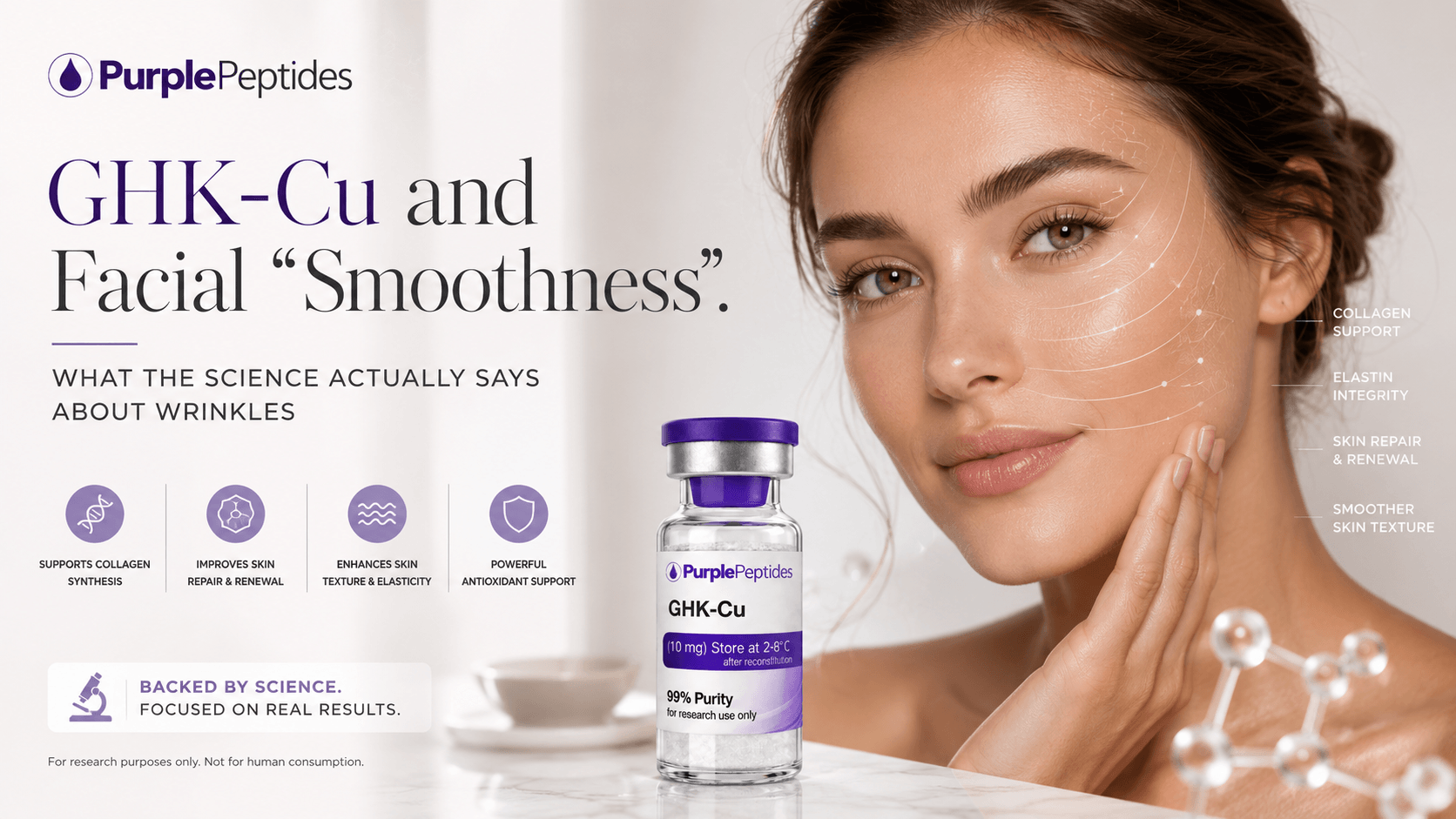
Why Facial Smoothness Changes With Age
Smooth-looking skin is not just about the surface. It is influenced by deeper structural factors such as collagen density, elastin organization, hydration inside the extracellular matrix, and how evenly the skin reflects light. When people say their skin looks less smooth, they usually mean the skin has started to show fine lines, uneven texture, reduced firmness, dull reflection, or small changes around the eyes and mouth.
Over time, the skin’s repair system slows down. Collagen production can decline, elastin fibers become less organized, inflammation-related signaling can increase, and the extracellular matrix may lose some of its youthful structure. This does not always appear as deep wrinkles immediately. In many cases, it first appears as micro-texture, dryness, dullness, and a loss of that soft, even-looking finish.
- Collagen helps support firmness and structure.
- Elastin helps skin maintain bounce and flexibility.
- Glycosaminoglycans help support hydration within the skin matrix.
- The extracellular matrix helps organize the skin’s structural support system.
- Repair signaling becomes increasingly important as visible aging develops.
What Is GHK-Cu?
GHK stands for glycyl-L-histidyl-L-lysine, a naturally occurring peptide found in the body. When this peptide binds with copper, it forms the copper peptide complex known as GHK-Cu. This copper-binding form is the version most often discussed in skin research, tissue repair research, and cosmetic science.
GHK-Cu has been studied for decades because of its connection to wound repair, collagen remodeling, antioxidant-related activity, inflammation modulation, and gene expression patterns associated with tissue renewal. One reason researchers remain interested is that natural GHK-Cu levels appear to decline with age, which makes the molecule especially relevant in conversations about skin repair and visible aging.
How GHK-Cu May Support Skin Smoothness
From a skin biology perspective, facial smoothness is closely connected to how well the dermal matrix is maintained. GHK-Cu is often discussed because it may influence several processes involved in that matrix. These include collagen synthesis, glycosaminoglycan production, extracellular matrix remodeling, and inflammatory pathway balance.
In simple words, GHK-Cu is interesting because it appears to communicate with the skin’s repair environment. Instead of simply covering texture, the research discussion around GHK-Cu focuses on biological signals that may help skin behave in a more repair-oriented and resilient way.
Main Research Pathways
- Collagen and elastin-related support
- Extracellular matrix organization
- Glycosaminoglycan and hydration support
- Inflammation pathway modulation
- Tissue repair and remodeling signals
What This Means Visually
These pathways are relevant to the visible qualities people associate with smoother skin: softer texture, improved firmness, better light reflection, and reduced appearance of fine micro-lines over time.
GHK-Cu, Fine Lines, and Wrinkle Appearance
Wrinkles are not all the same. Fine lines often develop from early collagen changes, hydration loss, repetitive movement, and surface texture changes. Deeper wrinkles usually involve more advanced structural breakdown, volume loss, and long-term changes in the dermis. GHK-Cu is most realistically discussed in the context of gradual skin quality support, not instant wrinkle removal.
Cosmetic research around copper peptides has reported interest in skin firmness, elasticity, fine line appearance, and texture over time. This does not mean GHK-Cu acts like filler, Botox, or a dramatic overnight treatment. A better way to understand it is as a peptide involved in skin health signaling and matrix support.
- Fine lines may appear softer when skin hydration and texture improve.
- Firmness is connected to collagen and extracellular matrix structure.
- Elasticity depends on both collagen and elastin organization.
- Visible smoothness improves when the surface reflects light more evenly.
- GHK-Cu research is best understood as gradual support, not instant correction.
Topical GHK-Cu vs Injectable GHK-Cu: Why the Difference Matters
For facial smoothness, wrinkles, and visible skin texture, the strongest cosmetic conversation is usually around topical copper peptide formulations. Topical products are designed to interact with the skin surface and upper layers, depending on formulation quality and delivery design.
Injectable or systemic applications are a different category. They may be discussed in research circles, but they have less cosmetic-specific human evidence and introduce more complexity. For a skin blog, it is important to keep the distinction clear: topical cosmetic evidence and systemic investigational discussion are not the same thing.
| Category | Primary Discussion | Best Research Framing |
|---|---|---|
| Topical GHK-Cu | Skin texture, fine lines, firmness, cosmetic appearance | Most relevant for facial smoothness and visible skin quality discussions |
| Injectable/Systemic GHK-Cu | Broader biological research and investigational use | Requires careful language because cosmetic-specific evidence is more limited |
GHK-Cu vs Retinoids: Different Skin Aging Pathways
Retinoids are famous in skin care because they support cellular turnover and epidermal renewal. GHK-Cu belongs to a different lane. It is more often discussed in relation to matrix repair, collagen support, tissue remodeling, and inflammatory balance. That means the two categories are not identical and should not be marketed as if they do the same thing.
| Skin Tool | Main Focus | Practical Note |
|---|---|---|
| Retinoids | Cell turnover, epidermal renewal, texture improvement | Can be irritating or drying for sensitive skin |
| GHK-Cu | Matrix repair signaling, collagen support, skin resilience | Often discussed as a gentler skin-support pathway in topical cosmetic routines |
In a complete skin health strategy, different tools may support different layers of the aging process. The key is understanding the mechanism instead of chasing one miracle ingredient.
What GHK-Cu Can and Cannot Do
One of the biggest mistakes in peptide content is overpromising. GHK-Cu should not be presented as an instant wrinkle eraser. It should not be compared directly to neuromodulators or dermal fillers. Those tools work through very different mechanisms. GHK-Cu is better framed as a research-backed copper peptide involved in skin repair signaling and long-term skin quality support.
GHK-Cu May Support
- Gradual improvement in skin texture appearance
- Firmness and elasticity-related research outcomes
- Collagen and matrix-support pathways
- Healthier-looking skin over time
GHK-Cu Will Not
- Erase deep wrinkles overnight
- Replace Botox-class treatments
- Act like a dermal filler
- Replace sunscreen, sleep, nutrition, or skin care basics
The Bigger Picture: Smooth Skin Is Built From Multiple Signals
GHK-Cu is only one part of a larger skin health conversation. Facial smoothness is also influenced by UV exposure, sleep quality, hydration, protein intake, oxidative stress, glycation, hormones, and consistency with basic skin care. A copper peptide can be biologically interesting, but it cannot compensate for daily damage if the foundation is ignored.
- Sun protection helps reduce collagen breakdown and photoaging.
- Sleep supports repair rhythm and skin barrier recovery.
- Protein intake supports structural proteins like collagen and elastin.
- Hydration and barrier care influence visible smoothness.
- Consistent routines usually matter more than aggressive routines.
This is where GHK-Cu fits best: not as a standalone miracle, but as a research-supported peptide within a broader skin quality and healthy aging framework.
Key Takeaways
- GHK-Cu is a naturally occurring copper-binding peptide connected to repair signaling.
- It is widely discussed in relation to collagen support, extracellular matrix remodeling, and skin texture.
- Facial smoothness depends on collagen, elastin, hydration, and matrix organization.
- GHK-Cu is best understood as gradual skin quality support, not an instant wrinkle eraser.
- Topical copper peptide evidence is more directly relevant to cosmetic skin texture discussions.
- Systemic or injectable applications remain more investigational and require careful language.
- The best skin results usually come from combining research-backed tools with strong daily skin fundamentals.
If you are researching GHK-Cu for smoother-looking skin, the goal should not be hype. The goal should be better understanding: how the skin repairs, how collagen changes over time, how texture develops, and how copper peptides may fit into the larger skin health picture.
Stay research-driven. Stay realistic. Build better skin biology from the foundation upward.
GHK-Cu Copper Peptide
Explore GHK-Cu for research discussions focused on copper peptide biology, skin texture pathways, collagen-support signaling, repair research, and extracellular matrix remodeling.
- Large premium 16:9 vial image area
- Clean white clinical Purple Peptides design
- Placed at the end for stronger product conversion
- Built with SEO-friendly skin research wording