Peptides vs Proteins vs Drugs: What’s the Difference?
Peptides, proteins, and drugs are often discussed as if they are the same thing. They are not. Each category has a different structure, a different biological role, and a different way of interacting with the body. Understanding the difference helps beginners, clinicians, coaches, researchers, and biohackers separate real science from hype.
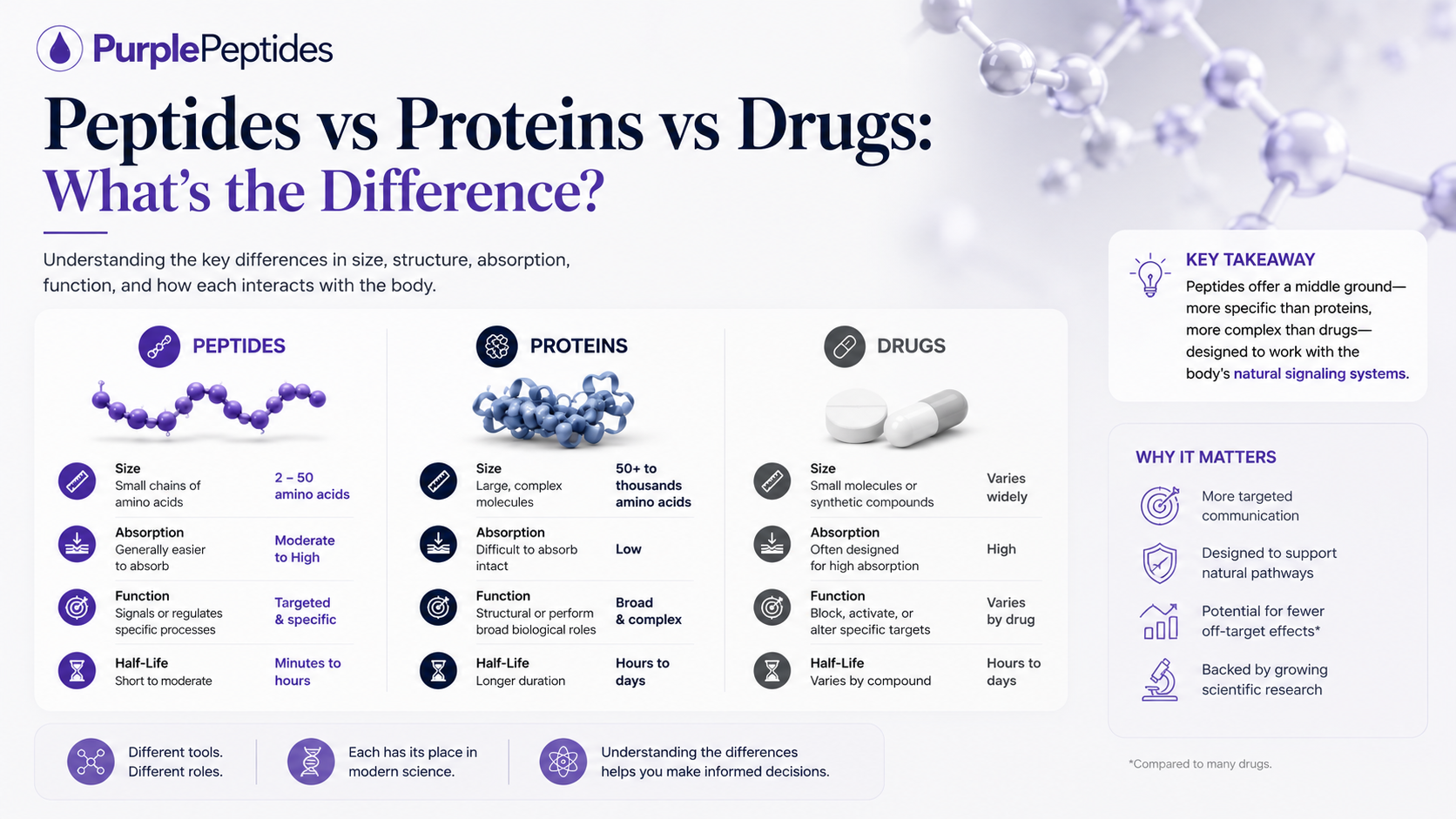
The Confusion Starts With Language
One of the biggest sources of confusion in peptide education is language. People hear phrases like “peptides are just proteins,” “peptides are basically drugs,” or “peptides are like supplements but stronger.” These statements sound simple, but they miss the biology.
Peptides, proteins, and pharmaceutical drugs can all influence biological systems, but they are not the same category. Proteins usually perform structural, enzymatic, or functional work. Peptides often act as short biological messages. Drugs are usually small molecules designed to bind, block, activate, or modify specific targets.
Proteins do the work. Peptides send the message. Drugs control the pathway.
This article is educational only. It explains biological differences between peptides, proteins, and drugs. It is not medical advice, treatment guidance, or a usage protocol.
Start With Amino Acids
Amino acids are the basic building blocks used to create both peptides and proteins. The main difference is usually size, structure, folding, and function. A short chain of amino acids may be called a peptide. A much longer chain that folds into a complex shape and performs a major biological job is usually called a protein.
This size difference matters because it changes how the molecule behaves. A small peptide may act quickly as a signal. A large protein may become an enzyme, a structural material, a carrier, or a complex biological machine.
What Are Proteins?
Proteins are large molecules made from long chains of amino acids. These chains fold into specific three-dimensional structures. That folded shape determines what the protein can do. In the body, proteins are everywhere: muscles, enzymes, antibodies, transport molecules, receptors, hormones, and structural tissues all depend on protein function.
Proteins commonly function as:
- Structural materials: collagen, keratin, muscle fibers, and connective tissue support.
- Enzymes: biological catalysts that speed up chemical reactions.
- Transporters: molecules such as hemoglobin that carry oxygen.
- Immune components: antibodies and immune signaling proteins.
- Receptors: large proteins that receive signals from hormones, peptides, and other molecules.
In simple terms, proteins are the workers and machinery of the body. They build, carry, protect, repair, digest, move, and regulate.
What Are Peptides?
Peptides are shorter chains of amino acids. Many educational sources describe peptides as being shorter than proteins, often in the range of a few amino acids up to around 50 amino acids, although the exact cutoff can vary by context. What matters most is not only size, but function.
In biological systems, many peptides act as messengers. They may bind to receptors, trigger cellular signaling cascades, influence gene expression, modulate inflammation, or help regulate repair and metabolic pathways. Peptides often do not “build” tissue directly. Instead, they tell cells what to do.
Peptides are often studied for:
- Cellular signaling and receptor activation.
- Repair and recovery pathway communication.
- Metabolic regulation and appetite-related signaling.
- Collagen, skin, and tissue remodeling research.
- Inflammatory modulation and immune communication.
What Are Traditional Drugs?
Traditional pharmaceutical drugs are often small molecules that are chemically synthesized. Unlike peptides and proteins, many drugs are not made from amino acid chains. They are designed to interact with specific biological targets such as receptors, enzymes, ion channels, transporters, or DNA-related pathways.
Drugs can block a pathway, activate a receptor, inhibit an enzyme, suppress a process, or change how a biological system behaves. This does not make drugs “bad.” It means they are often built for strength, durability, and target control.
Drugs are commonly designed to:
- Block receptors or enzymes.
- Activate specific pathways.
- Reduce symptoms by modifying biological activity.
- Stay active longer in the body than many natural signals.
- Create predictable pharmacological effects at specific targets.
Why Size Changes Everything
Size affects how a molecule behaves in the body. Proteins are large and complex. Peptides are smaller and often more flexible. Small-molecule drugs are tiny by comparison. This influences absorption, distribution, half-life, receptor interaction, tissue penetration, and how long the effect may last.
Peptides often break down faster than many traditional drugs because enzymes can degrade amino acid chains. This short-lived nature is one reason peptides are studied as signaling molecules. They can deliver a message and then be broken down into amino acids.
Reference: Review on therapeutic peptide properties
How They Interact With Cells
Proteins, peptides, and drugs can all affect cells, but the style of interaction is different. A protein may serve as a structural component or enzyme. A peptide may bind to a receptor and trigger a signal. A drug may bind to a target and block, activate, inhibit, or modify a pathway.
- Proteins: perform structural, enzymatic, immune, transport, or receptor-based functions.
- Peptides: often bind to receptors and trigger signaling cascades.
- Drugs: often bind receptors, enzymes, channels, or other targets to modify pathway activity.
Reference: Overview of receptor signaling
Signaling vs Structure vs Pathway Control
The easiest way to understand the difference is to think in three categories. Proteins are often the structure and machinery. Peptides are often the message. Drugs are often the control lever.
A peptide may mimic or modulate a natural biological signal. A protein may physically perform a job in the body. A drug may strongly block or activate a target to produce a desired pharmacological result. Each category has strengths, limitations, and different research uses.
Different tools. Different biology. Different trade-offs.
Peptides vs Proteins vs Drugs: Quick Comparison
| Feature | Peptides | Proteins | Traditional Drugs |
|---|---|---|---|
| Basic Structure | Short amino acid chains | Long folded amino acid chains | Usually small chemical molecules |
| Primary Role | Signaling and modulation | Structure, enzymes, transport, function | Pathway control, blocking, activation, inhibition |
| Size | Small to medium | Large and complex | Very small by comparison |
| Specificity | Often high receptor specificity | Function depends on shape and folding | Variable; can be specific or broad |
| Duration | Often shorter-lived | Can be long-lasting or continuously produced | Often designed for longer activity |
| Research Focus | Receptor signaling and biological communication | Biological function and structural roles | Therapeutic target control |
Where Confusion Usually Starts
Confusion usually starts when people expect one category to behave like another. Someone may expect a peptide to work like a long-lasting drug. Someone may expect a protein to act like a quick signal. Someone may describe peptides as supplements, even though many peptides are studied for receptor-based biological signaling.
- Expecting peptides to behave like traditional small-molecule drugs.
- Expecting proteins to act like short-lived cellular messages.
- Assuming all amino-acid-based molecules have the same function.
- Assuming “natural signal” means simple or risk-free.
- Ignoring dose, timing, receptor activity, and biological context.
What to Remember
- Proteins are large folded molecules that perform structural, enzymatic, transport, immune, and functional roles.
- Peptides are shorter amino acid chains that often act as biological messengers and receptor-based signals.
- Traditional drugs are usually small molecules designed to block, activate, inhibit, or control specific biological targets.
- Size, structure, specificity, and duration shape how each category behaves.
- Peptides are not simply proteins, drugs, or supplements. They are their own category of biological signaling molecules.
The Science Becomes Clearer When the Categories Are Clear
If you lump peptides, proteins, and drugs together, the science becomes confusing. If you respect their differences, the picture becomes much clearer. Proteins build and perform work. Peptides communicate. Drugs control targets.
Biology is not about hacks. It is about communication, structure, and control working together. Once you understand the language, peptide science stops sounding mysterious and starts making sense.
Educational content only. This article is not medical advice, diagnosis, treatment guidance, or a usage protocol. Any discussion of peptides, proteins, drugs, or biological pathways is for general research education only.