How Peptides Work in the Body: Cellular Signaling, Simplified
Peptides are often discussed in conversations about metabolism, skin research, recovery pathways, inflammation modulation, tissue repair, and body composition science. But the most important idea is also the simplest: peptides are biological messages. They help cells communicate, respond, adapt, and regulate activity through highly specific signaling pathways.
Your Body Runs on Communication
The human body is not simply a collection of muscles, organs, hormones, and tissues. It is a coordinated communication network. Every second, cells send and receive chemical signals that influence repair, energy use, immune activity, inflammation, sleep rhythm, appetite, growth, and adaptation.
This communication system is what allows the body to remain balanced. When tissue is damaged, signals help organize repair. When energy is low, signals help adjust metabolism. When the immune system detects stress, signals help coordinate a response. Peptides are one category of molecules involved in this complex biological language.
Peptides matter because they are not just “ingredients.” They are instructions.
- They can help researchers study how cells receive and respond to biological messages.
- They may interact with receptors involved in repair, growth, inflammation, or metabolic regulation.
- They are often explored because many peptide pathways already exist naturally inside the body.
- Their effects depend heavily on receptor activity, timing, dose, tissue context, and biological feedback loops.
What Is Cellular Signaling?
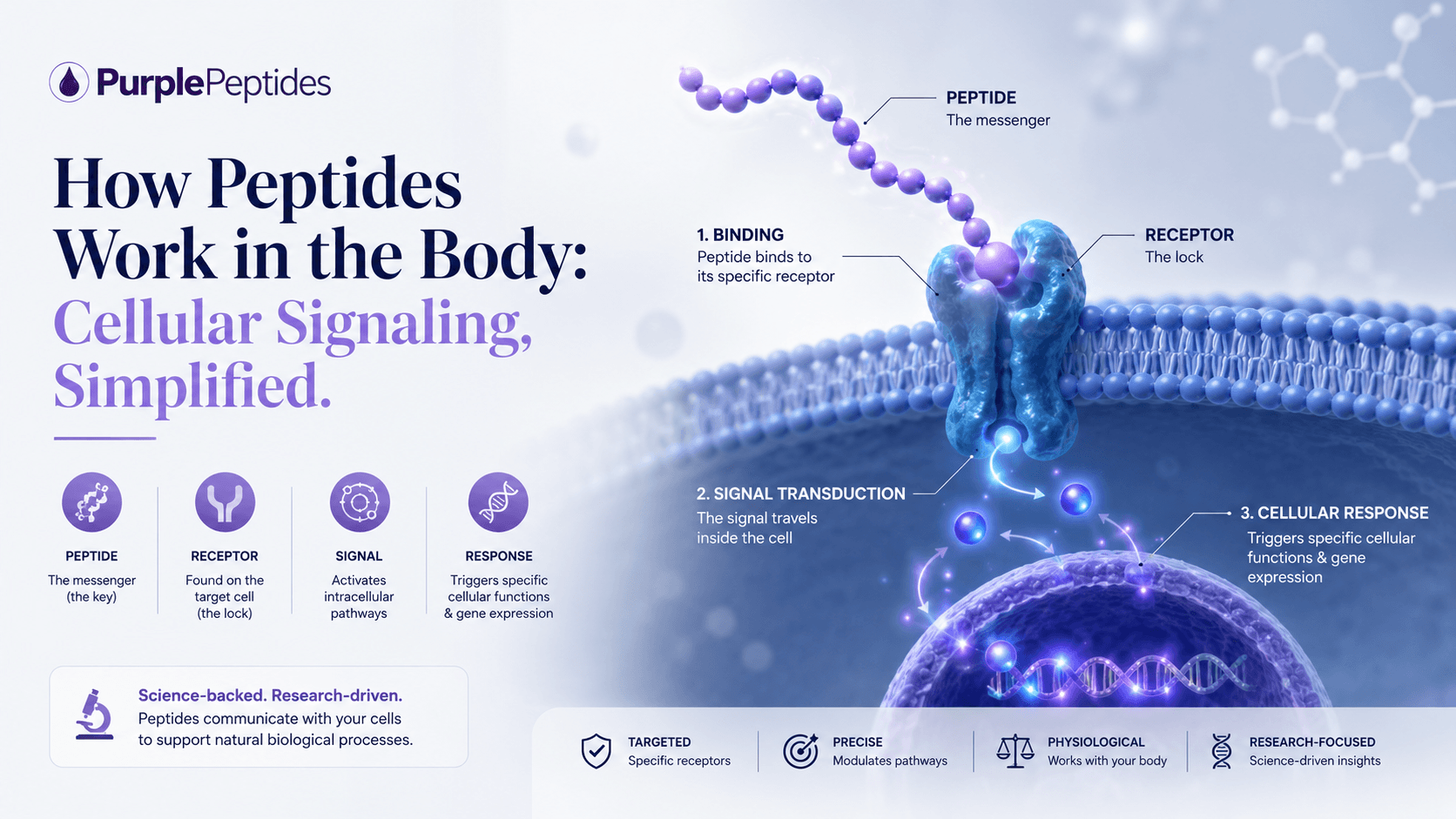
Cellular signaling is the process cells use to communicate with each other. A signal may be released by one cell, travel through the bloodstream or local tissue environment, and then bind to a receptor on another cell. Once that receptor is activated, the cell begins a response.
These signals can include hormones, neurotransmitters, growth factors, cytokines, enzymes, and peptides. Each type of signal has its own role, but the purpose is similar: to transfer information from one part of the body to another.
In simple words: cellular signaling is how the body “texts” itself. A peptide can be one of those text messages, and the receptor is the inbox that decides whether the message is received.
A cell responds based on three major factors:
- The receptor it has: A cell can only respond to a signal if it has the correct receptor.
- The signal it receives: Different peptides can activate different pathways.
- The state of the cell: A stressed, inflamed, damaged, or energy-depleted cell may respond differently than a healthy cell.
This is why peptide research is not one-size-fits-all. Biology is dynamic. The same signal may produce different results depending on tissue type, receptor sensitivity, timing, and the larger physiological environment.
For a foundational overview, see this educational resource from the NIH: cell signaling overview.
Peptides as Biological Messengers
A peptide is a short chain of amino acids. Amino acids are the building blocks of proteins, but peptides are usually smaller than full proteins and often act as signaling molecules. Many naturally occurring peptides in the body help regulate appetite, growth hormone signaling, immune activity, tissue repair, sleep, pain perception, and metabolic rhythm.
In research conversations, peptides are often discussed because they can mimic, modify, or support investigation into naturally occurring signaling pathways. Instead of forcing a cell to behave in a completely artificial way, peptide signaling is studied for how it may influence existing biological systems.
The peptide travels
A peptide may circulate through fluid or act locally near the tissue where it is released or introduced in a research model.
It finds a matching receptor
The receptor is usually located on the surface of a cell or inside a cell. The peptide must fit the receptor correctly to begin signaling.
The receptor activates a pathway
Once activated, the receptor can trigger internal chemical events such as calcium release, cAMP signaling, enzyme activation, or gene expression changes.
The cell changes its behavior
The final response may involve protein production, inflammation control, repair signaling, metabolic adjustment, or other pathway-specific effects.
Why Receptor Specificity Matters
A common way to understand peptide signaling is the lock-and-key analogy. The peptide is the key. The receptor is the lock. If the peptide fits the receptor, the message can be delivered. If it does not fit, the cell may not respond.
This specificity is one reason peptide research is so interesting. A peptide may target a certain receptor family or pathway more precisely than a broad compound. However, specificity does not mean simplicity. Receptors can behave differently depending on tissue type, receptor density, biological stress, and feedback regulation.
Why this matters in peptide research:
- Different receptors can create different downstream effects.
- Two peptides may appear similar but activate very different pathways.
- Receptor sensitivity can change over time with repeated exposure.
- More signaling is not always better; biological systems depend on balance.
For deeper reading, this review discusses peptide-receptor interactions: peptide-receptor interaction review.
What Happens After a Peptide Binds?
The most important activity often happens after receptor binding. Once a peptide binds to its receptor, the cell may begin a chain reaction known as signal transduction. This means the message on the outside of the cell is translated into activity inside the cell.
This internal response can involve secondary messengers, transcription factors, enzymes, ion channels, and changes in gene expression. The cell may begin making certain proteins, reducing others, activating repair processes, or changing how it uses energy.
Common intracellular signaling events include:
- cAMP signaling: A common pathway involved in metabolism, hormone activity, and cellular regulation.
- Calcium signaling: Important for muscle activity, neurotransmission, secretion, and many cell responses.
- Gene expression changes: Signals may influence which genes become more or less active.
- Protein synthesis changes: The cell may create proteins involved in repair, structure, or signaling.
- Inflammation modulation: Some pathways are studied for their relationship with immune and inflammatory balance.
For a simple scientific overview, see Nature’s educational explanation of signal transduction pathways.
Peptides Are Not the Same as Supplements
Supplements usually provide nutrients, minerals, herbs, amino acids, or supportive raw materials. Peptides are different because they are studied primarily as signaling molecules. Instead of simply adding a nutrient, a peptide may interact with a receptor and influence a biological pathway.
This is why peptide “stacking” should not be viewed like combining vitamins. In research discussions, combining peptides means combining signaling influences. That makes the timing, pathway overlap, receptor activity, and research objective much more important.
A smarter way to think about peptide stacks:
- What pathway is being studied? Metabolic signaling, repair signaling, recovery, skin research, or inflammation modulation?
- Do the compounds overlap? Similar pathways may amplify or confuse the research signal.
- What is the timing? Some pathways may respond differently depending on exposure schedule.
- What is the endpoint? A clear research goal is better than random combination.
This is the reason structured research frameworks are often more useful than random peptide combinations. Organization creates clearer observation. Guesswork creates noise.
Why Peptide Research Is So Context-Dependent
Peptide signaling does not happen in isolation. The body is full of feedback loops. A signal may trigger one pathway, which then affects another pathway, which then changes how the original signal is received. This is why results in biological research are often context-dependent.
Dose matters because receptor activation can be threshold-based. Timing matters because many biological systems follow rhythms. Context matters because a cell’s condition influences how it responds.
Three factors that shape peptide signaling:
- Receptor availability: A peptide cannot signal effectively if the target receptor is limited or desensitized.
- Biological environment: Stress, inflammation, energy status, and tissue condition may influence response.
- Signal duration: Short exposure and sustained exposure may create different cellular outcomes.
This is also why “more” is not automatically better. In cellular signaling, precision matters. The goal is not maximum stimulation. The goal is understanding pathway behavior.
Why Researchers Study Peptides
Peptides are widely discussed in research because they can help scientists explore how biological systems regulate themselves. They are relevant to many areas of study, including metabolic signaling, appetite pathways, mitochondrial function, collagen remodeling, recovery biology, tissue repair research, inflammatory balance, and age-related changes in cellular communication.
For example, some peptide pathways are studied because they relate to growth hormone signaling. Others are discussed in the context of skin texture research, wound repair models, glucose metabolism, body composition research, or cellular energy regulation. The unifying theme is not hype. The unifying theme is signaling.
Common peptide research categories include:
- Metabolic signaling research: Appetite, glucose regulation, energy balance, and body composition pathways.
- Repair and recovery research: Tissue remodeling, soft tissue repair models, and recovery-related pathways.
- Skin and collagen research: Collagen expression, elasticity, texture, and age-associated skin changes.
- Mitochondrial research: Cellular energy, oxidative stress, and metabolic adaptation.
- Inflammation research: Immune signaling, inflammatory response, and tissue environment regulation.
Peptides Do Not “Do Everything”
One of the biggest mistakes in peptide conversations is describing peptides as if they directly rebuild tissue, burn fat, reverse aging, or repair the body by themselves. That is not the best way to understand the science.
A more accurate explanation is that peptides are studied for how they may influence signaling pathways. The body still performs the biological work. Cells still need energy, nutrients, oxygen, time, and the correct environment. Peptides are part of the communication layer, not a replacement for physiology.
Peptides signal. Cells respond. Biology decides the outcome.
Key Takeaways
- The body operates through constant cellular communication.
- Peptides are short amino acid chains often studied as biological signaling molecules.
- Many peptides work by binding to specific receptors and activating internal cellular pathways.
- Peptide effects depend on receptor activity, tissue type, dose, timing, and biological context.
- Peptides are not the same as supplements because they function more like instructions than raw materials.
- Research peptide stacks should be organized around pathways, not random combinations.
- The most accurate way to understand peptides is through cellular signaling, receptor biology, and feedback loops.
Educational content only. This article is provided for general research education and does not provide medical advice, diagnosis, treatment guidance, or human-use instructions. Products and compounds discussed in research contexts should be understood according to applicable laws, regulations, and labeling requirements. For research purposes only. Not for human or animal consumption.