Kisspeptin
What Is Kisspeptin?
Kisspeptin is a naturally occurring family of peptide hormones that plays a fundamental role in regulating reproductive endocrinology and neuroendocrine communication.
Originally identified for its involvement in cellular signaling, Kisspeptin is now recognized as one of the body's primary regulators of the hypothalamic-pituitary-gonadal (HPG) axis through its interaction with the GPR54 receptor, also known as the Kiss1 receptor.
Because of its central role in hormonal communication, Kisspeptin has become an important investigational peptide in reproductive biology, endocrinology, and neuroscience. Researchers continue studying how Kisspeptin coordinates communication between the brain and reproductive organs while influencing puberty, fertility, hormone secretion, and broader neuroendocrine regulation.
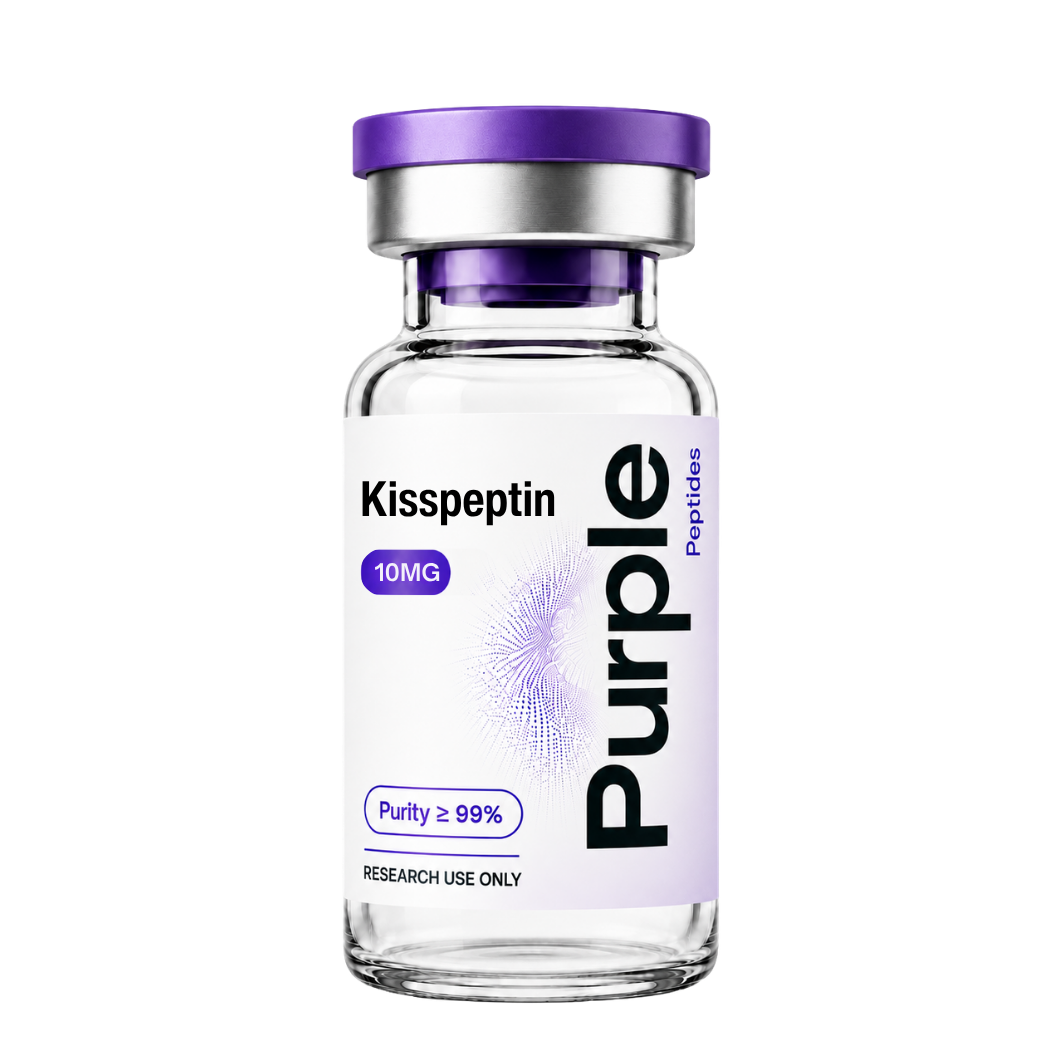
Kisspeptin 10mg Profile
Naturally occurring neuroendocrine peptide
10mg
Kisspeptin-10
374675-21-5
Approximately 1,302 g/mol
Kiss1 Receptor (GPR54)
KISS1
Laboratory research only
Primary Research Focus: Neuroendocrine regulation, Kiss1 receptor signaling, GnRH regulation, reproductive hormone communication, and hypothalamic-pituitary-gonadal axis research.
Kisspeptin Overview
Kisspeptin refers to a family of naturally occurring peptides derived from the KISS1 gene. These peptides include Kisspeptin-10, Kisspeptin-13, Kisspeptin-14, and Kisspeptin-54.
These peptides bind selectively to the Kiss1 receptor, also known as GPR54, initiating signaling pathways involved in the regulation of gonadotropin-releasing hormone (GnRH) secretion within the hypothalamus.
Through this upstream regulatory role, Kisspeptin serves as an important signaling molecule for reproductive hormone communication. Rather than replacing hormones directly, Kisspeptin helps coordinate endogenous hormonal signaling through neuroendocrine pathways.
Current areas of investigation include:
- Hypothalamic signaling
- GnRH regulation
- Reproductive endocrinology
- Puberty-related physiology
- Fertility research
- Hormonal communication
- Neuroendocrine regulation
- Brain-gonadal signaling
The Science Behind Kisspeptin
The endocrine system depends upon precise communication between the brain and peripheral organs to maintain hormonal balance. One of the most important signaling pathways within this network is the hypothalamic-pituitary-gonadal axis.
Kisspeptin functions near the top of this communication hierarchy. By activating Kiss1 receptors located on GnRH-producing neurons, Kisspeptin influences gonadotropin-releasing hormone signaling, which subsequently regulates luteinizing hormone (LH) and follicle-stimulating hormone (FSH) secretion from the pituitary gland.
Researchers continue investigating how this signaling network integrates physiological inputs including metabolic status, circadian rhythms, stress responses, and sex steroid feedback to coordinate reproductive physiology.
Ongoing investigations continue to examine its interaction with:
- Kiss1 receptor signaling
- GnRH neuron activation
- Hypothalamic communication
- LH and FSH regulation
- Neuroendocrine feedback loops
- Reproductive hormone signaling
- Brain-endocrine communication
- Hormonal homeostasis
History & Development
The KISS1 gene was first identified during cancer biology research in the 1990s, where it was recognized for its involvement in suppressing tumor metastasis.
Several years later, researchers discovered that peptides encoded by the KISS1 gene also serve an important function within neuroendocrine signaling and reproductive hormone regulation.
The discovery that mutations affecting the Kiss1 receptor could disrupt normal reproductive development significantly changed scientific understanding of puberty and endocrine physiology.
Today, Kisspeptin continues to provide researchers with valuable insight into how the brain coordinates reproductive and endocrine communication across multiple physiological systems.
Kisspeptin Structure
Kisspeptin-10
10mg
374675-21-5
Approximately 1,302 g/mol
Kiss1 Receptor (GPR54)
KISS1
Current Areas of Research
Published scientific literature continues to investigate Kisspeptin across numerous areas of endocrinology and neuroscience.
Endocrine Research
- Hypothalamic-pituitary-gonadal axis
- GnRH regulation
- Hormonal communication
- Endocrine feedback mechanisms
Reproductive Biology Research
- Fertility physiology
- Puberty regulation
- Gonadal signaling
- Reproductive hormone dynamics
Neuroscience Research
- Hypothalamic function
- Neuroendocrine communication
- Brain hormone signaling
- Central peptide regulation
Cellular Research
- Kiss1 receptor biology
- Intracellular signaling pathways
- Hormonal receptor interactions
- Peptide-receptor pharmacology
Why Researchers Continue Studying Kisspeptin
Kisspeptin has significantly reshaped scientific understanding of reproductive endocrinology by revealing one of the primary signaling systems responsible for coordinating communication between the brain and reproductive organs.
Unlike peptides that act directly on peripheral tissues, Kisspeptin occupies a central regulatory position within an important hormonal communication network.
This upstream role allows researchers to investigate how environmental, metabolic, neurological, and hormonal signals converge within the brain to regulate endocrine physiology.
Purple Peptides Research Snapshot
Neuroendocrine regulation and reproductive hormone signaling
Kiss1 receptor activation and GnRH regulation
Yes
Yes
Extensive
Mid-1990s
Early 2000s
Extensive
Key Biological Pathways
- Hypothalamic-Pituitary-Gonadal Axis
- Kiss1 Receptor Signaling
- GnRH Regulation
- LH & FSH Signaling
- Neuroendocrine Communication
- Hormonal Homeostasis
Scientific References
View References
- Lee JH, et al. Journal of the National Cancer Institute. 1996;88(23):1731-1737.
- de Roux N, et al. Proceedings of the National Academy of Sciences. 2003;100(19):10972-10976.
- Seminara SB, et al. New England Journal of Medicine. 2003;349(17):1614-1627.
- Pinilla L, Aguilar E, Dieguez C, et al. Physiological Reviews. 2012;92(3):1235-1316.
- Oakley AE, Clifton DK, Steiner RA. Endocrine Reviews. 2009;30(6):713-743.
Research Use Only
For Laboratory Research Purposes Only
This product is intended exclusively for laboratory research and analytical applications.
- Not for human consumption
- Not intended for diagnostic or therapeutic use
- Not intended to prevent, treat, or cure disease
Products sold by Purple Peptides are intended exclusively for qualified research professionals and laboratory investigators for research use only.