PP-31
What Is PP-31?
PP-31, scientifically known as SS-31 or Elamipretide, is a synthetic mitochondria-targeting tetrapeptide extensively studied for its interaction with mitochondrial membranes and its role in cellular bioenergetics, oxidative stress regulation, and mitochondrial function.
Unlike many investigational peptides that act through traditional cell-surface receptors, PP-31 is notable because SS-31 selectively localizes to the inner mitochondrial membrane, where researchers have investigated its influence on mitochondrial membrane stability and energy production.
Because mitochondria serve as the primary energy-producing structures within cells, SS-31 has become an important investigational peptide across aging biology, neuroscience, cardiovascular research, muscle physiology, and metabolic science.
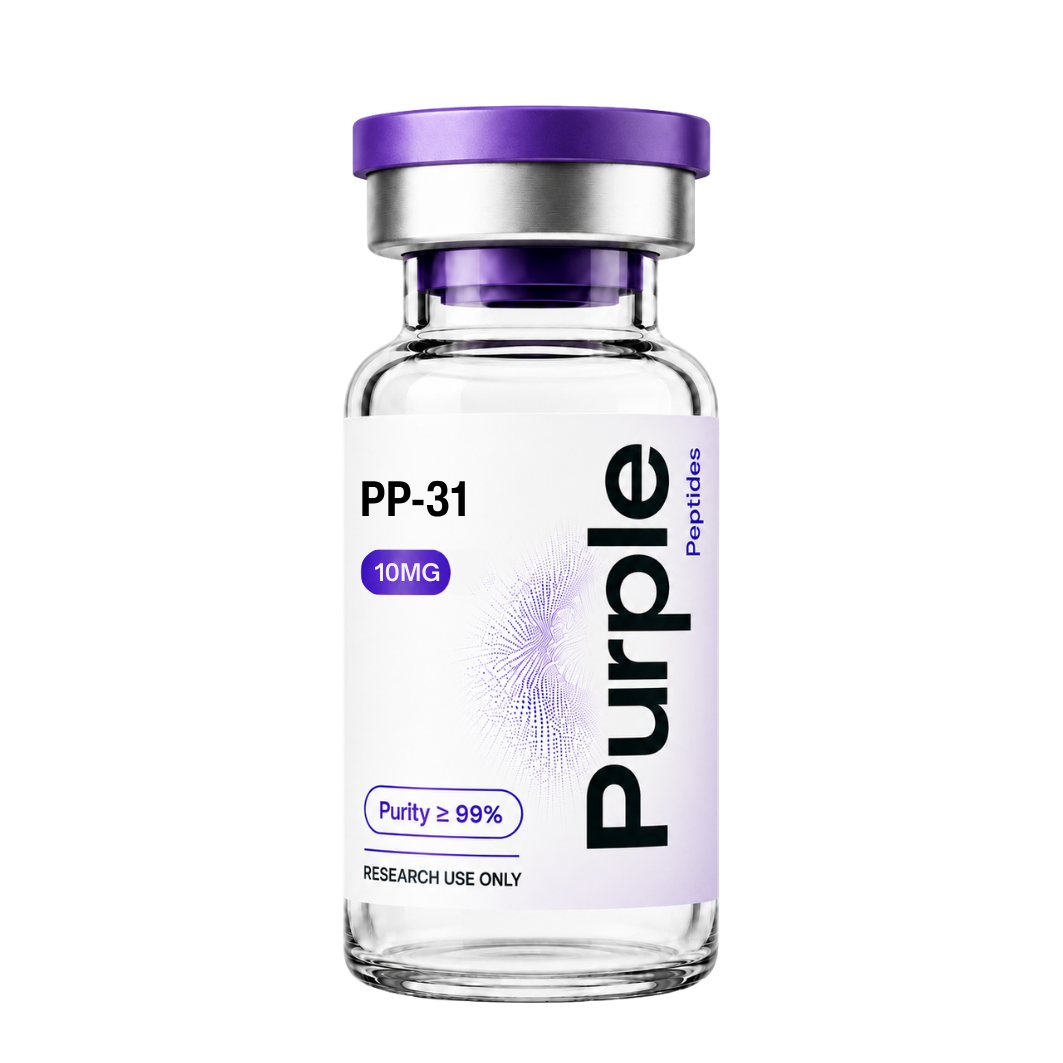
PP-31 10mg Profile
Synthetic mitochondria-targeting tetrapeptide
10mg
SS-31
Elamipretide
736992-21-5
C₃₂H₄₉N₉O₅
639.8 g/mol
11759955
Laboratory research only
Primary Research Focus: Mitochondrial function, cellular bioenergetics, cardiolipin interaction, oxidative stress regulation, mitochondrial membrane integrity, and ATP production.
PP-31 Overview
PP-31 refers to the research compound scientifically known as SS-31, a four-amino-acid synthetic peptide belonging to a class of compounds known as Szeto-Schiller peptides.
Unlike larger peptides that depend primarily on receptor-mediated signaling, SS-31 possesses structural characteristics that allow it to penetrate cells and selectively accumulate within mitochondria.
Once localized to the inner mitochondrial membrane, SS-31 has been investigated for its interaction with cardiolipin, a specialized phospholipid involved in maintaining mitochondrial membrane integrity and efficient electron transport chain activity.
Current areas of investigation include:
- Mitochondrial bioenergetics
- Cardiolipin stabilization
- ATP production
- Oxidative stress regulation
- Cellular energy metabolism
- Mitochondrial membrane integrity
- Tissue resilience
- Healthy aging biology
The Science Behind PP-31
Mitochondria generate the majority of cellular adenosine triphosphate (ATP), the molecule used to power numerous biological processes. Mitochondria also participate in cellular signaling, apoptosis, calcium homeostasis, and oxidative balance.
One important component of mitochondrial function is cardiolipin, a phospholipid located within the inner mitochondrial membrane that helps organize protein complexes responsible for oxidative phosphorylation.
Laboratory research has investigated whether changes in cardiolipin structure may influence mitochondrial efficiency and reactive oxygen species production.
SS-31 has been extensively studied because of its selective association with cardiolipin. Researchers have explored its relationship with mitochondrial membrane organization, electron transport chain efficiency, ATP generation, and oxidative stress regulation.
Ongoing investigations continue to examine:
- Cardiolipin biology
- Electron transport chain function
- ATP synthesis
- Mitochondrial membrane stability
- Reactive oxygen species regulation
- Cellular bioenergetics
- Mitochondrial signaling pathways
- Cellular stress adaptation
History & Development
SS-31 was developed during the late 1990s and early 2000s by Dr. Hazel Szeto and colleagues as part of research into small peptides capable of selectively targeting mitochondria.
Their work demonstrated that certain aromatic-cationic peptides could rapidly penetrate cells and localize within mitochondria independently of mitochondrial membrane potential.
Subsequent investigations identified SS-31 as an important member of this peptide family because of its interaction with cardiolipin and its mitochondrial research profile.
Over the following decades, SS-31 became the subject of laboratory and clinical research involving cardiovascular physiology, skeletal muscle biology, neuroscience, renal physiology, ocular research, mitochondrial function, and healthy aging.
PP-31 Structure
SS-31
Elamipretide
4 Amino Acids
736992-21-5
C₃₂H₄₉N₉O₅
639.8 g/mol
11759955
10mg
Current Areas of Research
Published scientific literature continues to investigate SS-31 across multiple areas of mitochondrial and cellular biology.
Mitochondrial Research
- Cardiolipin stabilization
- ATP production
- Oxidative phosphorylation
- Electron transport chain function
- Mitochondrial bioenergetics
Cellular Biology Research
- Oxidative stress regulation
- Cellular energy metabolism
- Mitochondrial signaling
- Cellular resilience
- Redox homeostasis
Cardiovascular Research
- Cardiac mitochondrial physiology
- Myocardial energy metabolism
- Ischemia-reperfusion biology
- Vascular bioenergetics
Neuroscience Research
- Neuronal mitochondrial function
- Neuroenergetics
- Cellular stress adaptation
- Brain energy metabolism
Healthy Aging Research
- Age-related mitochondrial changes
- Cellular resilience
- Muscle physiology
- Longevity-associated pathways
Why Researchers Continue Studying PP-31
Few investigational peptides possess a research mechanism as distinctive as SS-31. Rather than primarily interacting with traditional cell-surface receptors, SS-31 targets mitochondrial structures involved in cellular energy production.
Its selective interaction with cardiolipin has provided researchers with a way to investigate how mitochondrial membrane organization relates to ATP production, oxidative stress, electron transport, and cellular communication.
As scientific understanding of mitochondrial biology continues to evolve, SS-31 remains an important investigational peptide for studying mitochondrial resilience, bioenergetics, and cellular aging pathways.
Purple Peptides Research Snapshot
Mitochondrial function and cellular bioenergetics
Cardiolipin interaction and mitochondrial membrane stabilization
Yes
Yes
Extensive
Early 2000s
Extensive
10mg
Key Biological Pathways
- Mitochondrial Bioenergetics
- Cardiolipin Biology
- ATP Production
- Electron Transport Chain
- Oxidative Stress Regulation
- Cellular Energy Metabolism
Scientific References
View References
- Szeto HH. Biochimica et Biophysica Acta (BBA) – Bioenergetics. 2014;1837(8):1212-1219.
- Szeto HH, Schiller PW. Pharmaceutical Research. 2011;28(11):2669-2679.
- Birk AV, et al. PLoS ONE. 2013;8(1):e54334.
- Zhao K, et al. Journal of Biological Chemistry. 2004;279(33):34682-34690.
- Daubert MA, et al. Circulation. 2017;136(6):546-557.
Research Use Only
For Laboratory Research Purposes Only
This product is intended exclusively for laboratory research and analytical applications.
- Not for human consumption
- Not intended for diagnostic or therapeutic use
- Not intended to prevent, treat, or cure disease
Products sold by Purple Peptides are intended exclusively for qualified research professionals and laboratory investigators for research use only.