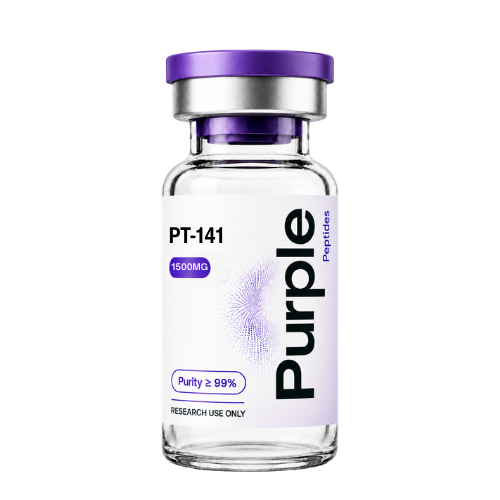
PT-141
What Is PT-141?
PT-141, also known as Bremelanotide, is a synthetic melanocortin peptide originally developed from Melanotan II and extensively studied for its interaction with melanocortin receptors within the central nervous system.
Unlike many peptides investigated primarily for peripheral physiological activity, PT-141 has attracted significant scientific interest because of its relationship with neurobiological signaling pathways involved in motivation, behavior, autonomic regulation, and neuroendocrine communication.
Rather than being studied primarily through peripheral vascular mechanisms, PT-141 is investigated for its influence on central melanocortin receptor activity, providing researchers with a tool for examining how peptide signaling within the brain relates to complex physiological and behavioral responses.
PT-141 10mg Profile
Synthetic cyclic melanocortin peptide
10mg
Bremelanotide
189691-06-3
C₅₀H₆₈N₁₄O₁₀
1,025.2 g/mol
11949646
MC4R and MC3R
Laboratory research only
Primary Research Focus: Central melanocortin receptor signaling, neuroendocrine communication, hypothalamic signaling, autonomic regulation, behavioral neuroscience, and melanocortin receptor biology.
PT-141 Overview
PT-141 is a cyclic synthetic peptide derived from Melanotan II through structural modifications designed to optimize receptor activity while reducing melanogenic effects.
It primarily interacts with melanocortin receptors, particularly MC4R and, to a lesser extent, MC3R. These receptors are distributed throughout the central nervous system and participate in behavioral, neuroendocrine, metabolic, and autonomic signaling.
Current areas of investigation include:
- Central melanocortin receptor signaling
- Neuroendocrine communication
- Behavioral neuroscience
- Autonomic nervous system regulation
- Hypothalamic signaling pathways
- Dopaminergic network interactions
- Motivation and reward circuitry
- Brain-body communication
The Science Behind PT-141
The melanocortin system represents an important neuropeptide communication network involved in appetite regulation, energy balance, autonomic function, endocrine signaling, and complex behavioral responses.
These effects are mediated through a family of melanocortin receptors distributed throughout the central nervous system and peripheral tissues.
PT-141 has become an important investigational peptide because it activates central melanocortin receptors involved in neurological and neuroendocrine communication rather than functioning primarily through direct peripheral vascular pathways.
Laboratory research has investigated how melanocortin receptor activation may interact with downstream neurotransmitter systems, including dopaminergic and oxytocinergic networks involved in behavioral and neuroendocrine regulation.
Ongoing investigations continue to examine:
- Melanocortin receptor signaling
- Hypothalamic communication
- Dopamine pathway regulation
- Neuroendocrine signaling
- Autonomic nervous system activity
- Brain reward circuitry
- Hormonal communication networks
- Central nervous system peptide signaling
History & Development
PT-141 originated during research involving Melanotan II, a synthetic analog related to alpha-melanocyte-stimulating hormone (α-MSH).
During early investigations, researchers observed physiological activity extending beyond pigmentation-related pathways, prompting further investigation into the compound's interaction with central melanocortin receptors.
Subsequent structural refinement led to PT-141, which became an important research compound for investigating melanocortin receptor-mediated neurological pathways while reducing unwanted melanogenic activity.
Since its development, PT-141 has been studied across laboratory and clinical research involving neuroendocrine regulation, behavioral neuroscience, autonomic physiology, and melanocortin receptor biology.
PT-141 Structure
Bremelanotide
10mg
189691-06-3
C₅₀H₆₈N₁₄O₁₀
1,025.2 g/mol
11949646
MC4R / MC3R
Cyclic melanocortin peptide
Current Areas of Research
Published scientific literature continues to investigate PT-141 across several disciplines within neuroscience and endocrine biology.
Neuroscience Research
- Melanocortin receptor signaling
- Central nervous system communication
- Behavioral neurobiology
- Dopaminergic pathway regulation
- Reward system physiology
Neuroendocrine Research
- Hypothalamic signaling
- Brain-endocrine communication
- Hormonal regulation pathways
- Peptide neurotransmission
Autonomic Research
- Autonomic nervous system regulation
- Central autonomic signaling
- Brain-body communication
- Physiological homeostasis
Receptor Biology Research
- MC3R receptor physiology
- MC4R receptor signaling
- Peptide-receptor interactions
- Intracellular signaling mechanisms
Why Researchers Continue Studying PT-141
PT-141 remains an important investigational peptide because it provides researchers with a way to study how central peptide signaling influences physiology through the melanocortin system.
Rather than acting primarily on peripheral tissues, PT-141 provides insight into how the brain integrates hormonal, neurological, behavioral, and autonomic information through specialized melanocortin receptor networks.
Its characterized receptor activity and body of published research continue to make PT-141 a useful compound for laboratory investigations involving central nervous system signaling, receptor pharmacology, neuroendocrine biology, and autonomic regulation.
Purple Peptides Research Snapshot
Central melanocortin receptor signaling
MC4R and MC3R receptor agonism
Yes
Yes
Yes
Early 2000s
Extensive
10mg
Key Biological Pathways
- Melanocortin Signaling
- MC4 Receptor Activation
- Neuroendocrine Communication
- Dopaminergic Networks
- Hypothalamic Signaling
- Autonomic Regulation
Scientific References
View References
- Hadley ME, et al. Peptides. 2001;22(4):595-600.
- Wessells H, et al. Journal of Urology. 2000;164(2):389-393.
- Diamond LE, et al. Journal of Sexual Medicine. 2004;1(1):74-82.
- Kingsberg SA, et al. Obstetrics & Gynecology. 2019;134(5):899-908.
- Cone RD. Nature Reviews Neuroscience. 2005;6(7):571-578.
Research Use Only
For Laboratory Research Purposes Only
This product is intended exclusively for laboratory research and analytical applications.
- Not for human consumption
- Not intended for diagnostic or therapeutic use
- Not intended to prevent, treat, or cure disease
Products sold by Purple Peptides are intended exclusively for qualified research professionals and laboratory investigators for research use only.