Reta for Overweight Research Models: What Beginners Should Understand First
A clean, beginner-friendly research guide to Retatrutide, appetite signaling, metabolic rhythm, body composition research, and why Reta is widely discussed in overweight research models.

What Is Reta?
Retatrutide, commonly called Reta, has become one of the most searched and discussed compounds in modern metabolic research because it is associated with multiple signaling pathways linked to appetite, energy balance, and body composition studies.
For beginners, the most important thing to understand is that Reta should not be viewed as a simple “weight loss product.” In research language, it is better understood as a compound being studied for how biological systems respond to appetite-related signals, metabolic regulation, and energy-use patterns over time.
This is why Reta appears frequently in discussions around overweight research models. These models are designed to study how appetite patterns, food intake behavior, metabolic rhythm, and body composition may shift when specific pathways are being observed.
Why Overweight Research Models Matter
Overweight research models help researchers explore the relationship between appetite signaling, energy storage, energy usage, and metabolic adaptation. The goal is not only to observe body weight. The broader goal is to understand the biological communication systems that influence weight-related patterns.
In many research conversations, overweight models are used to study how the body responds to changes in appetite cues, satiety signals, cravings, feeding behavior, and metabolic consistency. This makes them useful for exploring compounds that interact with pathways connected to weight regulation and body composition.
- Appetite signaling and satiety pathway research
- Energy balance and metabolic rhythm studies
- Body composition and weight-related research models
- Craving behavior and food intake observation
- Long-term metabolic adaptation discussions

Why Reta Is Discussed in Metabolic Research
Reta receives attention because researchers are interested in compounds that may interact with more than one metabolic pathway. Instead of looking at appetite from a single direction, Reta-related discussions often focus on broader signaling networks that may influence hunger, fullness, energy balance, and metabolic behavior.
For SEO-focused educational content, this is an important distinction. Reta is often searched by people looking for information about Retatrutide research, appetite signaling, overweight research models, metabolic research peptides, and body composition pathways. The best way to present it is with clear, responsible, research-only language.
Beginner Research Areas Linked to Reta
- Retatrutide research and metabolic signaling
- Appetite pathway and satiety research models
- Body composition research discussions
- Energy balance and metabolic rhythm observation
- Weight-related research models in controlled settings
What Beginners Should Understand First
If you are new to Reta-related research, start with the foundation. The first step is understanding that Reta is commonly discussed in relation to appetite and metabolism. The second step is understanding that structured research is usually more useful than random combinations or unclear protocols.
Beginners often focus only on the outcome. A better approach is to understand the mechanism. Research becomes clearer when the focus is placed on appetite signals, metabolic response, energy balance, and consistent observation instead of hype-driven claims.
- Do not frame Reta as a quick fix or guaranteed outcome.
- Understand the difference between research discussion and medical claims.
- Focus on appetite signaling, metabolic pathways, and body composition research.
- Use structured educational language instead of exaggerated marketing language.
- Keep all positioning research-only and compliant.
Reta and Appetite Signaling
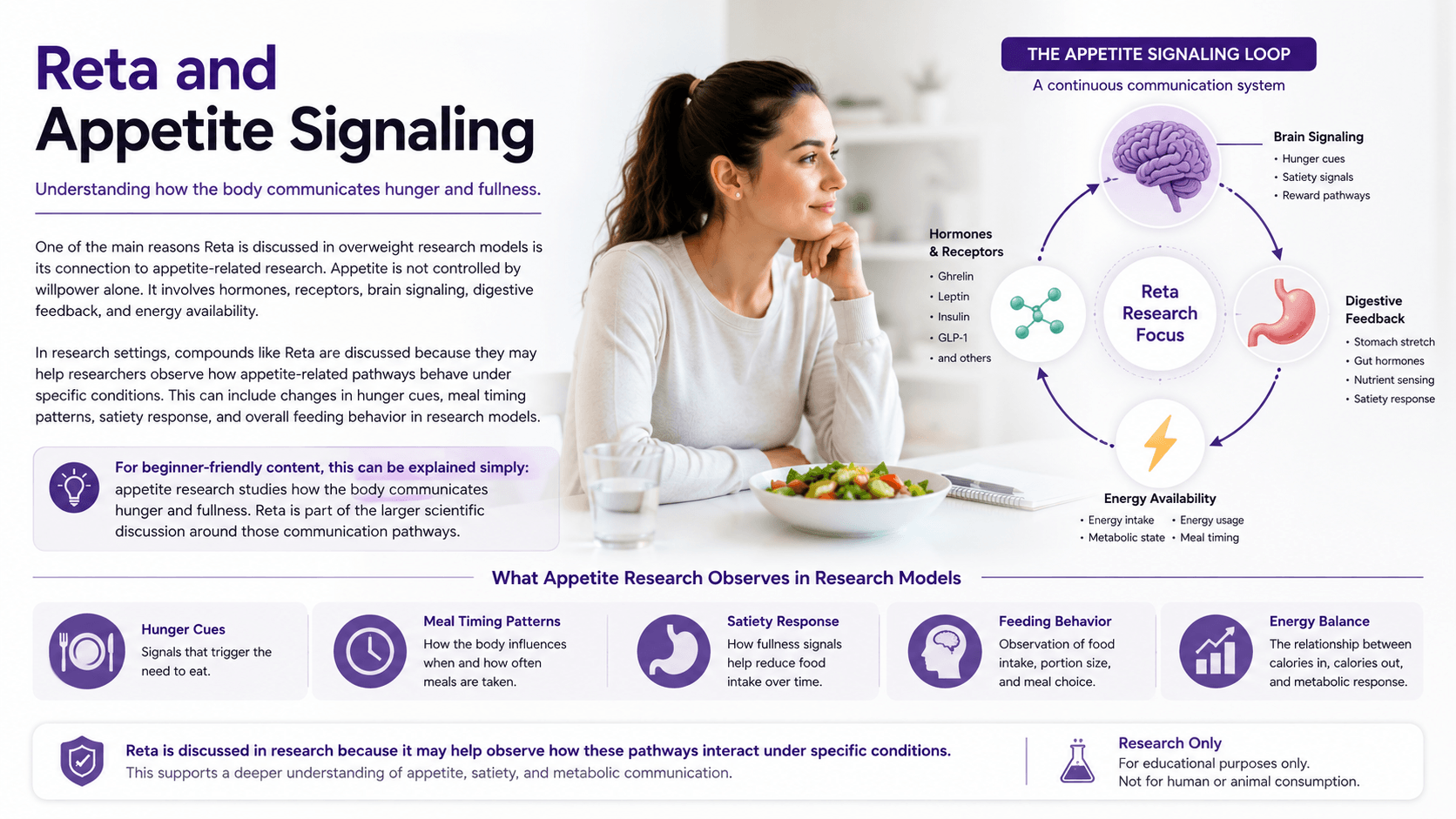
One of the main reasons Reta is discussed in overweight research models is its connection to appetite-related research. Appetite is not controlled by willpower alone. It involves hormones, receptors, brain signaling, digestive feedback, and energy availability.
In research settings, compounds like Reta are discussed because they may help researchers observe how appetite-related pathways behave under specific conditions. This can include changes in hunger cues, meal timing patterns, satiety response, and overall feeding behavior in research models.
For beginner-friendly content, this can be explained simply: appetite research studies how the body communicates hunger and fullness. Reta is part of the larger scientific discussion around those communication pathways.
Reta and Body Composition Research
Body composition research looks beyond total body weight. It focuses on the relationship between fat mass, lean mass, water balance, metabolic activity, and overall physical composition. This is important because two research models may show similar weight changes but very different body composition patterns.
Reta-related discussions often appear in this space because appetite and energy balance can influence body composition over time. In research language, this does not mean making direct claims. It means Reta is studied within broader models that observe metabolic behavior and body composition-related pathways.
Why Structure Matters More Than Guesswork
A common beginner mistake is jumping into random stacks or unclear combinations without understanding the reason behind each compound. In research, structure matters because it creates cleaner observation. When the research design is organized, it becomes easier to understand what is being studied and why.
This is especially important for Reta-related research. Because metabolic signaling is complex, a structured framework helps separate meaningful observation from confusion. The focus should remain on pathway education, controlled research thinking, and responsible presentation.
| Research Focus | Beginner Meaning | Why It Matters |
|---|---|---|
| Appetite Signaling | How hunger and fullness cues are communicated | Helps explain why appetite behavior can change in research models |
| Metabolic Rhythm | How the body manages energy patterns over time | Supports a clearer view of consistency and adaptation |
| Body Composition | How weight-related changes may involve more than scale weight | Encourages deeper research beyond simple weight tracking |
| Structured Protocols | Organized research frameworks instead of random stacking | Creates cleaner, more responsible educational discussion |
What Reta Is Not
To keep the conversation responsible, Reta should not be presented as a miracle solution, a guaranteed weight loss product, or a treatment recommendation. When sold for research use, it should be discussed as a research compound only.
- Not a medical treatment recommendation
- Not a guaranteed fat loss solution
- Not a replacement for clinical advice
- Not intended for human or animal consumption when sold for research use
- Not something that should be marketed with exaggerated health claims
Why Researchers Are Watching Reta
Reta is widely searched because it sits at the intersection of several high-interest research areas: appetite signaling, metabolic pathway studies, overweight research models, body composition research, and energy balance discussions.
For research-focused buyers and educational readers, clarity matters. Clean labeling, transparent positioning, clear product identity, and responsible research language help separate serious peptide education from hype-driven marketing.
Key Takeaways
- Reta is commonly discussed in appetite and metabolic signaling research.
- Overweight research models study more than simple weight change.
- Appetite, satiety, energy balance, and body composition are major research themes.
- Structured research education is stronger than random stacking or hype.
- Reta should be positioned responsibly as a research-use compound only.
The science behind Reta is not about shortcuts. It is about understanding how appetite signals, metabolic pathways, and body composition models are studied in controlled research conversations.
That is the Purple Peptides approach: clean education, premium research presentation, and clear separation between science and exaggeration.

Reta Research Peptide
Explore Purple Peptides Reta for research applications involving Retatrutide, appetite signaling, metabolic pathway studies, overweight research models, energy balance, and body composition research discussions.
Buy NowFor research purposes only. Not for human or animal consumption.