TB-500 & Hair Follicle Research: What the Studies Suggest
A research-focused look at thymosin beta-4, follicular stem cells, cell migration, angiogenesis, tissue regeneration, and what preclinical models may tell us about hair follicle biology.
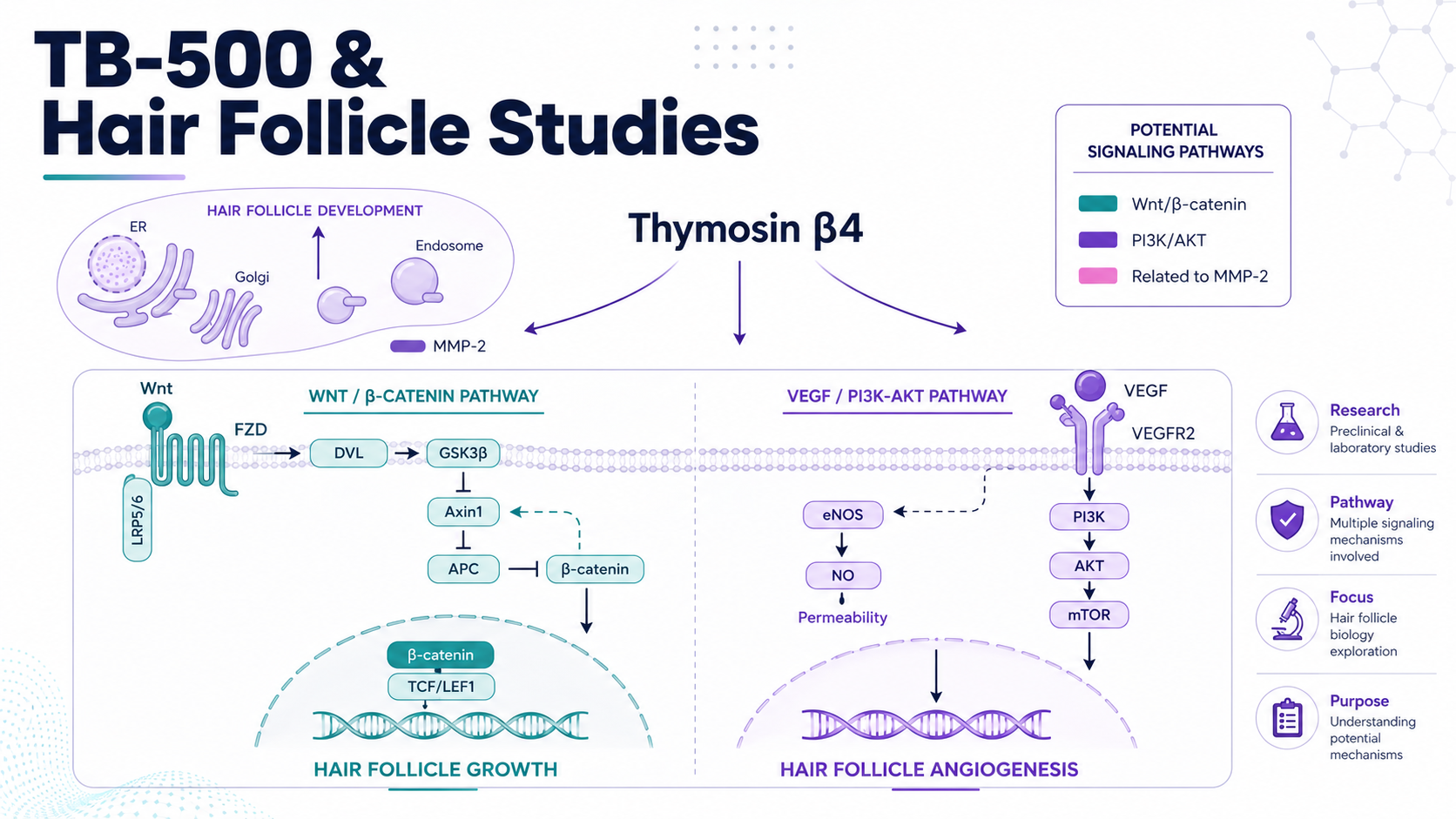
What Is TB-500?
TB-500 is a synthetic peptide based on a portion of thymosin beta-4 (Tβ4), a naturally occurring peptide found across many tissues.
Researchers have investigated thymosin beta-4 and related peptide fragments for their possible involvement in biological processes including cell migration, tissue repair, angiogenesis, and regenerative signaling.
Those mechanisms have generated experimental research across several areas, including dermal repair, cardiovascular biology, wound healing, stem-cell migration, and hair follicle research.
Why Are Researchers Studying TB-500 and Hair Follicles?
Hair follicles are dynamic biological structures that continually move through stages of growth, regression, rest, and regeneration.
Those cycles depend on much more than the hair shaft itself.
Researchers study a network of processes surrounding the follicle, including stem-cell activity, extracellular signaling, vascular support, and tissue remodeling.
Thymosin beta-4 has been investigated in several of these areas. Because TB-500 is related to thymosin beta-4 biology, these findings have contributed to interest in related peptide research involving hair follicle activation and regeneration.
Key Research Observations
Hair Follicle Stem Cell Activity
In mouse and rat research models, thymosin beta-4 has been associated with activity involving follicular keratinocytes and stem-cell populations located around the hair follicle bulge region. Researchers have examined its effects on stem-cell migration, differentiation, and follicular growth.
Angiogenesis and Vascular Support
Thymosin beta-4 is also widely studied in connection with angiogenesis—the biological formation of new blood vessels. Vascular support is relevant to actively growing tissue because surrounding vessels participate in nutrient, oxygen, and signaling exchange within the local biological environment.
Hair Follicles and Tissue Repair
Hair follicle biology overlaps with several pathways examined in dermal wound-repair research. Experimental work involving thymosin beta-4 has explored cell migration, stem/progenitor-cell mobilization, tissue regeneration, and wound healing—mechanisms that may also interact with follicular biology.
The research question is how thymosin beta-4-related biology may interact with the mechanisms controlling follicular regeneration.
What the Hair-Growth Models Found
A notable experimental study reported that thymosin beta-4 stimulated hair growth in animal models and examined its relationship with follicular stem cells.
The researchers investigated follicle stem-cell growth, migration, differentiation, and protease production as possible mechanisms underlying the observed effects.
A later publication further discussed thymosin beta-4-associated hair growth through stem-cell migration and differentiation.
Research Applications
In laboratory and preclinical research, thymosin beta-4 and related peptide biology have been investigated to:
- Investigate signaling involving dermal and follicular stem cells.
- Examine relationships between angiogenesis and hair follicle cycling.
- Explore cellular migration during tissue regeneration.
- Study skin and wound-repair models in which follicular changes may also be observed.
- Better understand biological connections between tissue repair and hair follicle activity.
What Does the Research Currently Tell Us?
The most interesting evidence surrounding TB-500-related hair follicle research comes primarily from research involving thymosin beta-4, rather than from large controlled human trials of TB-500 for hair loss.
Experimental findings suggest that thymosin beta-4 can interact with several biological processes relevant to follicular regeneration, including stem-cell migration, angiogenic signaling, cellular movement, and tissue repair.
That makes the biology interesting.
But interesting biology is not the same thing as an established clinical outcome.
The Responsible Interpretation
Current evidence supports continued investigation of thymosin beta-4-related mechanisms in hair follicle and regenerative biology. Additional research is needed to determine how findings from animal, cellular, and tissue models translate into broader applications.