Retatrutide for 48 Weeks: What the Clinical Trial Actually Did and What the Results Showed
Retatrutide has become one of the most discussed investigational metabolic peptides because of its 48-week Phase 2 clinical trial data. But to understand the excitement responsibly, it is important to look at how the study was actually structured, how dose escalation worked, what outcomes were measured, and what questions still remain unanswered.
Retatrutide Is Still Investigational
Let’s start with honesty. There is no officially approved dosing protocol for Retatrutide. It is still an investigational peptide under development. That means there is no FDA label, no final prescribing insert, no approved long-term safety profile, and no public medical-use protocol for general consumers.
What we do have is high-quality Phase 2 clinical trial data. For anyone serious about understanding Retatrutide, the important question is not “what does social media say?” The better question is: what did the clinical trial actually do, and what did it show by week 48?
Understanding the trial structure is education. Copying it blindly is not.
This article is educational only. It is not medical advice, not a usage guide, not a dosing protocol, and not a recommendation for human use. Retatrutide remains investigational.
How the 48-Week Retatrutide Study Was Structured
The primary 48-week Phase 2 obesity study was published in The New England Journal of Medicine in 2023. The study evaluated different target dose groups and followed participants through a structured escalation and maintenance period. The goal was not only to measure weight reduction, but also to evaluate tolerability, adverse events, and metabolic effects over time.
- Full article: NEJM full text
- PubMed index: PubMed 37366315
The real mechanics of the trial are found in the study design and supplementary materials, where escalation schedules, target doses, and group structure are described. This matters because Retatrutide was not simply given at a full target amount from day one.
At a structural level, the study included:
- Weekly subcutaneous administration in a controlled trial setting.
- Participants randomized to different target dose groups.
- Stepwise escalation over staged intervals.
- Maintenance dosing through the rest of the 48-week study period.
- Ongoing monitoring for body weight change, tolerability, and adverse events.
No Group Started at Full Strength
One of the most important educational points is that no group began at full target strength. The trial used gradual escalation because incretin-based compounds can create dose-dependent gastrointestinal effects. Starting too high too quickly can reduce tolerability and increase discontinuation risk.
This is a common design principle in incretin research. Semaglutide and tirzepatide trials also used escalation strategies to help participants adapt to receptor activation over time. Retatrutide followed the same broad principle: build gradually, monitor tolerability, then remain at the assigned maintenance level.
The trial did not overwhelm the system on day one. It built up over time.
Related references: Semaglutide STEP-1 and Tirzepatide SURMOUNT-1.
What Makes Retatrutide Different?
Retatrutide is often described as a triple agonist because it activates three receptor systems: GLP-1, GIP, and glucagon. That is what separates it from older single-pathway compounds and makes the Retatrutide clinical data so interesting from a metabolic research perspective.
GLP-1 signaling is associated with appetite regulation, gastric emptying, and glucose-related pathways. GIP signaling adds another incretin pathway. The glucagon receptor component may influence energy expenditure and fat oxidation signaling. Together, these mechanisms create a broader metabolic profile than GLP-1 alone.
Mechanism references: GLP-1 receptor biology and glucagon receptor physiology.
The 48-Week Study in Three Conceptual Phases
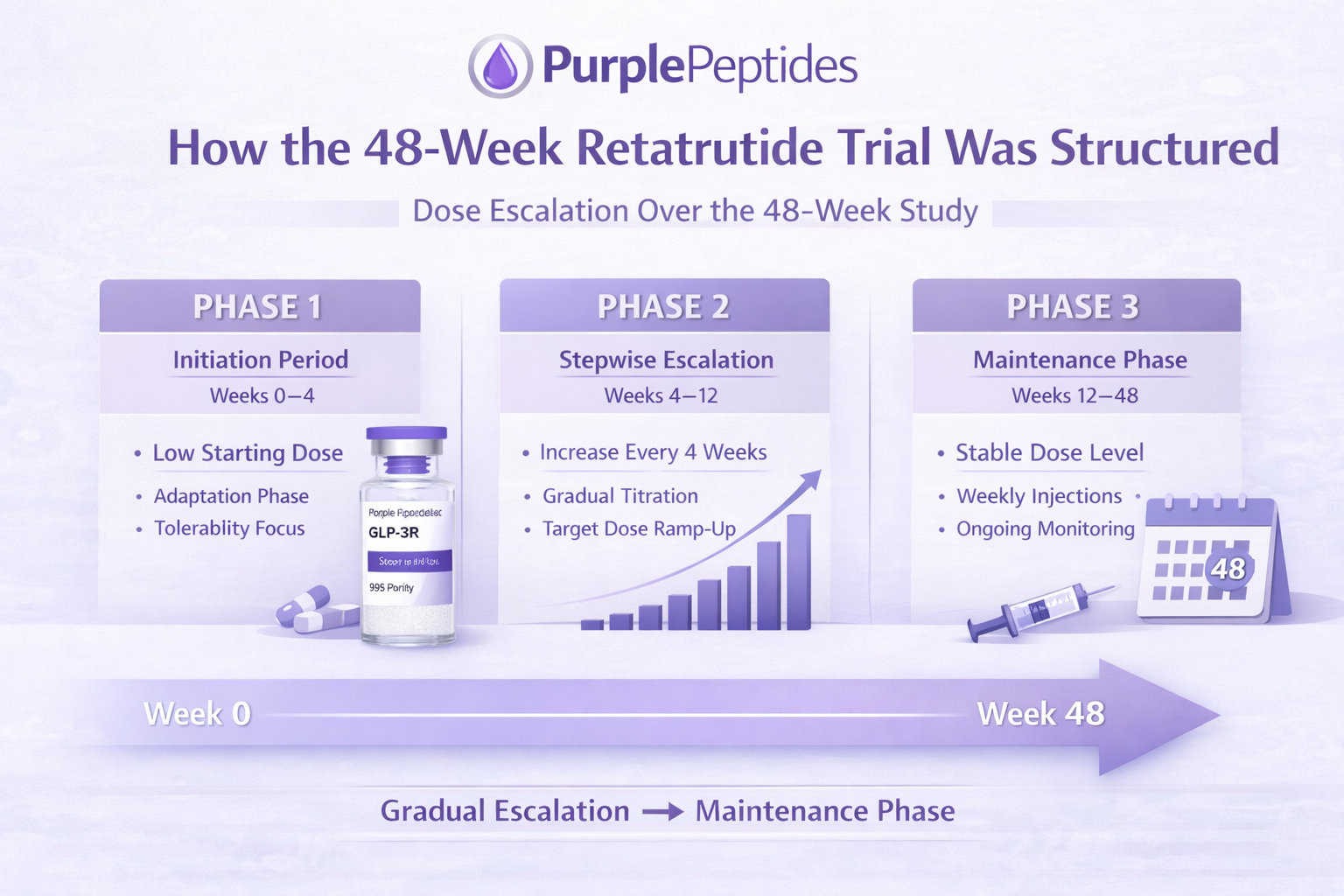
Without turning the clinical trial into a self-use protocol, the study can be understood in three educational phases: initiation, escalation, and maintenance. This framework helps explain why the results took time to develop and why tolerability was central to the design.
| Phase | Trial Purpose | Why It Mattered |
|---|---|---|
| Initiation Period | Participants began at a low introductory level. | This helped the body adapt to incretin receptor activation and reduced early tolerability issues. |
| Stepwise Escalation | Doses were increased over staged intervals toward assigned target groups. | This supported adherence and helped reduce dose-dependent gastrointestinal adverse events. |
| Maintenance Phase | Participants remained at the assigned maintenance level through week 48. | This is where sustained metabolic effects and larger outcome differences became clearer. |
What Happened at 48 Weeks?
At week 48, Retatrutide showed dose-dependent body weight reduction in the Phase 2 trial. The higher target groups produced the largest average changes, which is why the molecule received significant attention in metabolic research and obesity medicine conversations.
Reported average body weight reduction by group:
- 1 mg group: approximately 8–9% average reduction.
- 4 mg group: approximately 17% average reduction.
- 8 mg group: approximately 23% average reduction.
- 12 mg group: approximately 24% average reduction.
For comparison, semaglutide STEP-1 reported about 15% average weight reduction over approximately 68 weeks, while tirzepatide SURMOUNT-1 reported about 20–22% over approximately 72 weeks. Trial designs, populations, durations, and mechanisms differ, so comparisons should be interpreted carefully.
Why the Trial Did Not Start at the Highest Dose
Tolerability matters. In the Retatrutide Phase 2 data, gastrointestinal adverse events were dose-dependent. Higher target groups were associated with more nausea, vomiting, and GI complaints. This is consistent with the broader incretin literature, where gradual escalation is often used to improve tolerability.
GLP-1 receptor activation can slow gastric emptying and affect appetite and nausea pathways. That is one reason escalation is not a minor detail. It is central to study design, adherence, and safety monitoring.
Related reference: GLP-1 gastrointestinal effects.
The key lesson is simple: clinical trial structure matters. Outcomes cannot be separated from escalation, monitoring, and tolerability management.
48 Weeks Is Meaningful, But It Is Not Long-Term Certainty
The 48-week data is important, but it does not answer every question. Long-term metabolic therapy research requires extended follow-up, broader populations, cardiovascular outcomes, discontinuation data, safety monitoring, and analysis of how the body adapts over time.
Questions still being studied include:
- Long-term cardiovascular outcome data.
- Post-discontinuation weight regain or rebound patterns.
- Long-term endocrine adaptation.
- Extended effects of glucagon receptor activation.
- Safety and tolerability across broader real-world populations.
- How Retatrutide compares to other incretin-based compounds in longer trials.
Strong Phase 2 data is exciting. It is not the same as final long-term approval data.
Mechanism First. Data First. Hype Last.
Retatrutide’s 48-week trial matters because it gives researchers a structured view of how triple agonism may influence body weight and metabolic outcomes. But the responsible way to talk about it is to separate trial data from social media claims.
- Escalation was critical to the study design.
- Maintenance exposure helped drive the observed results.
- Higher target groups showed larger average reductions.
- Side effects were dose-dependent.
- Long-term safety and outcome data remain important open questions.
The goal is not to copy a trial. The goal is to understand the research, the mechanism, the limitations, and the difference between clinical evidence and online interpretation.
What to Remember About the 48-Week Retatrutide Trial
- Retatrutide is an investigational triple agonist targeting GLP-1, GIP, and glucagon receptors.
- The Phase 2 trial used gradual escalation rather than starting participants at full target strength.
- Participants remained in a maintenance phase through week 48 after reaching assigned target levels.
- The 8 mg and 12 mg groups showed the largest average body weight reductions.
- Gastrointestinal side effects were dose-dependent and influenced by tolerability.
- 48-week results are meaningful, but long-term safety and outcome data are still needed.
Explore RETA Research Peptide
RETA is featured in metabolic research conversations because of the growing interest around Retatrutide-style triple agonist science, appetite-related signaling, energy expenditure research, and body composition study models.

RETA
A research-focused Retatrutide-style peptide product discussed in relation to triple agonist metabolic science, GLP-1/GIP/glucagon pathway research, body composition models, and metabolic signaling education.
Buy NowEducational content only. This article is not medical advice, diagnosis, treatment guidance, or a usage protocol. Products discussed are for research purposes only and are not intended for human or animal consumption. Always follow applicable laws, regulations, and product labeling requirements.