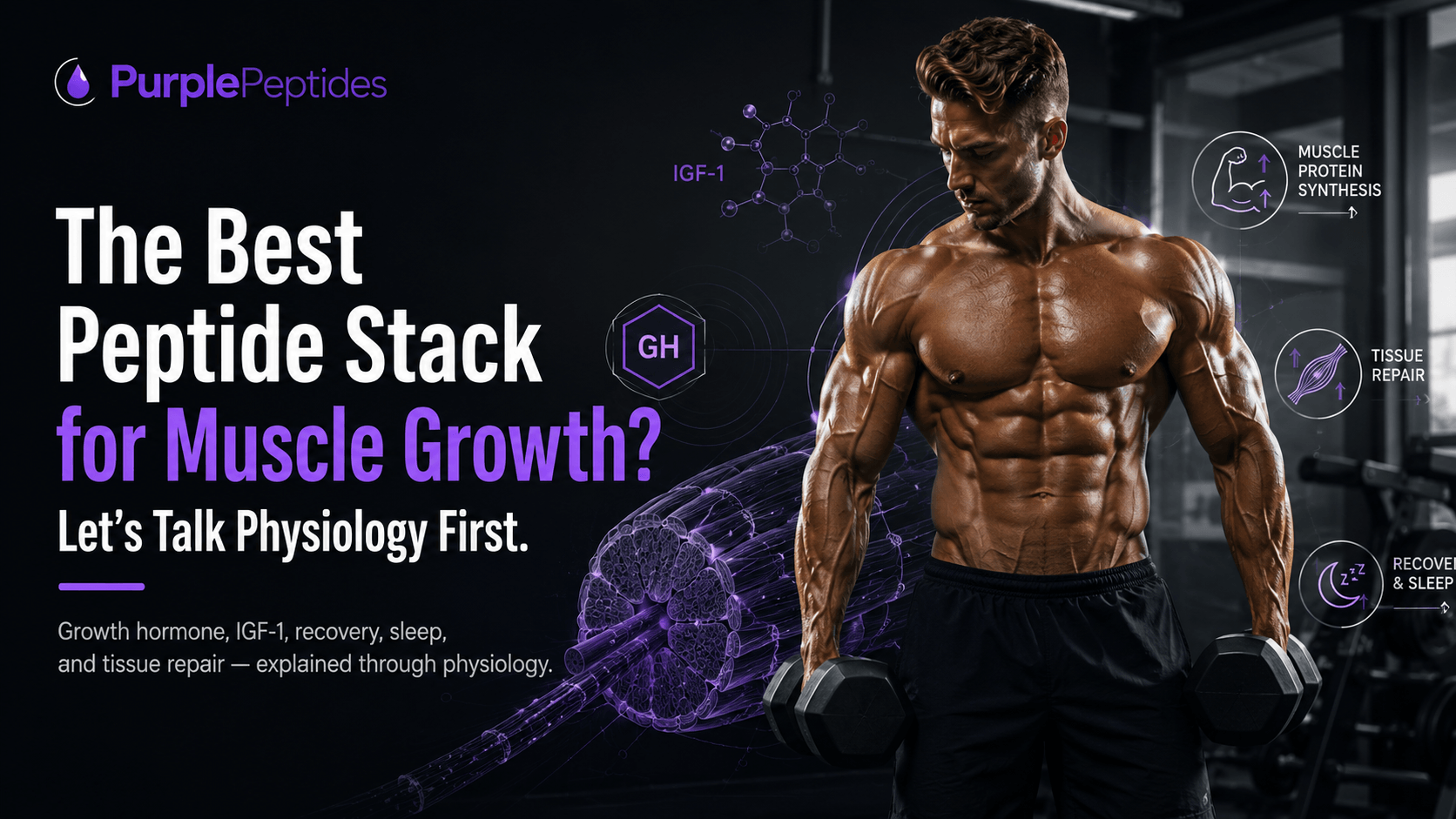
The Best Peptide Stack for Muscle Growth? A Research-Based Look at Recovery, GH Signaling, and Training Adaptation
Searching for the best peptide stack for muscle growth can quickly lead to hype, aggressive claims, and confusing advice. A smarter conversation starts with physiology. Muscle growth is not created by a vial, a trend, or a shortcut. It is created by training stress, progressive overload, adequate nutrition, sleep quality, and recovery capacity. Peptides discussed in research settings may support the biological environment around those factors, but they do not replace the fundamentals.
Muscle Growth Still Depends on the Basics
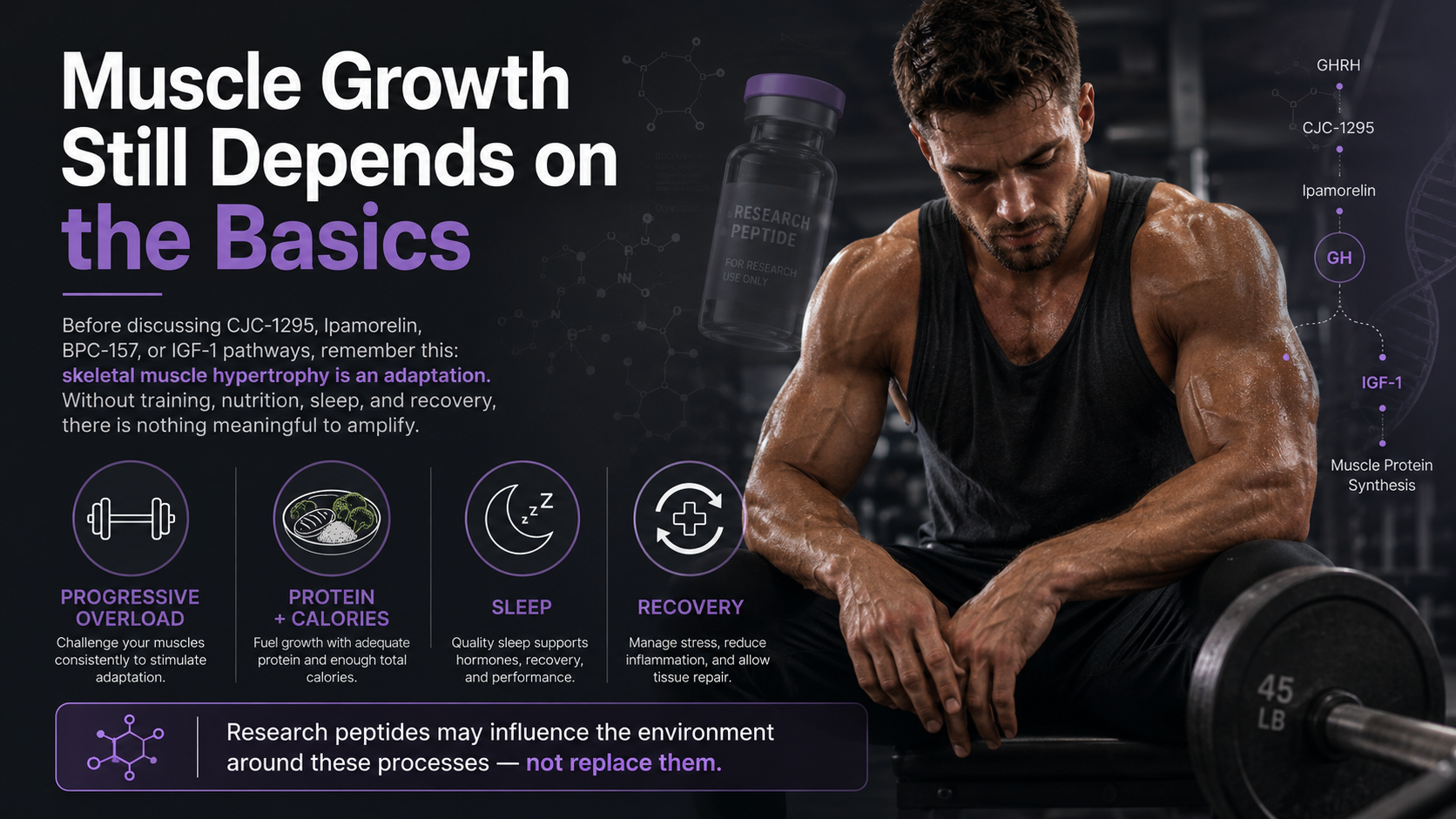
Before discussing CJC-1295, Ipamorelin, BPC-157, IGF-1 pathways, or any muscle-focused peptide stack, the most important point is simple: skeletal muscle hypertrophy is an adaptation. The body adapts when it is challenged repeatedly and then given enough resources to recover. Without that training signal, even an optimized hormonal environment has nothing meaningful to amplify.
In simple terms, the best research stack for muscle growth only makes sense when the base system is already organized. That means consistent resistance training, progressive overload, sufficient protein intake, quality sleep, calorie control, and recovery management. Peptides may be discussed as tools that influence recovery signaling, growth hormone pulsatility, connective tissue repair models, or IGF-1-related pathways, but they are not magic muscle builders.
- Progressive overload creates the muscle-building signal.
- Protein and calories provide the raw materials for tissue remodeling.
- Sleep supports hormone rhythm, nervous system recovery, and adaptation.
- Recovery capacity determines how consistently training can be repeated.
- Research peptides may influence the environment around these processes, not replace them.
What Are Muscle-Focused Peptide Stacks Actually Targeting?
Most muscle growth peptide discussions center around one of three goals: improving growth hormone signaling, supporting IGF-1 activity, or improving recovery so training can remain consistent. These are connected, but they are not the same. A GH-focused stack is usually about hormone pulse signaling. A recovery-focused compound is usually about tissue repair models. An IGF-related compound is more directly tied to anabolic signaling, but also carries a more complex research profile.
Common Research Targets
- Growth hormone pulsatility and pituitary signaling
- IGF-1 production and downstream anabolic pathways
- Recovery between high-intensity training sessions
- Sleep quality and overnight repair rhythm
- Connective tissue resilience in tendon and ligament models
The Smart Stack Principle
A stack should not simply combine popular compounds. It should combine complementary mechanisms. The goal is not “more” stimulation; the goal is cleaner research logic, better pathway separation, and less redundancy.
CJC-1295 + Ipamorelin: The Classic GH Pulse Research Stack
CJC-1295 and Ipamorelin are often discussed together because they approach growth hormone release through different but complementary receptor pathways. This is why the pairing has become one of the most recognized research combinations in muscle recovery, body composition, sleep, and GH pulse discussions.
CJC-1295 is a growth hormone-releasing hormone analog. In research discussion, it is associated with pituitary stimulation and increased growth hormone release. Ipamorelin is a selective ghrelin receptor agonist discussed for its ability to stimulate GH release through the GHS-R1a receptor pathway. Together, they are commonly described as a dual-signal GH research stack.
- CJC-1295 is discussed for GHRH receptor signaling.
- Ipamorelin is discussed for ghrelin receptor pathway activation.
- The combination may support pulsatile GH output in research models.
- GH signaling may support recovery, sleep rhythm, and IGF-1-related research outcomes.
- The stack still depends on training stimulus to make muscle-growth research meaningful.
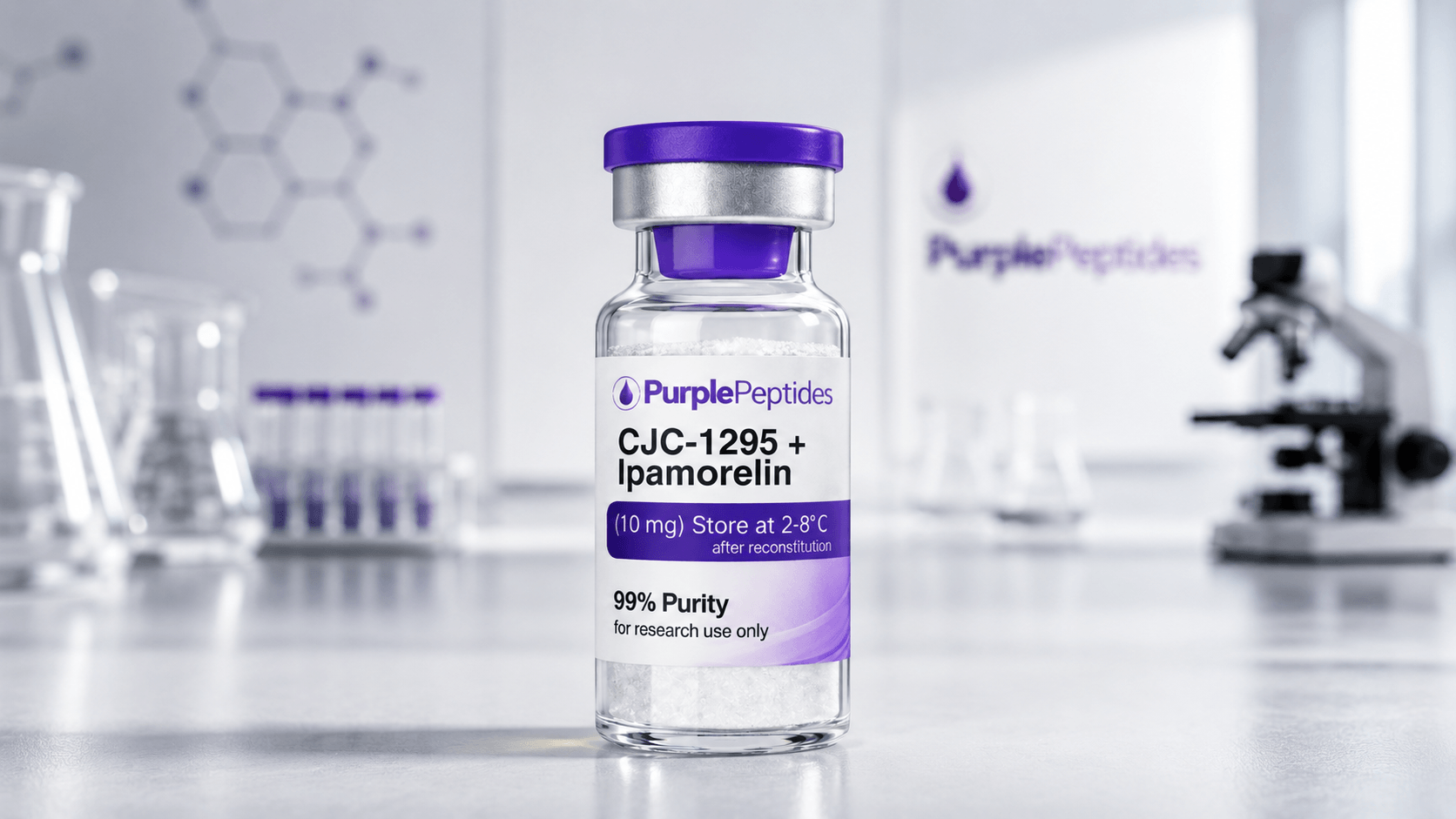
CJC-1295 + Ipamorelin
A classic GH pulse research pairing for studies focused on growth hormone signaling, recovery rhythm, sleep-supportive physiology, and body composition research frameworks.
- Large 16:9 vial image area for premium product display
- Built for GH signaling and recovery-focused blog placement
- Clean white clinical card design with Purple Peptides styling
From a physiology perspective, the logic behind this stack is that GH may influence recovery capacity, connective tissue turnover, sleep architecture, and IGF-1 production. However, increased GH signaling alone does not guarantee muscle hypertrophy. The muscle still requires mechanical tension, progressive overload, and enough recovery time to remodel.
Tesamorelin: Targeted GH Modulation in Research
Tesamorelin is another GHRH analog often discussed in the context of endogenous growth hormone and IGF-1 activity. Its research profile is different from generic muscle-building claims because it is more commonly associated with metabolic and body composition research, especially where visceral fat and GH-related pathways are part of the conversation.
In muscle-focused discussions, Tesamorelin is sometimes mentioned because improving metabolic health, body composition markers, or recovery environment may indirectly support training adaptation. That is very different from saying it directly builds muscle. The stronger research framing is that it may influence the background environment in which training and recovery occur.
- Discussed in relation to endogenous GH release.
- Associated with IGF-1 elevation in research contexts.
- Often connected to body composition and metabolic research.
- Not a replacement for resistance training or recovery planning.
IGF-1 Pathways: Powerful, Complex, and Not Beginner-Level
IGF-1 is one of the most important anabolic signaling molecules discussed in muscle physiology. It is involved in mTOR activation, satellite cell signaling, muscle fiber growth pathways, and tissue remodeling. Because of this, IGF-related compounds often appear in advanced muscle-growth peptide conversations.
However, this is also where research complexity increases. IGF-1 signaling is not limited to skeletal muscle. It can influence cell proliferation, glucose handling, tissue growth, and broader metabolic activity. For that reason, “more anabolic signaling” should never be confused with “better” or “safer” signaling.
BPC-157: Recovery Support, Not Direct Hypertrophy
BPC-157 is often included in muscle stack conversations, but it should not be framed as a direct muscle growth compound. Its research discussion is more closely connected to tissue repair, tendon models, ligament models, angiogenesis, inflammation modulation, and structural recovery. In a muscle-building context, that matters because training consistency depends on the body’s ability to recover from stress.
A researcher may include BPC-157 in a recovery-focused framework when the limiting factor is not motivation or programming, but tissue resilience. If joints, tendons, or connective tissue repeatedly interrupt training blocks, long-term progressive overload becomes harder to maintain. In that sense, BPC-157 is better understood as a recovery-support research compound rather than a hypertrophy driver.
- Studied in preclinical tissue repair and recovery models.
- Discussed in relation to tendon, ligament, and soft tissue pathways.
- Does not directly stimulate GH release.
- Does not directly activate muscle hypertrophy like an anabolic pathway compound.
- May be relevant where recovery consistency is the research focus.
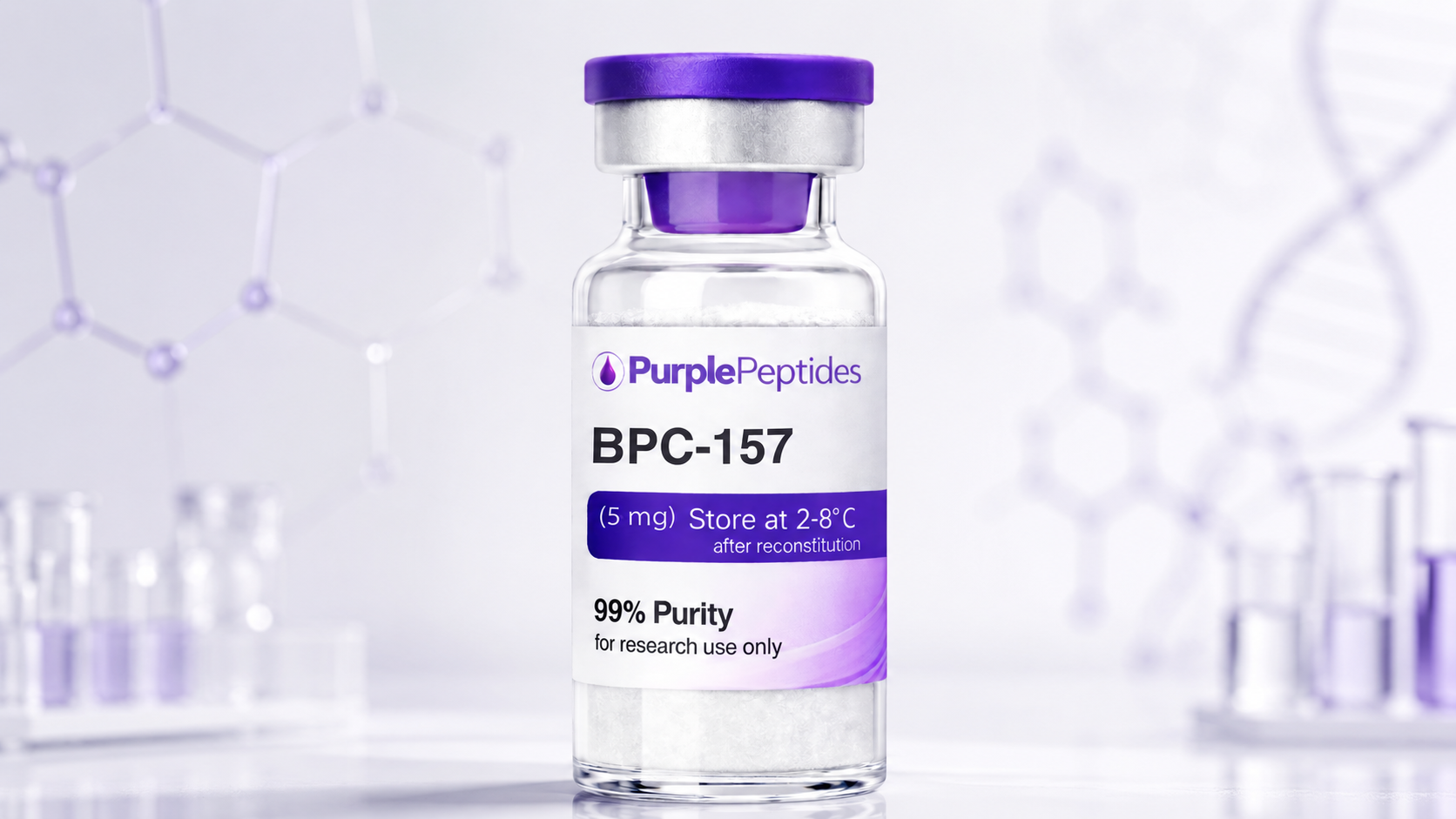
BPC-157
A recovery-focused research peptide commonly discussed in tissue repair models, connective tissue resilience, tendon research, ligament research, and inflammation-modulation studies.
- Big premium vial image area in 16:9 ratio
- Perfect placement inside the recovery section
- Designed to keep the white clinical blog theme attractive
The key point is this: muscle growth requires uninterrupted training cycles. If recovery limitations repeatedly break the cycle, then supporting tissue repair research becomes relevant. BPC-157 belongs in that recovery conversation, not in a direct “muscle-building shortcut” conversation.
What Makes a Peptide Stack Make Sense?
A good research stack has logic. A weak stack simply combines compounds because they are popular. In muscle growth research, the strongest framework is to identify the bottleneck first. Is the goal GH signaling? Is the goal connective tissue recovery? Is the goal body composition? Is the goal sleep and recovery rhythm? Each answer points to a different research pathway.
- CJC-1295 + Ipamorelin makes sense as a GH pulse research pairing.
- BPC-157 makes sense when the research focus is recovery and connective tissue resilience.
- IGF-related pathways belong in more advanced anabolic signaling discussions.
- Multiple GH stimulators stacked together may become redundant rather than intelligent.
- Training, nutrition, and sleep remain the real foundation of muscle adaptation.
The Muscle Growth Equation No One Should Ignore
The best peptide stack for muscle growth is not a universal formula. For most research discussions, the more accurate question is: which biological system is limiting adaptation? If recovery is poor, a recovery-support model may be more relevant. If GH signaling is the research focus, a CJC-1295 and Ipamorelin pairing may be discussed. If connective tissue resilience is the issue, BPC-157 belongs in the recovery conversation.
Still, no research peptide changes the core equation. Muscle growth comes from mechanical tension, repeated training exposure, enough protein, enough calories, and enough sleep. Hormone signaling can support the adaptation process, but the body needs a reason to adapt first.
- Train with progressive overload.
- Eat enough protein to support muscle protein synthesis.
- Sleep enough to support recovery and endocrine rhythm.
- Control fatigue so performance can improve over time.
- Use research compounds as educational tools, not as shortcuts.
Why Safety, Research Context, and Responsible Language Matter
Many peptide compounds discussed for muscle growth, recovery, or body composition are investigational. Long-term safety data may be limited, especially in healthy populations. Because endocrine systems are tightly regulated, changing one pathway can influence many others, including glucose regulation, fluid balance, appetite, sleep, and tissue growth signaling.
Responsible research content should avoid exaggerated claims. It should explain mechanisms, limitations, and unknowns clearly. That is especially important for compounds connected to GH and IGF-1 pathways, where the same signals that support recovery and growth may also have broader systemic effects.
- Glucose regulation and insulin sensitivity concerns may be discussed with GH/IGF-related pathways.
- Water retention, edema, or joint discomfort may appear in research conversations.
- Receptor sensitivity and adaptation may change over time.
- Off-target growth signaling is an important theoretical concern.
- Long-term outcomes remain an important research limitation.
Key Takeaways
- Peptides do not build muscle by themselves. Training creates the adaptation signal.
- CJC-1295 + Ipamorelin is a commonly discussed GH pulse research stack because the compounds act through complementary pathways.
- BPC-157 is better understood as a recovery-support research compound, not a direct hypertrophy compound.
- IGF-1-related pathways are powerful, complex, and should be discussed carefully.
- The smartest peptide stack is based on mechanism, not popularity.
- Recovery, sleep, protein intake, calories, and progressive overload remain the foundation of muscle growth.
- Research-use language matters because many compounds remain investigational.
The best muscle growth strategy begins with physiology. Build the training signal first, support recovery second, and only then explore research tools with a clear understanding of what each pathway is supposed to do. That is the Purple Peptides approach: research with structure, not guesswork.