The Longevity 30
What Is The LONGEVITY Protocol™?
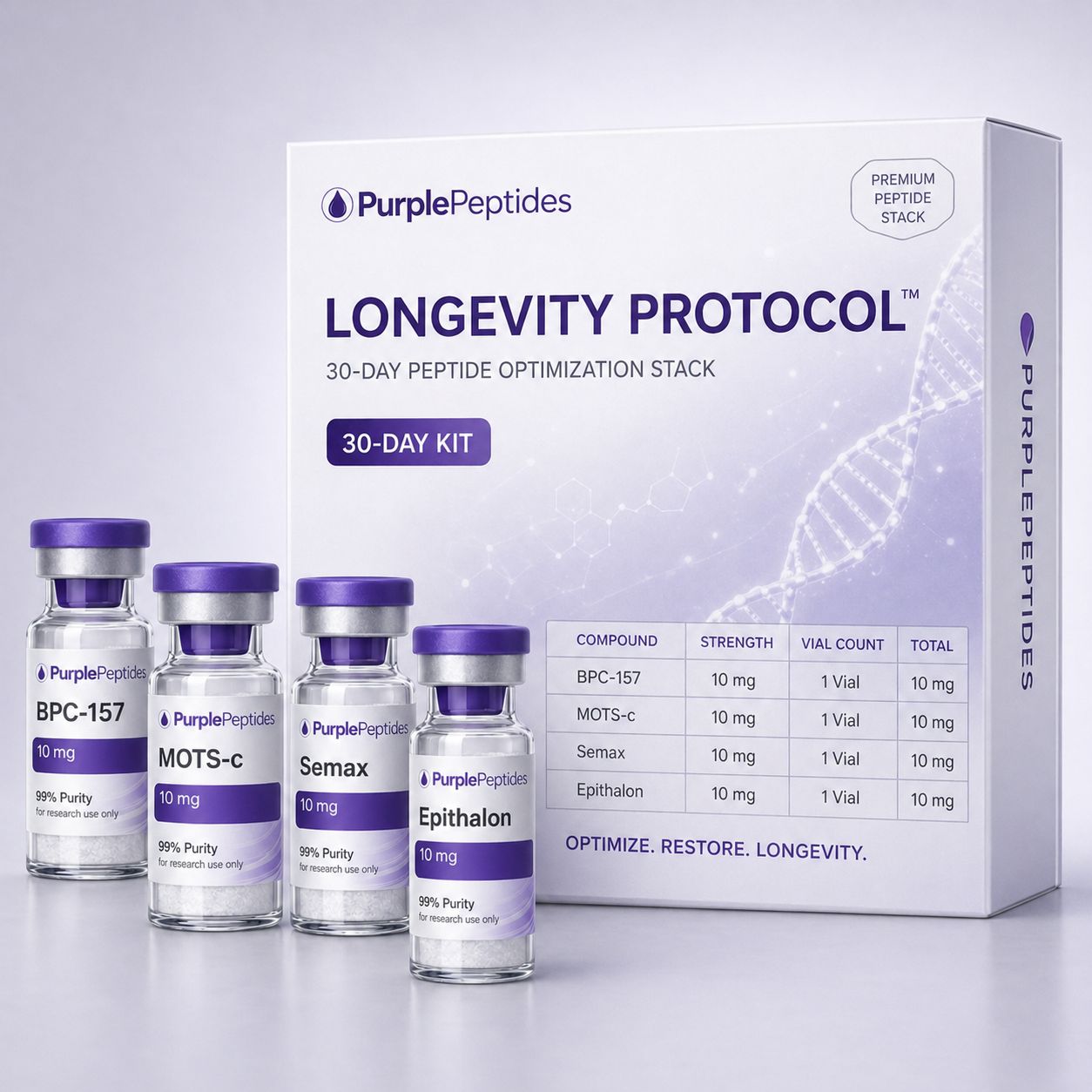
The LONGEVITY Protocol™ is a 30-day structured research framework designed to examine aging-related biological signaling across cellular, mitochondrial, neurological, and repair-focused pathways.
This protocol combines BPC-157, MOTS-c, Semax, and Epithalon — four research compounds studied across complementary areas of longevity biology, cellular resilience, metabolic communication, neuro-support signaling, and repair-related pathway research.
Rather than focusing on one isolated aging-related pathway, The LONGEVITY Protocol™ uses a systems-based research approach. It is designed to help researchers observe how cellular aging models, mitochondrial function, cognitive signaling, and tissue-response pathways may interact within a structured 30-day research window.
The goal is not aggressive stimulation. The goal is structured observation across multiple biological systems connected to energy, clarity, repair signaling, cellular aging, and adaptive resilience.
Certificate of Analysis
Third-party testing documentation available for purity and analytical verification.
The LONGEVITY Protocol™ Research Overview
The LONGEVITY Protocol™ was designed as a coordinated 30-day longevity-focused research cycle.
It brings together four major research domains:
- Cellular Aging & Telomere-Related Signaling: Epithalon is studied for its relationship with telomere biology, cellular aging models, circadian rhythm pathways, and pineal-related neuroendocrine signaling.
- Mitochondrial Function & Metabolic Communication: MOTS-c is studied as a mitochondrial-derived peptide involved in metabolic signaling, AMPK-related pathways, glucose metabolism, and cellular stress-response models.
- Cognitive Signaling & Neuro-Support Research: Semax is studied as an ACTH-derived peptide analog associated with neurotrophic signaling, BDNF-related research, oxidative-stress response, and CNS resilience models.
- Repair & Systemic Resilience Research: BPC-157 is studied in preclinical models for its relationship with tissue-integrity signaling, angiogenesis, collagen regulation, nitric-oxide pathways, and inflammatory-response models.
Together, these compounds create a broad research framework for examining how aging-related systems may communicate across cellular, metabolic, neurological, and repair-focused domains.
What Makes The LONGEVITY Protocol™ Different?
The LONGEVITY Protocol™ is built for coordinated longevity signaling research, not single-pathway observation.
- It is designed as a clean 30-day research cycle.
- It focuses on multiple aging-related biological systems.
- It integrates cellular, mitochondrial, neurological, and repair domains.
- It supports structured observation and research consistency.
- It is built around systems biology rather than isolated compound use.
- It is positioned for research and educational use only.
What You Receive in The LONGEVITY Protocol™ 30-Day Kit
Each kit is assembled to align with a complete 30-day coordinated longevity research cycle.
Research Domains Addressed
Cellular Aging & Telomere Signaling
Epithalon is a synthetic tetrapeptide studied for its interaction with cellular aging models, telomerase activity, telomere-related signaling, circadian rhythm biology, and neuroendocrine regulation.
Within The LONGEVITY Protocol™, Epithalon represents the cellular-aging and biological-rhythm research component.
Mitochondrial Function & Metabolic Signaling
MOTS-c is a mitochondrial-derived peptide encoded within mitochondrial DNA. It is studied for its relationship with mitochondrial communication, AMPK-related signaling, glucose metabolism, energy sensing, and adaptive stress-response pathways.
Within The LONGEVITY Protocol™, MOTS-c represents the mitochondrial and metabolic communication component.
Cognitive Function & Neuro-Support Signaling
Semax is a synthetic ACTH 4–10 analog studied for its relationship with BDNF expression, neurotrophic signaling, oxidative-stress response, cognitive-process models, and neurological resilience pathways.
Within The LONGEVITY Protocol™, Semax represents the cognitive and CNS-support research component.
Repair & Systemic Resilience
BPC-157 is a synthetic pentadecapeptide studied in preclinical research for its relationship with tissue-integrity signaling, collagen organization, fibroblast activity, angiogenesis, nitric-oxide pathway interaction, and inflammatory-response models.
Within The LONGEVITY Protocol™, BPC-157 represents the repair-signaling and resilience research component.
Why a 30-Day Protocol?
Longevity research is not built around one pathway alone. Aging-related biology involves the interaction of multiple systems, including mitochondrial function, genomic maintenance, neuro-signaling, cellular stress response, circadian rhythm, and tissue repair.
The 30-day structure gives researchers a clean introductory window to observe how these systems may interact in a coordinated research framework.
The LONGEVITY Protocol™ was designed for simplicity, consistency, and multi-pathway observation without unnecessary protocol complexity.
Research-Based Ingredient Overview
BPC-157
BPC-157 is studied in preclinical models for repair-related signaling, tissue integrity, collagen regulation, angiogenic activity, nitric-oxide pathway interaction, inflammatory-response modulation, and systemic resilience research.
MOTS-c
MOTS-c is studied for mitochondrial-derived peptide signaling, metabolic regulation, AMPK activation, glucose utilization, skeletal-muscle metabolic adaptation, mitochondrial-to-nuclear communication, and cellular stress-response models.
Semax
Semax is studied for neurotrophic signaling, BDNF-associated pathways, cognitive-process research, neuroprotection models, oxidative-stress response, and central nervous system resilience.
Epithalon
Epithalon is studied for telomerase activity, telomere-related signaling, cellular aging models, circadian rhythm regulation, pineal-related signaling, and neuroendocrine communication.
Why These Peptides Are Studied Together
The LONGEVITY Protocol™ combines four different research angles into one structured framework:
- BPC-157: Repair signaling and systemic resilience
- MOTS-c: Mitochondrial and metabolic communication
- Semax: Cognitive and neurological signaling
- Epithalon: Cellular aging and telomere-related pathways
Together, these compounds create a coordinated longevity-focused research model for studying aging-related systems across energy, cognition, repair, cellular regulation, and biological resilience.
How The LONGEVITY Protocol™ Works
The LONGEVITY Protocol™ is built for coordinated longevity signaling research.
- Cellular Signaling: Epithalon is included for its research connection to cellular aging models, telomere-related signaling, and circadian rhythm pathways.
- Metabolic Communication: MOTS-c is included for its research connection to mitochondrial function, cellular energy regulation, AMPK-related signaling, and metabolic pathway communication.
- Cognitive Support Research: Semax is included for its research connection to neuro-support pathways, BDNF-related signaling, oxidative-stress response, and neurological resilience models.
- Repair & Resilience Research: BPC-157 is included for its research connection to repair signaling, tissue integrity, angiogenic pathways, inflammatory-response balance, and systemic resilience models.
Research Applications
The LONGEVITY Protocol™ may be useful in controlled research models focused on:
- Longevity-related biological signaling
- Cellular aging and telomere pathway research
- Mitochondrial communication models
- Metabolic-response observation
- Cognitive and neurological signaling research
- Repair and resilience pathway studies
- Circadian and neuroendocrine pathway research
- Structured 30-day multi-compound observation
- Systems-based aging biology research
What Researchers May Document
In controlled research environments, researchers may document broad patterns related to:
- Energy-related observations
- Cognitive-signaling research notes
- Recovery-related markers
- Sleep and rhythm-related observations
- Metabolic-response trends
- Stress-response pathway observations
- Repair and tissue-response models
- Protocol consistency
- Cellular aging and resilience-related research markers
The goal of The LONGEVITY Protocol™ is not to promise outcomes. The goal is to provide a structured framework for observing multiple longevity-related signaling domains.
What The LONGEVITY Protocol™ Is — and Is Not
- Research-based
- Structured
- Designed as a 30-day longevity signaling cycle
- A coordinated systems-based research framework
- Focused on cellular, mitochondrial, neurological, and repair-related pathways
- A quick-fix guarantee
- A medical therapy
- A treatment protocol
- A diagnostic tool
- A human-use protocol
- A guaranteed outcome
The Purple Standard™
Every vial included in The LONGEVITY Protocol™ is handled according to the Purple Standard™. This includes third-party testing, purity verification, controlled storage conditions, batch tracking, and internal rejection of any lot that does not meet required quality thresholds.
The Purple Standard™ exists to support consistency, documentation, and research confidence across every Purple Protocol™.
Frequently Asked Questions
Is The LONGEVITY Protocol™ approved for human use?
No. The LONGEVITY Protocol™ is supplied strictly for laboratory research and educational purposes only. It is not approved for human consumption.
Is this a medical treatment protocol?
No. The LONGEVITY Protocol™ is a research framework designed to examine cellular aging, mitochondrial function, cognitive signaling, and repair-related pathways. It is not a medical therapy.
Why is this structured as a 30-day protocol?
The 30-day structure creates a clean introductory research cycle for examining coordinated longevity-related signaling across multiple biological domains.
Why are these four compounds included together?
Each compound represents a different research domain. Epithalon relates to cellular aging models, MOTS-c relates to mitochondrial signaling, Semax relates to neurological signaling, and BPC-157 relates to repair and tissue-response models.
Investigational Research Context
The LONGEVITY Protocol™ should be considered an investigational research protocol. Available scientific literature primarily examines the included compounds individually or in related research contexts. Findings should not be interpreted as approved therapeutic, clinical, cosmetic, veterinary, or human-use outcomes for this protocol.
This product is supplied for laboratory research only and is not intended for human consumption, clinical use, veterinary use, diagnostic use, or self-experimentation.
Scientific References
View References
BPC-157 Research
- Huang T. et al. (2015) — Body protective compound-157 enhances alkali-burn wound healing in vivo and promotes proliferation, migration, and angiogenesis in vitro.
- Seiwerth S. et al. (2021) — Stable gastric pentadecapeptide BPC 157 and wound healing.
- McGuire F.P. et al. (2025) — Regeneration or Risk? A narrative review of BPC-157 for musculoskeletal and neuromuscular healing.
MOTS-c Research
- Lee C. et al. (2015) — The mitochondrial-derived peptide MOTS-c promotes metabolic homeostasis and reduces obesity and insulin resistance.
- Kim K.H. et al. (2018) — The mitochondrial-encoded peptide MOTS-c translocates to the nucleus to regulate nuclear gene expression in response to metabolic stress.
- Wan W. et al. (2023) — Mitochondria-derived peptide MOTS-c: effects and mechanisms related to stress, metabolism, and aging.
Semax Research
- Dolotov O.V. et al. (2006) — Semax, an analogue of adrenocorticotropin 4–10, affects BDNF-related signaling in rat basal forebrain.
- Medvedeva E.V. et al. (2014) — Semax affects expression of genes related to immune and vascular systems in rat brain ischemia models.
- Glazova N.Y. et al. (2021) — Semax, a synthetic ACTH 4–10 analog, demonstrates neuroprotective activity in preclinical CNS models.
Epithalon Research
- Khavinson V.K. et al. (2003) — Epithalon peptide induces telomerase activity and telomere elongation in human somatic cells.
- Araj S.K. et al. (2025) — Overview of Epitalon: highly bioactive pineal tetrapeptide with promising properties.
- Al-Dulaimi S. et al. (2025) — Epitalon increases telomere length in human cell lines through telomerase upregulation or alternative lengthening pathways.
Need Help?