The Longevity 90
What is The LONGEVITY Protocol™ 90-Day?
The LONGEVITY Protocol™ is a 90-day, research-informed biological signaling framework designed to examine how cellular aging, mitochondrial function, cognitive signaling, and repair pathways interact over extended timeframes.
Rather than focusing on isolated mechanisms, The LONGEVITY Protocol™ integrates complementary research peptides studied across metabolic, neurological, cellular, and recovery-related domains. This systems-based approach reflects emerging research suggesting that long-term biological performance is influenced by coordinated signaling across multiple systems.
The LONGEVITY Protocol™ is intended for research and educational use only and is not designed to diagnose, treat, cure, or prevent any disease.
Certificate of Analysis
Third-party testing documentation available for purity and analytical verification.
Protocol Overview
The LONGEVITY Protocol™ was designed as a coordinated 90-day longevity cycle examining how cellular regulation, mitochondrial signaling, cognitive support, and repair pathways interact across extended biological phases.
- Cellular aging and telomere-related signaling
- Mitochondrial function and metabolic communication
- Cognitive signaling and neuro-support pathways
- Repair, resilience, and inflammatory pathway balance
Short Overview
The LONGEVITY Protocol™ is a research-informed, 90-day peptide protocol designed to support the study of aging-related biological systems including energy production, cellular signaling, cognitive function, and systemic repair pathways.
This extended structure allows for deeper observation of multi-system interaction across metabolic, neurological, and cellular domains.
For research and educational purposes only. Not intended for human consumption.
What Makes The LONGEVITY Protocol™ Different
- Designed as a full 90-day longevity cycle
- Targets multiple aging-related systems simultaneously
- Supports extended biological observation and signaling patterns
- Structured, clean, and scalable system design
- Research-driven, systems-based formulation
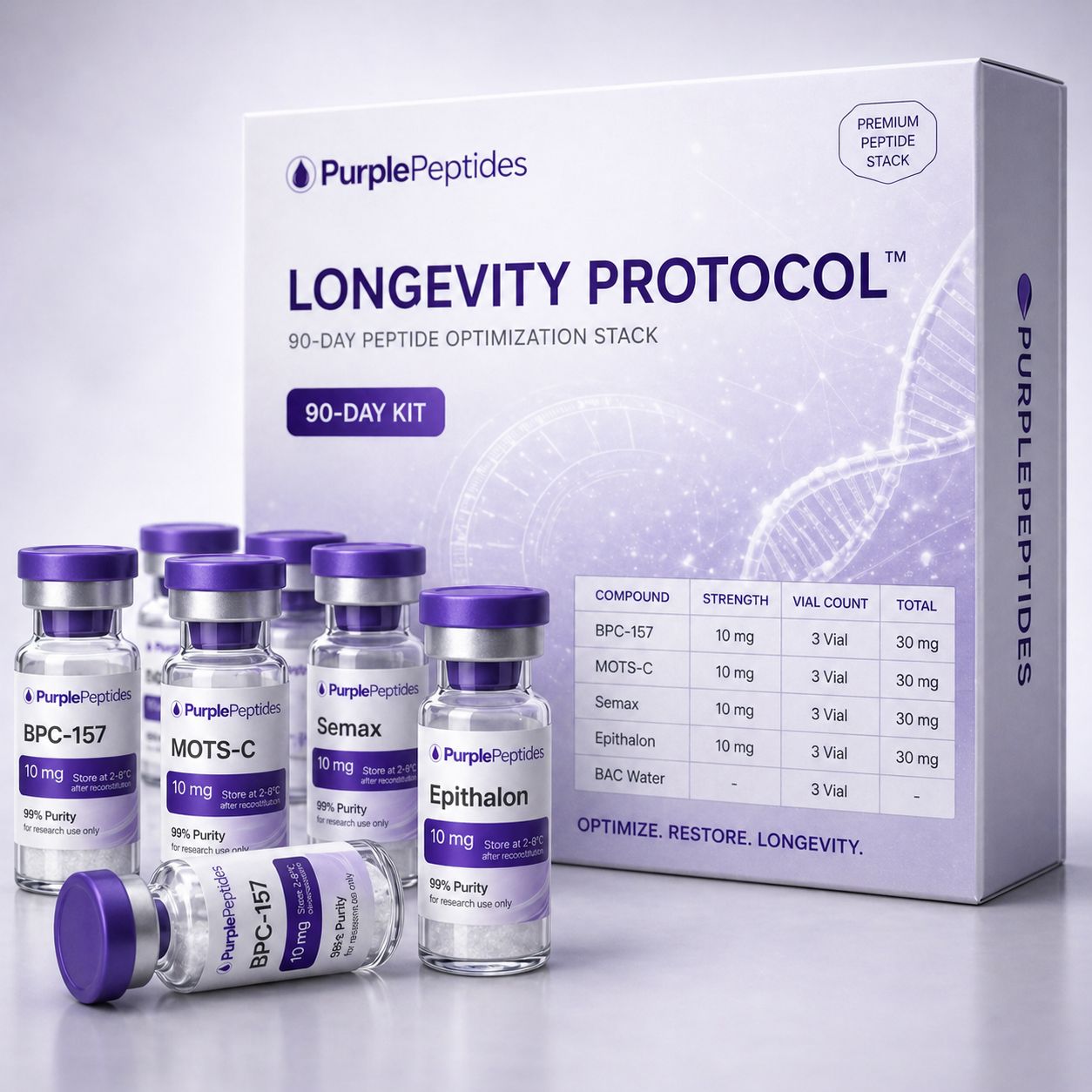
What You Receive in The LONGEVITY Protocol™ 90-Day Kit
Kit Contents Per 90-Day Protocol
Total Provided: 30 mg
Total Provided: 30 mg
Total Provided: 30 mg
Total Provided: 30 mg
Each kit is assembled to align with a complete 90-day coordinated longevity signaling cycle, structured across multiple biological phases.
Research Domains Addressed
Cellular Aging & Telomere Signaling
Epithalon has been studied for its interaction with cellular aging models, telomere-related signaling, and circadian rhythm pathways.
Mitochondrial Function & Metabolic Signaling
MOTS-C is a mitochondrial-derived peptide studied for its role in metabolic communication, AMPK-related pathways, and energy regulation.
Cognitive Function & Neuro-Support
Semax has been studied for its relationship with neurological signaling, cognitive performance research, and neuroprotective pathway models.
Repair & Systemic Resilience
BPC-157 has been studied in preclinical models for its involvement in tissue signaling, repair pathways, angiogenic signaling, and inflammatory modulation.
Why a 90-Day Protocol
Longevity-related biological signaling occurs over extended timeframes. The 90-day structure allows for a more complete observation of multi-phase adaptation across interconnected systems.
This reflects a longer-term research framework compared to short-cycle protocols, supporting deeper analysis of biological coordination.
Why These Peptides Are Studied Together
- BPC-157: Repair signaling and systemic resilience
- MOTS-C: Mitochondrial and metabolic communication
- Semax: Cognitive and neurological signaling
- Epithalon: Cellular aging and telomere-related pathways
Together, these peptides form a coordinated longevity-focused research framework aligned with systems biology models examining aging, energy, cognition, and recovery signaling.
How The LONGEVITY Protocol™ Works
- Cellular Signaling: Epithalon supports research into cellular aging pathways and circadian rhythm regulation.
- Metabolic Communication: MOTS-C supports mitochondrial signaling and energy regulation research models.
- Cognitive Support: Semax supports neurological signaling and cognitive pathway research.
- Repair & Resilience: BPC-157 supports tissue signaling, repair pathways, and systemic resilience research.
What The LONGEVITY Protocol™ Is — and Is Not
- Research-based
- Structured
- A 90-day longevity signaling framework
- Designed for multi-system support
- A quick-fix solution
- A medical treatment
- A guaranteed outcome
- A short-term protocol
Important Notice
The LONGEVITY Protocol™ is intended for research and educational use only. These products are not approved for human consumption and are not intended to diagnose, treat, cure, or prevent any disease.
Need Help?