What Is GHK-Cu?
A clean, beginner-friendly research guide to GHK-Cu, copper peptide science, skin structure research, tissue repair pathways, oxidative stress, and regenerative signaling models.
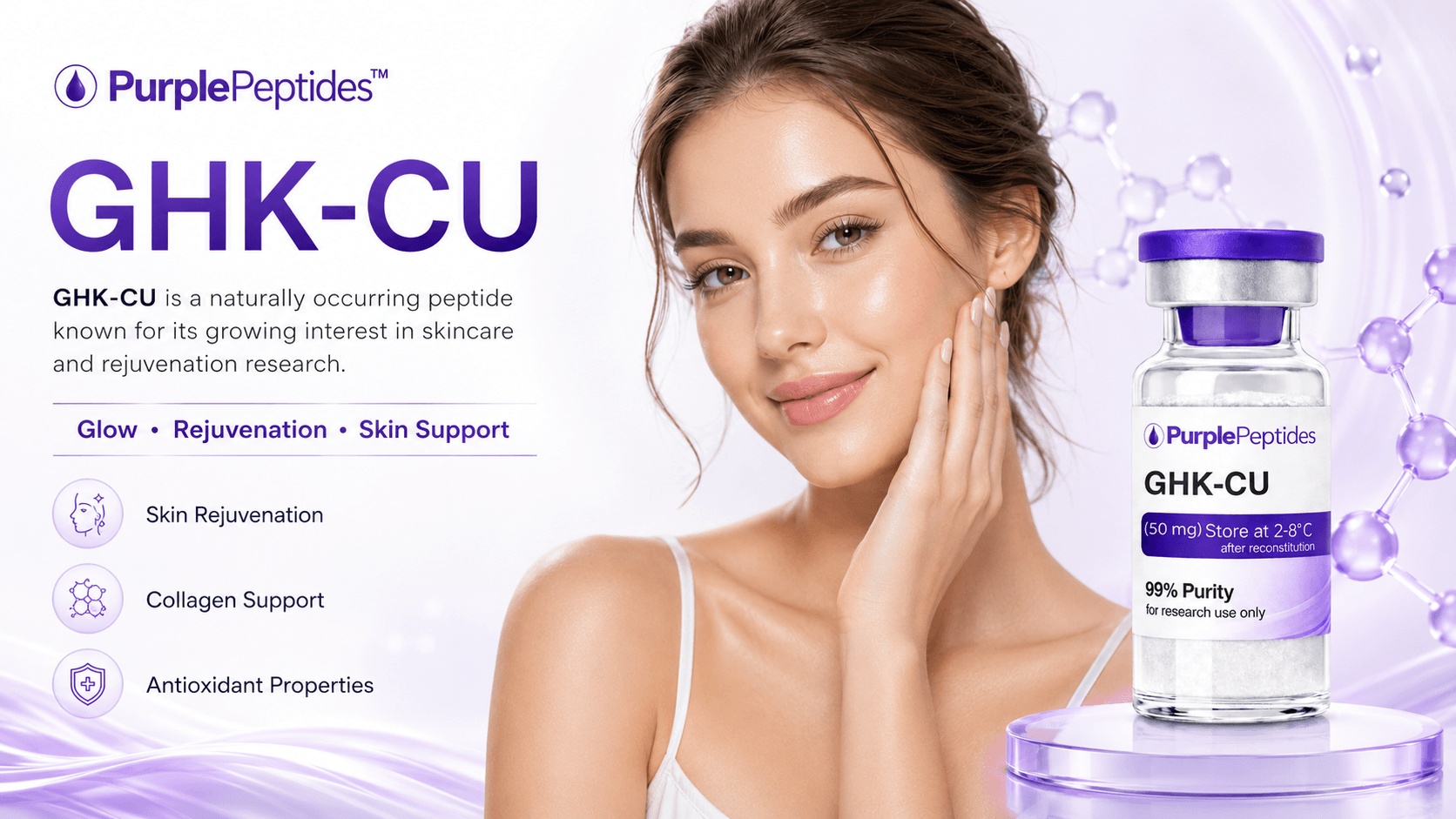
What Is GHK-Cu?
GHK-Cu stands for glycyl-L-histidyl-L-lysine copper. It is a naturally occurring copper peptide complex that has been found in human plasma, saliva, and urine.
In research, GHK-Cu is widely studied because of its connection to skin quality, tissue repair pathways, collagen support, oxidative stress, inflammation-related signaling, and cellular regeneration models.
At Purple Peptides™, we focus on clear and responsible peptide education. GHK-Cu is one of the most talked-about compounds in cosmetic, dermatology, and recovery-related research because it appears to interact with several important biological pathways.
What Is GHK-Cu Known For?
GHK-Cu is often studied as a copper-binding peptide. This means the peptide structure attaches to copper and may help influence biological systems where copper plays an important role.
Copper is involved in enzyme function, tissue structure, and cellular protection. Because of this, researchers are interested in how GHK-Cu may support signaling pathways connected to repair and regeneration.
1. Skin Structure and Appearance Research
GHK-Cu is commonly studied in skin-related research because of its potential connection to collagen, elastin, and glycosaminoglycans.
- Collagen helps support firmness in skin structure research.
- Elastin supports flexibility and tissue movement models.
- Glycosaminoglycans help maintain hydration and tissue structure.
- Researchers explore GHK-Cu in models related to texture, firmness, elasticity, and visible aging.
2. Tissue Support and Repair Pathways
GHK-Cu has also been studied in models related to tissue repair and remodeling. Repair is a complex process that involves cell signaling, matrix rebuilding, immune response, and oxidative balance.
Researchers are interested in GHK-Cu because it may interact with several pathways involved in tissue response and regeneration.
- Tissue remodeling research
- Wound-response models
- Collagen production studies
- Blood vessel formation research
- Extracellular matrix support
3. Oxidative Stress and Inflammation Research
Another major area of interest is oxidative stress. Oxidative stress occurs when there is an imbalance between free radicals and protective antioxidant systems.
In research models, oxidative stress is often linked to aging, tissue damage, and cellular stress. GHK-Cu has been studied for its potential antioxidant and anti-inflammatory activity.
Researchers are interested in how it may influence gene expression, cellular protection, and tissue recovery signaling.
4. Hair and Scalp Research
GHK-Cu is also discussed in hair and scalp research. Some studies have explored its relationship with hair follicle activity, scalp quality, and tissue support around the follicle environment.
This does not mean GHK-Cu should be viewed as a guaranteed hair-growth solution. It simply remains a topic of interest in cosmetic and dermatology-related research models.
5. Nervous System and Regeneration Models
GHK-Cu has also been examined in research connected to nerve growth, brain repair models, and cellular regeneration.
This area is still developing, but researchers are interested in how GHK-Cu may influence signaling pathways involved in repair, protection, and cellular communication.
Why Researchers Study GHK-Cu
GHK-Cu is popular because it has multiple research angles. It is not only discussed for skin. It is also studied for repair signaling, oxidative stress, inflammation, tissue structure, and regeneration.
- Skin rejuvenation research
- Collagen and elastin support
- Tissue remodeling pathways
- Oxidative stress response
- Inflammation-related signaling
- Hair and scalp research
- Cellular repair models
How GHK-Cu Works in Research Models
GHK-Cu is believed to work by influencing cellular communication and supporting copper-related biological activity. In simple terms, researchers study how this peptide may help cells send repair-related signals more effectively.
Some research suggests GHK-Cu may influence gene expression, collagen synthesis, antioxidant pathways, inflammatory response, matrix remodeling, and cellular protection.
The important point is that GHK-Cu is not studied as a single-action compound. It is studied because it may affect multiple systems involved in tissue health and repair.
GHK-Cu and Copper Biology
Copper is an essential trace element involved in many biological processes. It supports enzymes that play roles in connective tissue formation, antioxidant defense, and cellular energy systems.
When copper is attached to the GHK peptide, researchers believe it may become more biologically useful in certain experimental models. This copper-binding feature is what makes GHK-Cu different from many other peptides.
| Research Focus | Beginner Meaning | Why It Matters |
|---|---|---|
| Skin Structure | Collagen, elastin, firmness, texture, and skin quality research | Helps explain why GHK-Cu is widely discussed in cosmetic research |
| Tissue Repair | Repair signaling, wound-response models, and remodeling pathways | Supports broader research beyond surface-level skin discussions |
| Oxidative Stress | Cellular stress, antioxidant balance, and protection models | Connects GHK-Cu to aging and cellular resilience research |
| Copper Biology | Peptide signaling combined with copper-related biological activity | Gives GHK-Cu a unique position among research peptides |
GHK-Cu in Cosmetic Research
GHK-Cu is especially well known in cosmetic research because of its connection to skin appearance and aging-related models.
- Skin smoothness research
- Firmness and elasticity models
- Texture and tone research
- Fine-line appearance models
- Skin barrier support
- Repair signaling studies
This is why GHK-Cu is often included in discussions around skin rejuvenation and anti-aging research. However, it should always be understood as a research compound, not a medical treatment or guaranteed cosmetic product.
What Makes GHK-Cu Different?
GHK-Cu stands out because it has a broad research profile. Many peptides are studied for one narrow function. GHK-Cu is different because it is connected to several biological areas at once.
- It is naturally occurring.
- It binds copper.
- It is studied for skin and tissue support.
- It has antioxidant research interest.
- It may influence repair-related genes.
- It has cosmetic and regenerative research relevance.
Key Takeaways
- GHK-Cu is a naturally occurring copper peptide complex.
- It is studied in skin, tissue repair, oxidative stress, and regeneration models.
- GHK-Cu is commonly discussed for collagen, elastin, and extracellular matrix research.
- Its copper-binding structure makes it different from many other peptides.
- It should be positioned responsibly as a research-use compound only.
The Purple Peptides™ Perspective
At Purple Peptides™, we believe peptide research should be built on clarity, structure, and responsible education.
GHK-Cu is one of the most interesting peptides because it connects beauty-focused research with deeper biological systems such as tissue repair, oxidative balance, and cellular communication.
It is not just a “skin peptide.” It is a copper peptide complex with a wide research footprint.
Final Thoughts
GHK-Cu is a naturally occurring copper peptide complex that continues to receive attention in skin, tissue repair, inflammation, oxidative stress, hair, and regeneration research.
Its popularity comes from its versatility. Researchers study it because it may interact with several important systems involved in cellular repair and tissue structure.
For anyone learning about peptide research, GHK-Cu is a strong starting point because it shows how small peptides can influence complex biological pathways.
References
- Maquart, F.X., et al. Stimulation of collagen synthesis in fibroblast cultures by the tripeptide–copper complex GHK-Cu. FEBS Letters, 238(2), 343–346.
- Campiche, R., et al. GHK-Cu as a promising peptide for skin health: Clinical and mechanistic evidence. International Journal of Cosmetic Science, 41(4), 332–339.
- Pickart, L., & Margolina, A. GHK-Cu and oxidative stress in nervous system models.
- Pickart, L., & Margolina, A. The Human Tripeptide GHK-Cu in Prevention of Oxidative Stress and Degenerative Conditions of Aging: Implications for Cognitive Health. BioMed Research International, 2012.
- Pickart, L., Margolina, A., & Vasquez-Soltero, J.M. GHK Peptide as a Natural Modulator of Multiple Cellular Pathways in Skin Regeneration. BioMed Research International, 2015.
- Pickart, L., & Margolina, A. Regenerative and Protective Actions of the GHK-Cu Peptide in the Light of the New Gene Data. International Journal of Molecular Sciences, 2018;19(7):1987. doi:10.3390/ijms19071987.
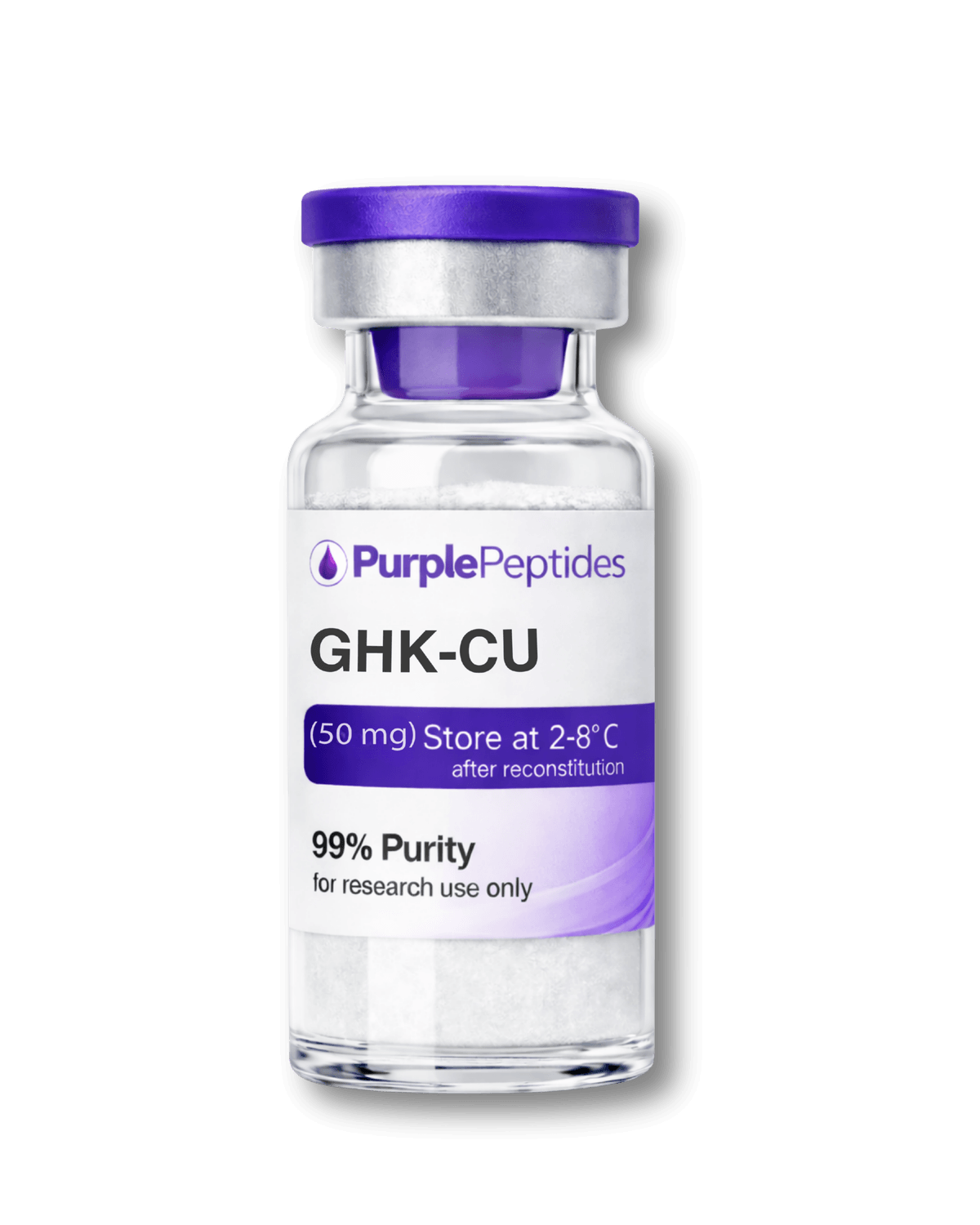
GHK-Cu Research Peptide
Explore Purple Peptides GHK-Cu for research applications involving copper peptide science, skin structure research, tissue repair pathways, oxidative stress models, and regenerative signaling discussions.
Buy NowFor research purposes only.