The Phoenix 60
What Is The PHOENIX Protocol™ 60-Day?
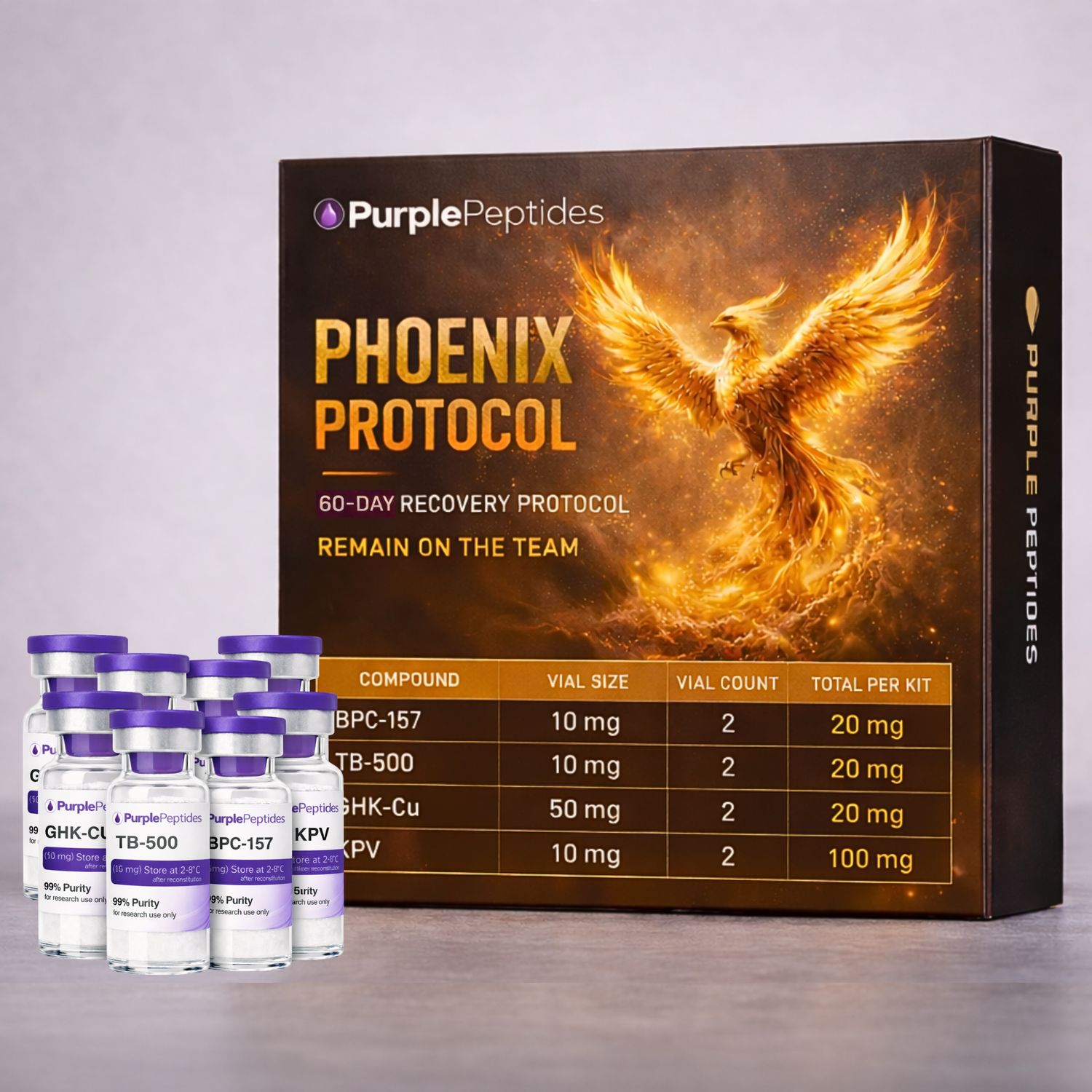
The PHOENIX Protocol™ 60-Day is an extended structured research framework designed to examine connective-tissue signaling, cellular remodeling, inflammatory-response pathways, mucosal-barrier signaling, extracellular matrix communication, and recovery-related biological processes during controlled tissue-stress research models.
This protocol combines BPC-157, TB-500, GHK-Cu, and KPV — four research compounds studied across complementary areas of tissue integrity, cellular migration, vascular signaling, collagen regulation, inflammatory-response modulation, mucosal-barrier signaling, and cellular stress-response biology.
Rather than focusing on one isolated repair pathway, The PHOENIX Protocol™ 60-Day uses a systems-based research approach. It is designed to help researchers observe how structural communication, cellular remodeling, collagen signaling, inflammatory balance, mucosal-barrier signaling, and extracellular matrix processes may interact across a longer 60-day research window.
The goal is not short-term symptom relief. The goal is structured observation across multiple biological systems connected to tissue remodeling, inflammatory-response balance, vascular signaling, extracellular matrix organization, and repair-related pathway research.
Certificate of Analysis
Third-party testing documentation available for purity and analytical verification.
The PHOENIX Protocol™ 60-Day Research Overview
The PHOENIX Protocol™ 60-Day was designed as an extended recovery-signaling research cycle for longer observation of tissue-stress and remodeling pathways.
It brings together four major research domains:
- Connective Tissue & Structural Signaling: BPC-157 is studied in preclinical models for its relationship with tissue-integrity signaling, tendon and ligament models, collagen organization, angiogenesis, nitric-oxide pathways, and inflammatory-response research.
- Cellular Migration & Remodeling: TB-500 is studied as a thymosin beta-4-related peptide fragment associated with actin regulation, cytoskeletal organization, cellular migration, angiogenic signaling, and tissue-remodeling models.
- Collagen & Extracellular Matrix Communication: GHK-Cu is studied for collagen and elastin regulation, fibroblast activity, copper-dependent signaling, glycosaminoglycan synthesis, skin/connective-tissue research, and extracellular matrix remodeling.
- Inflammatory Response & Mucosal Signaling: KPV is studied as a Lys-Pro-Val tripeptide derived from the C-terminal sequence of α-MSH and associated with NF-κB signaling, cytokine-response modulation, mucosal-barrier models, epithelial signaling, and immune-response research.
Together, these compounds create a broad research framework for examining how connective-tissue, cellular, vascular, inflammatory, mucosal-barrier, and extracellular matrix systems may communicate across an extended tissue-stress research period.
What Makes The PHOENIX Protocol™ 60-Day Different?
The PHOENIX Protocol™ 60-Day is built for coordinated recovery-signaling research, not single-pathway observation.
- It is designed as a full 60-day research cycle.
- It examines structural, cellular, inflammatory-response, mucosal-barrier, and extracellular matrix domains together.
- It supports extended observation of tissue-stress and remodeling pathway interaction.
- It combines peptide-based structural signaling with KPV inflammatory-response research.
- It is structured for consistency, documentation, and research clarity.
- It is positioned strictly for research and educational use only.
What You Receive in The PHOENIX Protocol™ 60-Day Kit
Each kit is assembled to align with a complete 60-day coordinated recovery-signaling research cycle across multiple biological domains.
Research Domains Addressed
Connective Tissue Signaling
BPC-157 is studied for its relationship with connective-tissue models, tendon and ligament research, collagen regulation, endothelial response, angiogenic signaling, nitric-oxide pathway interaction, and tissue-integrity signaling.
Within The PHOENIX Protocol™ 60-Day, BPC-157 represents the structural communication and tissue-integrity research component.
Cellular Migration & Remodeling
TB-500 is studied as a thymosin beta-4-related peptide fragment connected to actin regulation, cellular migration, cytoskeletal organization, angiogenic signaling, and tissue-remodeling research models.
Within this protocol, TB-500 represents the cellular movement and remodeling research component.
Collagen & Structural Integrity
GHK-Cu is a copper-binding tripeptide complex studied for its relationship with collagen and elastin regulation, fibroblast activity, glycosaminoglycan synthesis, copper-dependent signaling, and extracellular matrix organization.
Within this protocol, GHK-Cu represents the collagen, matrix, and connective-tissue communication component.
Inflammatory Response & Mucosal Signaling
KPV, or Lys-Pro-Val, is a tripeptide derived from the C-terminal sequence of α-melanocyte-stimulating hormone (α-MSH). It is studied in inflammation-related models for NF-κB signaling, cytokine-response modulation, epithelial-barrier research, mucosal signaling, and immune-response pathway observation.
Within this protocol, KPV represents the inflammatory-response and mucosal-barrier research component.
Why a 60-Day Protocol?
Recovery-related signaling and tissue adaptation are not single-step processes. They involve multiple biological layers, including connective-tissue communication, cellular migration, collagen remodeling, angiogenic signaling, inflammatory-response pathways, mucosal-barrier signaling, and epithelial-response models.
The 60-day structure gives researchers a longer observation window than short-cycle protocols. This extended format may support deeper documentation of pathway consistency, remodeling patterns, cellular response trends, and systems-level coordination across structural, cellular, inflammatory-response, mucosal-barrier, and extracellular matrix domains.
The PHOENIX Protocol™ 60-Day was designed for consistency, structured observation, and multi-pathway research without unnecessary protocol complexity.
Research-Based Ingredient Overview
BPC-157
BPC-157 is a synthetic pentadecapeptide studied in preclinical models for tissue-integrity signaling, cytoprotective pathways, collagen organization, angiogenic activity, nitric-oxide pathway interaction, inflammatory-response modulation, and systemic resilience research.
TB-500
TB-500 is a synthetic thymosin beta-4-related fragment commonly described as Ac-LKKTETQ. It is studied for its relationship with actin regulation, cellular migration, cytoskeletal remodeling, angiogenesis, and wound-response models.
GHK-Cu
GHK-Cu is a copper-binding tripeptide complex studied for collagen regulation, fibroblast activity, extracellular matrix remodeling, glycosaminoglycan synthesis, angiogenic signaling, antioxidant-response pathways, and skin/connective-tissue research models.
KPV
KPV is a tripeptide composed of lysine, proline, and valine. It is studied for inflammatory-response signaling, NF-κB pathway interaction, epithelial and mucosal-barrier models, antimicrobial-response research, and immune-balance pathway observation.
Why These Compounds Are Studied Together
The PHOENIX Protocol™ 60-Day combines four different research angles into one extended framework:
- BPC-157: Connective tissue signaling and structural communication
- TB-500: Cellular migration and remodeling pathways
- GHK-Cu: Collagen signaling and extracellular matrix organization
- KPV: Inflammatory-response signaling, mucosal-barrier research, and NF-κB pathway interaction
Together, these compounds create a coordinated recovery-focused research model for studying tissue signaling, cellular remodeling, collagen communication, inflammatory-response balance, mucosal-barrier signaling, and structural adaptation over a longer research window.
How The PHOENIX Protocol™ 60-Day Works
The PHOENIX Protocol™ 60-Day is built for coordinated recovery-signaling research across four layers.
- Structural Communication: BPC-157 is included for its research connection to connective-tissue models, tissue-integrity signaling, angiogenic pathways, collagen regulation, and systemic resilience research.
- Cellular Remodeling: TB-500 is included for its research connection to actin regulation, cytoskeletal organization, cellular migration, vascular response, and tissue-remodeling pathways.
- Collagen & Matrix Signaling: GHK-Cu is included for its research connection to copper-dependent signaling, collagen and elastin regulation, fibroblast activity, glycosaminoglycan synthesis, and extracellular matrix organization.
- Inflammatory Response & Mucosal Signaling: KPV is included for its research connection to NF-κB signaling, cytokine-response modulation, epithelial-barrier models, mucosal signaling, and immune-response pathway research.
Extended Observation Framework
The 60-day format allows researchers to observe the protocol across a longer cycle rather than a short snapshot.
This structure supports cleaner documentation across multiple research domains while keeping the protocol organized and repeatable.
Research Applications
The PHOENIX Protocol™ 60-Day may be useful in controlled research models focused on:
- Connective-tissue signaling research
- Tendon, ligament, fascia, and muscle-related models
- Cellular migration and remodeling pathway studies
- Angiogenesis and vascular-response research
- Collagen and extracellular matrix communication
- Inflammatory-response pathway observation
- Inflammatory-response and cytokine-signaling research
- Mucosal-barrier and epithelial signaling models
- Extended recovery-signaling observation
- Systems-based tissue remodeling research
What Researchers May Document
In controlled research environments, researchers may document broad patterns related to:
- Connective-tissue signaling notes
- Cellular remodeling observations
- Collagen and matrix-related markers
- Vascular-response pathway observations
- Inflammatory-response research notes
- Inflammatory-response pathway notes
- Mucosal-barrier and epithelial-signaling notes
- Recovery-related research markers
- Protocol consistency
- Tissue-integrity research observations
The goal of The PHOENIX Protocol™ 60-Day is not to promise outcomes. The goal is to provide a structured framework for observing multiple recovery-related signaling domains over an extended timeframe.
What The PHOENIX Protocol™ 60-Day Is — and Is Not
- Research-based
- Structured
- Designed as a 60-day recovery-signaling research cycle
- A coordinated systems-based research framework
- Focused on structural, cellular, inflammatory-response, mucosal-barrier, and extracellular matrix pathways
- Built for active tissue-stress research models
- Designed for longer observation than the 30-day version
- A quick-fix guarantee
- A pain treatment
- A medical therapy
- A treatment protocol
- A diagnostic tool
- A human-use protocol
- A guaranteed outcome
- A long-term maintenance program
The Purple Standard™
Every vial included in The PHOENIX Protocol™ 60-Day is handled according to the Purple Standard™. This includes third-party testing, purity verification, controlled storage conditions, batch tracking, and internal rejection of any lot that does not meet required quality thresholds.
The Purple Standard™ exists to support consistency, documentation, and research confidence across every Purple Protocol™.
Frequently Asked Questions
Is The PHOENIX Protocol™ 60-Day approved for human use?
No. The PHOENIX Protocol™ 60-Day is supplied strictly for laboratory research and educational purposes only. It is not approved for human consumption.
Is this a medical treatment protocol?
No. The PHOENIX Protocol™ 60-Day is a research framework designed to examine connective tissue, cellular, inflammatory-response, mucosal-barrier, and structural signaling pathways during active tissue-stress research models. It is not a medical therapy.
Why is this structured as a 60-day protocol?
The 60-day structure provides a longer research window for examining coordinated signaling across connective-tissue signaling, cellular remodeling, inflammatory-response pathways, mucosal-barrier signaling, and extracellular matrix communication.
How is this different from the 30-day PHOENIX Protocol™?
The 30-day version is designed as an introductory recovery-signaling research cycle. The 60-day version extends the observation window, allowing researchers to document longer-term signaling consistency, remodeling patterns, and systems-level pathway interaction.
Why are these four compounds included together?
Each compound represents a different research domain. BPC-157 relates to connective-tissue and repair signaling, TB-500 relates to cellular migration and actin remodeling, GHK-Cu relates to collagen and matrix communication, and KPV relates to inflammatory-response and mucosal-barrier research.
Investigational Research Context
The PHOENIX Protocol™ 60-Day should be considered an investigational research protocol. Available scientific literature primarily examines the included compounds individually or in related research contexts. Findings should not be interpreted as approved therapeutic, clinical, cosmetic, veterinary, or human-use outcomes for this protocol.
This product is supplied for laboratory research only and is not intended for human consumption, clinical use, veterinary use, diagnostic use, or self-experimentation.
Scientific References
View References
BPC-157 Research
- Chang C-H. et al. (2011) — The promoting effect of pentadecapeptide BPC 157 on tendon healing involves tendon outgrowth, cell survival, and cell migration.
- Huang T. et al. (2015) — Body protective compound-157 enhances wound-healing-related models and promotes proliferation, migration, and angiogenesis in vitro.
- Seiwerth S. et al. (2021) — Stable gastric pentadecapeptide BPC 157 and wound healing.
- McGuire F.P. et al. (2025) — Regeneration or Risk? A narrative review of BPC-157 for musculoskeletal and neuromuscular healing.
TB-500 / Thymosin Beta-4 Research
- Esposito S. et al. (2012) — Synthesis and characterization of the N-terminal acetylated 17–23 fragment of thymosin beta-4 identified in TB-500.
- Malinda K.M. et al. (1999) — Thymosin beta-4 accelerates wound healing.
- Philp D. et al. (2003) — The actin-binding site on thymosin beta-4 promotes angiogenesis.
- Philp D. et al. (2003) — Thymosin beta-4 and a synthetic peptide containing its actin-binding domain promote dermal wound repair.
- Goldstein A.L. & Hannappel E. (2012) — Thymosin beta-4: a multi-functional regenerative peptide.
GHK-Cu Research
- Wegrowski Y. et al. (1992) — Stimulation of sulfated glycosaminoglycan synthesis by the tripeptide-copper complex GHK-Cu.
- Maquart F.X. et al. (1993) — In vivo stimulation of connective tissue accumulation by the tripeptide-copper complex GHK-Cu.
- McCormack M.C. et al. (2001) — The effect of copper tripeptide and tretinoin on growth factor production in fibroblast cultures.
- Pickart L. et al. (2015) — GHK peptide as a natural modulator of multiple cellular pathways in skin regeneration.
- Pickart L. & Margolina A. (2018) — Regenerative and protective actions of the GHK-Cu peptide in the light of new gene data.
KPV Research
- Dalmasso G. et al. (2008) — PepT1-mediated tripeptide KPV uptake reduces intestinal inflammation.
- Land S.C. et al. (2012) — Mechanism of KPV action and a role for MC3R agonists in airway epithelial inflammation models.
- Brzoska T. et al. (2008) — Alpha-melanocyte-stimulating hormone and related tripeptides: anti-inflammatory and protective effects.
- Getting S.J. et al. (2003) — Dissection of the anti-inflammatory effect of the core and C-terminal tripeptide sequence of alpha-MSH.
- Kannengiesser K. et al. (2008) — Melanocortin-derived tripeptide KPV in murine colitis models.
Need Help?