The Wolverine 30
What Is The WOLVERINE Protocol™ 30-Day?
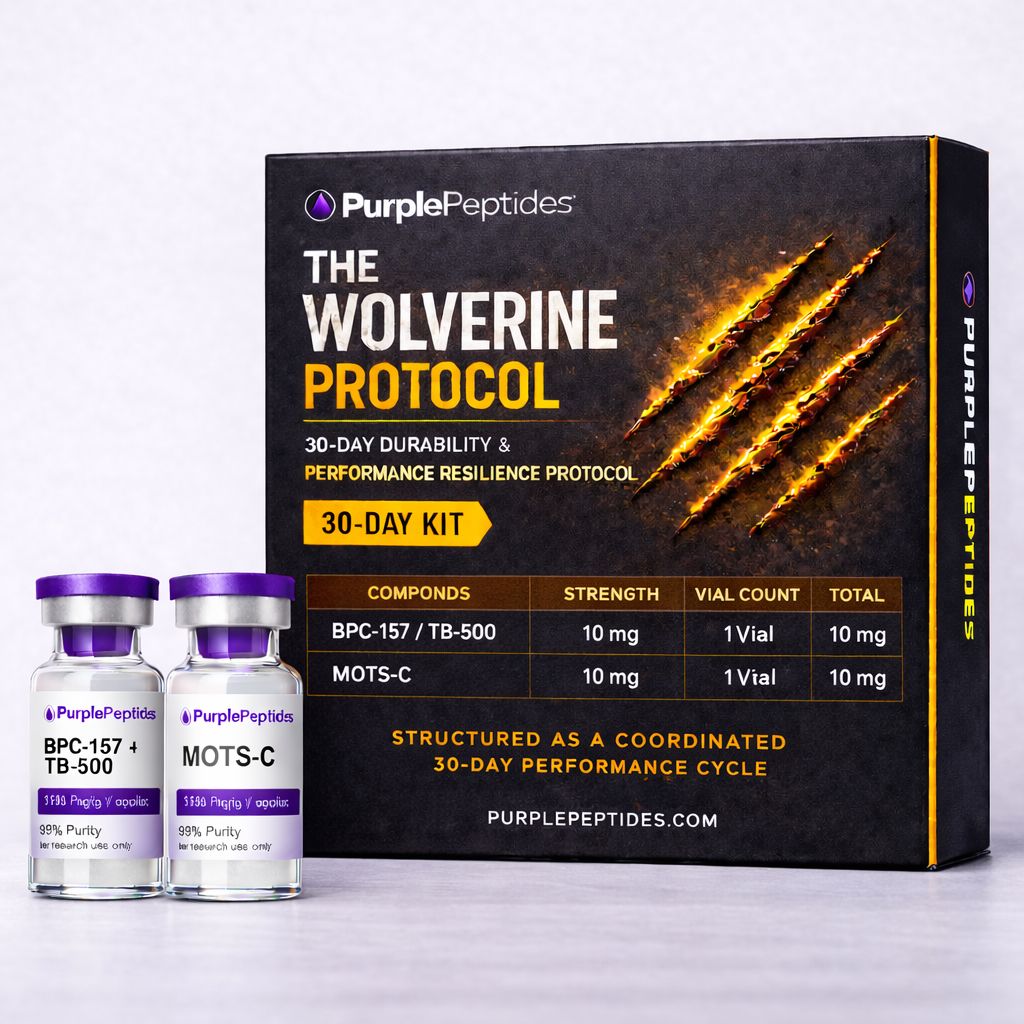
The WOLVERINE Protocol™ 30-Day is a structured research framework designed to examine connective-tissue signaling, cellular remodeling, mitochondrial communication, structural durability, and metabolic adaptation during sustained high-output research models.
This protocol combines BPC-157 + TB-500 with MOTS-c — research compounds studied across complementary domains of tissue integrity, cellular migration, actin remodeling, angiogenic signaling, mitochondrial-derived communication, AMPK-related pathways, and energy-adaptation research.
Rather than focusing on isolated recovery mechanisms, The WOLVERINE Protocol™ uses a systems-based research approach. It was developed to help researchers observe how connective tissue response, cellular remodeling, mitochondrial signaling, and metabolic adaptation may interact across a focused 30-day performance-resilience research window.
The goal is not short-term recovery positioning. The goal is structured observation of durability, resilience, and adaptation across structural and mitochondrial systems.
Certificate of Analysis
Third-party testing documentation available for purity and analytical verification.
The WOLVERINE Protocol™ 30-Day Overview
The WOLVERINE Protocol™ 30-Day was designed as a coordinated performance-resilience research cycle for observing structural and metabolic adaptation pathways.
The WOLVERINE Protocol™ is built around a simple principle: durability research should examine both structure and energy systems. Connective tissues, cellular remodeling pathways, and mitochondrial signaling do not operate separately during sustained physical-demand models. They communicate as part of a broader adaptation network.
What Makes The WOLVERINE Protocol™ Different?
The WOLVERINE Protocol™ is built for durability-focused research, not injury-positioned recovery language.
- It is designed as a focused 30-day research cycle.
- It examines structural resilience and mitochondrial adaptation together.
- It combines connective-tissue and cellular energy research domains.
- It supports observation during sustained high-output research models.
- It is structured for clarity, consistency, and documentation.
- It is positioned strictly for laboratory research and educational use only.
What You Receive in The WOLVERINE Protocol™ 30-Day Kit
Each kit is assembled to align with a complete 30-day coordinated performance-resilience research cycle across structural, cellular, and mitochondrial signaling domains.
Research Domains Addressed
Connective Tissue Resilience
BPC-157 is studied in preclinical models for its relationship with connective-tissue signaling, tendon and ligament research models, collagen organization, fibroblast activity, angiogenic pathways, nitric-oxide signaling, and tissue-integrity response.
Within The WOLVERINE Protocol™, BPC-157 represents the connective-tissue and structural communication component.
Cellular Remodeling Pathways
TB-500 is studied as a thymosin beta-4-related peptide fragment associated with actin regulation, cellular migration, cytoskeletal remodeling, angiogenesis, and tissue-remodeling models.
Within The WOLVERINE Protocol™, TB-500 represents the cellular movement and remodeling component.
Mitochondrial Signaling & Energy Adaptation
MOTS-c is a mitochondrial-derived peptide studied for its relationship with metabolic signaling, AMPK-related pathways, glucose metabolism, skeletal-muscle research models, mitochondrial-to-nuclear communication, and adaptive stress-response pathways.
Within The WOLVERINE Protocol™, MOTS-c represents the mitochondrial communication and energy-adaptation component.
Why a 30-Day Protocol?
Durability and adaptation are not single-event processes. They are studied across repeated exposure, structured observation, and multi-week biological signaling patterns.
The 30-day structure gives researchers a clean starting framework to examine:
- Structural signaling response
- Connective-tissue communication
- Cellular remodeling patterns
- Mitochondrial communication
- Energy-adaptation pathways
- Training-demand research observations
- Recovery-related signaling markers
- Protocol consistency over time
The WOLVERINE Protocol™ 30-Day was designed for focused observation, not random intensity.
Research-Based Ingredient Overview
BPC-157
BPC-157 is a synthetic pentadecapeptide studied in preclinical models for tissue-integrity signaling, collagen organization, cytoprotective pathways, angiogenic activity, nitric-oxide pathway interaction, inflammatory-response research, and connective-tissue models.
TB-500
TB-500 is a synthetic thymosin beta-4-related fragment commonly described as Ac-LKKTETQ. It is studied for its relationship with actin regulation, cellular migration, cytoskeletal remodeling, angiogenic signaling, vascular response, and tissue-remodeling pathways.
MOTS-c
MOTS-c is a 16–amino acid mitochondrial-derived peptide encoded within mitochondrial DNA. It is studied for metabolic communication, AMPK-related signaling, glucose utilization, skeletal-muscle metabolic adaptation, mitochondrial-to-nuclear communication, and cellular stress-response research.
Why These Compounds Are Studied Together
The WOLVERINE Protocol™ combines two major research layers into one 30-day framework:
- BPC-157 + TB-500: Connective-tissue signaling, cellular migration, actin remodeling, angiogenesis, and structural durability research.
- MOTS-c: Mitochondrial communication, cellular energy sensing, AMPK-related pathways, metabolic flexibility, and adaptive stress-response research.
Together, these compounds create a coordinated research model for studying how structural signaling and mitochondrial energy communication may interact during sustained high-output research phases.
How The WOLVERINE Protocol™ Works
The WOLVERINE Protocol™ is built for coordinated durability and performance-resilience research.
- Structural Communication Under Stress: BPC-157 is included for its research connection to connective-tissue models, collagen organization, tendon and ligament signaling, angiogenic pathways, and tissue-integrity response.
- Cellular Remodeling: TB-500 is included for its research connection to actin regulation, cytoskeletal organization, cellular migration, vascular signaling, and remodeling pathways.
- Mitochondrial Adaptation: MOTS-c is included for its research connection to mitochondrial-derived signaling, energy sensing, AMPK-related activity, glucose metabolism, skeletal-muscle research, and cellular adaptation under stress.
Research Applications
The WOLVERINE Protocol™ 30-Day may be useful in controlled research models focused on:
- Connective-tissue signaling research
- Tendon, ligament, fascia, and muscle-related models
- Cellular migration and remodeling pathway studies
- Actin regulation and cytoskeletal organization
- Angiogenesis and vascular-response research
- Mitochondrial communication models
- AMPK-related energy signaling
- Skeletal-muscle metabolic adaptation
- Sustained high-output research models
- Durability and performance-resilience pathway observation
What Researchers May Document
In controlled research environments, researchers may document broad patterns related to:
- Structural signaling notes
- Connective-tissue response observations
- Cellular remodeling markers
- Vascular-response pathway notes
- Mitochondrial and energy-related patterns
- Training-demand research observations
- Recovery-related signaling markers
- Protocol consistency
- Durability-related research trends
- Early adaptation patterns
The goal of The WOLVERINE Protocol™ 30-Day is not to promise performance outcomes. The goal is to provide a structured framework for observing durability-related signaling across connective-tissue, cellular, and mitochondrial domains.
What The WOLVERINE Protocol™ 30-Day Is — and Is Not
- Research-based
- Structured
- Designed as a 30-day durability-signaling research cycle
- Focused on connective-tissue, cellular remodeling, and mitochondrial domains
- Built for sustained high-output research models
- A coordinated systems-based research framework
- Designed for focused observation and documentation
- An injury treatment
- A pain treatment
- A medical therapy
- A treatment protocol
- A diagnostic tool
- A human-use protocol
- A guaranteed outcome program
- A short-term quick fix
The Purple Standard™
Every vial included in The WOLVERINE Protocol™ 30-Day is handled according to the Purple Standard™. This includes third-party testing, purity verification, controlled storage conditions, batch tracking, and internal rejection of any lot that does not meet required quality thresholds.
The Purple Standard™ exists to support consistency, documentation, and research confidence across every Purple Protocol™.
Frequently Asked Questions
Is The WOLVERINE Protocol™ 30-Day approved for human use?
No. The WOLVERINE Protocol™ 30-Day is supplied strictly for laboratory research and educational purposes only. It is not approved for human consumption.
Is this an injury recovery or medical treatment protocol?
No. The WOLVERINE Protocol™ is a research framework designed to examine connective tissue signaling, cellular remodeling, mitochondrial communication, and metabolic adaptation pathways. It is not a medical therapy, injury treatment, or human-use protocol.
Why is this structured as a 30-day protocol?
The 30-day structure gives researchers a focused observation window for studying structural signaling, cellular remodeling, mitochondrial communication, and energy-adaptation patterns during sustained high-output research models.
How is this different from the 60-day WOLVERINE Protocol™?
The 30-day version is designed as a focused introductory durability-signaling research cycle. The 60-day version provides a longer observation window for tracking consistency, progression, and extended adaptation patterns.
Why are these compounds included together?
BPC-157 + TB-500 represent structural and cellular remodeling research domains, while MOTS-c represents mitochondrial communication and energy-adaptation research. Together, they provide a focused model for studying durability and resilience across multiple biological layers.
How is WOLVERINE different from PHOENIX?
PHOENIX is positioned around active tissue-stress and recovery-signaling research with BPC-157, TB-500, GHK-Cu, and NAD⁺. WOLVERINE is positioned around durability and performance-resilience research with a more focused structure: BPC-157 + TB-500 for structural remodeling and MOTS-c for mitochondrial adaptation.
Investigational Research Context
The WOLVERINE Protocol™ 30-Day should be considered an investigational research protocol. Available scientific literature primarily examines the included compounds individually or in related research contexts. Findings should not be interpreted as approved therapeutic, clinical, cosmetic, veterinary, performance-enhancing, injury-recovery, or human-use outcomes for this protocol.
This product is supplied for laboratory research only and is not intended for human consumption, clinical use, veterinary use, diagnostic use, or self-experimentation.
Need Help?